 |
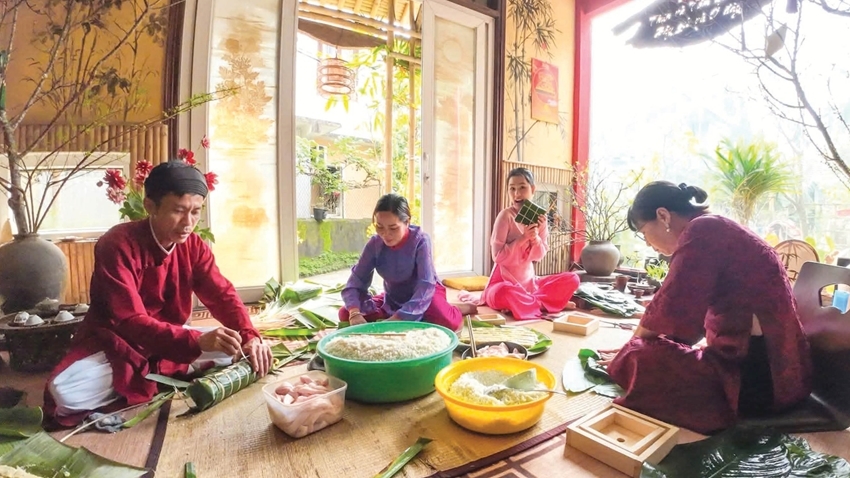
| Wrapping Chung cake for Tet. Photo: Anh Tuyet |
Different calendar systems - the Western solar calendar, the East Asian lunisolar calendar, the Hindu calendar of India, and the Islamic calendar - all share a common foundation in the human observation of the sun, the moon, and the transformations of nature and the cosmos. From these observations, people established holidays and festivals to mark significant milestones in the turning of heaven and earth.
In Sino-Vietnamese, the word “tet” (節) also means “tiet” (node), whose original meaning refers to the joints on a bamboo stalk, later used to denote time markers throughout the year. Ancient Chinese scholars observed Earth’s orbit around the sun, studied the sun’s influence on Earth’s climate - warmth, heat, coolness, cold - and defined 24 solar terms (known as tiet khi), such as Lap Xuan (Start of Spring), Vu Thuy (Rain Water), Xuan Phan (Spring Equinox), and Thanh Minh (Clear and Bright)…
In predominantly agricultural regions, these seasonal terms were applied to guide the timing of planting and harvesting in accordance with weather conditions and crop growth cycles, helping ensure good harvests and prosperous lives. China’s neighboring countries, including Vietnam, adopted this “agricultural calendar,” with some variations due to differing geographical locations. Culturally, the word “tet” came to refer to major celebrations throughout the year. Tet Nguyen Dan marks the start of the Lunar New Year. Tet Nguyen Tieu celebrates the first full moon of the year. Tet Doan Ngo (also called Tet Doan Duong) falls on the 5th day of the 5th lunar month near the summer solstice. The day the sun is highest in the sky. Daylight is longest. And, heat is greatest. Tet Trung Thu marks the full moon in mid-autumn, also the time when harvests are complete. People celebrate under the beautiful autumn moon. In this way, arising from cosmic and seasonal change, the ancients created their calendars and from them designated festival days to mark important milestones in nature’s cycle.
In earlier times, when human life depended entirely on agriculture, people’s activities revolved around crop cycles. Alongside the Chinese agricultural festivals mentioned above, many ethnic groups in Vietnam held their own agricultural celebrations such as Le xuong dong: the ceremony of starting the crop, held in early spring to open the new growing season, Le gieo hat: the seed-sowing ritual to awaken the rice spirit, Le cung comoi or Tet com moi held after harvest to give thanks to the spirits, and Le dam trau to celebrate an abundant harvest or a victory. These occasions brought communities together for ritual observances on one hand, and for festive games and entertainment on the other. Within the cycle of the year, there were periods dedicated to labor and periods reserved for rest, relaxation, and play. Festivals were also a time to pause from work, to visit one another, strengthen community bonds, and replenish energy for the work ahead.
Countries in the East Asian cultural sphere, including Vietnam, celebrate the Lunar New Year, with the notable exception of Japan, which abandoned the lunar calendar in 1873 and switched to the solar calendar as part of the Meiji Emperor’s (1867–1912) modernization reforms modeled on Western capitalism. Japan’s New Year holiday is a brief four days, from December 31 to January 3, after which people quickly return to work to drive economic growth. Yet all the traditional customs of the lunar new year are observed during this Gregorian celebration, so the old traditions remain fully intact. From that time forward, Japan has grown into an economic powerhouse while remarkably preserving its traditional cultural values.
Some decades ago in Vietnam, there was a lively debate about whether to merge the Lunar New Year into the Gregorian New Year, as Japan had done. The outcome was that Tet remained recognized as the most important holiday and continues to be celebrated today alongside the Gregorian New Year, which reflects Vietnam’s engagement with the international community. Tet aligns with the 24 solar terms of the lunar calendar, marking the beginning of spring with Lap Xuan (Start of Spring) in the first month. Tet is still understood as “the first morning,” which is precisely what the words literally mean.
It becomes clear, then, that Tet is ultimately a human conception of the significant milestones of time within the cosmic cycle — connected to weather, climate, and the agricultural traditions of a given land — and over time it has been shaped into culture. Once festivals become traditional customs, they take root in the human psyche and settle there as psychologically sacred moments. In a certain sense, they express the communion between humanity and the universe — a manifestation of the Oriental philosophical doctrine of Unity of Heaven and Humanity (Thien Nhan Hop Nhat).