 |
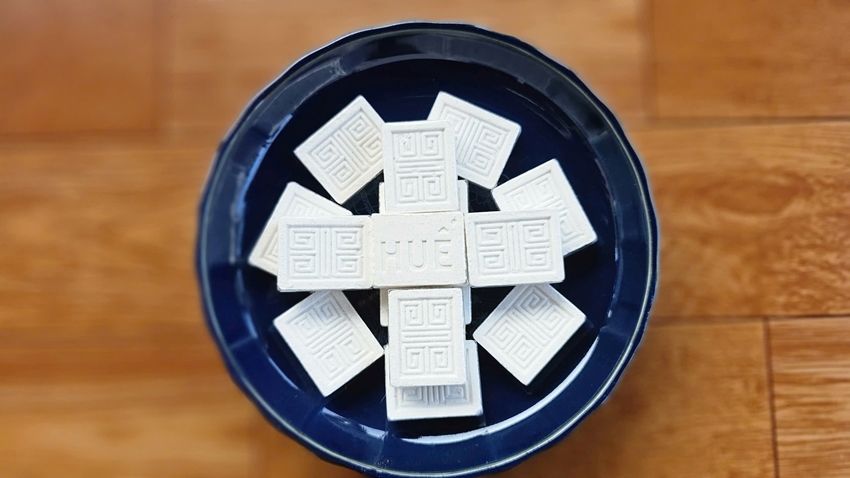
| Phuc linh cakes appear more often during festivals and Tet |
Simple in look, elaborate in making
Born and raised in a royal family, Mrs Ton Nu Minh Trang was trained in strict family etiquette and became skilled in traditional women’s household arts. Her daughter, Phan Nu Phuoc Hong, inherited a deep love for cuisine. Besides teaching foreign languages, she runs a small shop offering hands-on cake-making experiences in Bao Vinh Old Town (Hoa Chau Ward). The kitchen has become a meeting place between past and present, where mother and daughter freely share stories of preserving family traditions with visitors from Asia and the west.
Phuc linh cake is made from arrowroot. This elegantly-named ingredient once accompanied many kinds of candied treats in the imperial palace and on Hue people’s ancestral altars during Tet. The cake has no filling, only sugar and starch. Though simple, it captures the essence of heaven and earth, shaped by the skillful hands of the mothers and grandmothers of the ancient imperial capital.
After about eight months underground, the tubers are dug up, washed, pounded, filtered repeatedly to extract the starch, then dried. “Preparing arrowroot starch is the hardest step among all cake ingredients. It always reminds me of helping my grandmother make Tet sweets. Nowadays machines make everything much easier,” Ms Hong recalls.
The starch is dry-roasted with pandan leaves for fragrance, stirred until the leaves curl and dry. The flour is then placed under an upside-down bamboo basket to “absorb the night dew,” allowing it to take in the vitality of nature and become more cohesive when pressed into molds. Phuc linh cakes are molded into rectangles and usually wrapped in glossy white paper. Hue people use bronze molds engraved with characters such as Longevity, Fortune, and Happiness as New Year wishes for their ancestors.
Because the cakes are thin, molding them requires great care so that each one is identical. “In the past, the ladies had to be calm and unhurried. As the saying goes, ‘being fidgety ruins both sugar and flour.’ Perhaps our ancestors wanted to remind us to put our whole heart into the food,” Mrs Trang explains. “It’s the same with this cake. You need to press the flour firmly into every corner of the mold, hold two opposite corners with your thumbs and index fingers, and lift the cake out gently but decisively,” the woman with royal blood explained her secret.
Visitors quickly grasp the instructions, steady their minds, and begin. As promised from the instructions, each cake comes out with sharp edges and clear patterns, even the details of a century-old dragon mold remain intact. Everyone carefully transfers the cakes onto bamboo trays, check the coals, lightly shaking them as if handling precious objects.
Watching young guests absorbed in the craft, Ms Phan Nu Phuoc Hong’s eyes shine with joy. Carrying the “culinary legacy” passed down from her mother and grandmother, she flexibly organizes workshops according to demand. Beyond technique, she wants to share the spirit of the maker. “More deeply, I want to tell the story of Hue’s Tet culture, where women pour their hearts into making sweets to create a fragrant, abundant holiday for the family,” she says.
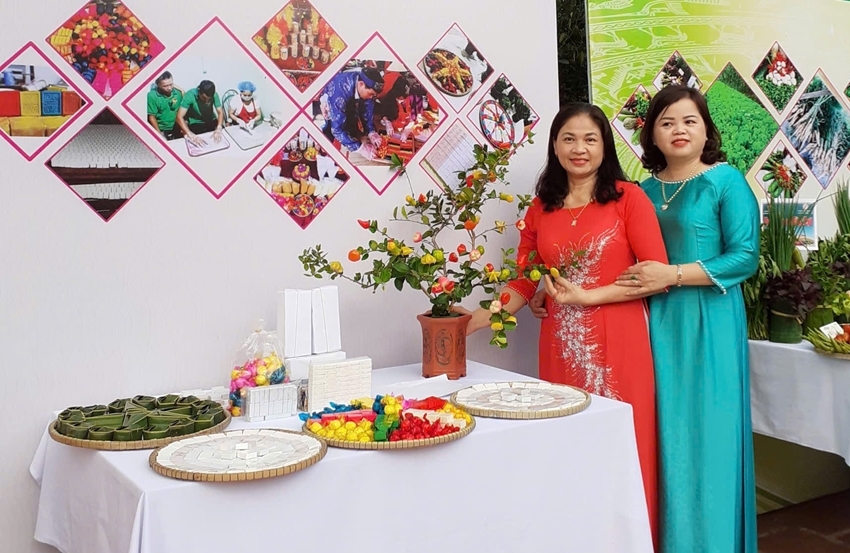 |
| Ms Tam (on the left) and the phuc linh cake at an exhibition |
“Taste it once, remember it forever”
According to folk knowledge, arrowroot helps cool the body, detoxify the liver, stabilize blood sugar, support weight loss, provide vitamin B9 for pregnant women, and supply gluten-free starch. Made entirely by hand from quality ingredients, phuc linh cakes cost 250,000–300,000 VND per kilogram, which is more expensive than printed cakes made from beans and glutinous rice. Still, the “healthy eating” trend and experiential tourism are opening new opportunities for this once-forgotten cake.
At a specialty showcase in the Imperial Citadel night street, many visitors were delighted to taste it. “The best part is waiting for the cake to melt in your mouth; you have to hold it there and savor it,” remarked a young visitor from Hanoi. Yet demands for reduced sweetness and improved packaging pose major challenges for producers.
In Kim Long, an area rich in old mansions, Ms Nguyen Thi Tam’s family once cooperated with a company to produce phuc linh cakes by order. With 20 years in the trade, the phuc linh cake is not strange to this kind woman. Mung bean cakes are made by machines nowadays, but she still molds each phuc linh cake by hand. Reducing the sugar makes molding much harder. After several batches, unstable sales left the dream of reviving the cake unfinished.
Fondling her shiny molds kept in a cloth bag, she confides: “We’ve found the right starch source and solved the low-sugar challenge. If we had a stable market, we could help revive this nearly lost cake. We’re still trying to connect and promote it, hoping for a new door to open.”
Over 90 years old, culinary artisan Mai Thi Tra, niece-in-law of Emperor Duy Tan, still remembers the cake served in the palace at Tet among countless delicacies. “Hue’s phuc linh is pure arrowroot starch, without tapioca or coconut milk like other regions. You don’t need to chew; it melts and spreads its aroma in your throat. One taste and you’ll never forget,” she says slowly, as if turning the pages of memory.
For her, eating a phuc linh cake means “holding it in the mouth and listening” - a Hue expression for deeply sensing and discerning fine food. A bite brings a gentle cool sweetness to the tip of the tongue; closing your eyes, you can almost hear the tiny crackle of starch crystals dissolving and awakening every taste bud.
Four years ago, the local specialty brand Moc Truly Hue launched a gift set featuring phuc linh in striking packaging. Many customers, especially Hue people living far from home, welcomed it for its authentic flavor. At its peak, more than 10,000 cakes were sold in a single month.
According to Pham Thi Dieu Hien, the founder, each family and artisan has their own secret recipe. But for this traditional cake to secure a place in the market, careful adjustments are needed to ensure consistent quality and reasonable prices. “Sustainable preservation requires long-term links between businesses and craft villages. I’m searching for a strong enough partnership so the product can go further,” she says.
After a period of absence, phuc linh cake has begun a new journey, from the home kitchen to experiential spaces and into the traditional product market of Hue. More than just food or a gift, it is an invitation to step into a rich culinary world that Hue people have long preserved and nurtured.