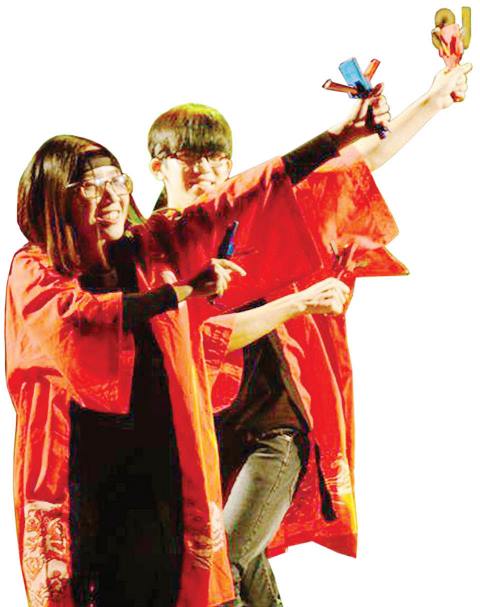
Yosakoi's signature is the smiles
Lifting people’s spirit
Yosakoi is a unique dance that originated in Japan. Although it is joyful and full of positive energy, few people know that this dance started from the pain of war.
Nguyen Thi Kieu Loan, President of Yosakoi Club said: “Yosakoi, which originated from Kochi city (Japan), is a variation of the Awa Odori dance. After the war, in order to cheer up, bringing faith and hope, the people of this city created Yosakoi.”
From Kochi, Yosakoi gradually spread to many places and now, like cherry blossoms, Mount Fuji, Yosakoi has become one of the symbols when it comes to Japan. With that influence, in the past 10 years, Yosakoi has increasingly attracted young Vietnamese people because of its strong and energetic style.
Kieu Loan said: "Not only being unique from the melody, choreography or costumes, props, Yosakoi's attractiveness also comes from the positive energy that each individual created when participating in the dance."
Vibrant and colorful, the costumes of a Yosakoi dance team are usually yukata and happi. “These costumes are used because they are not too fancy but still characterized by patterns. Most importantly, this costume is compact and colorful, beautiful, suitable for the positive energy that this dance wants to convey," said Tran Thi Thao Nguyen, a club member.
The music of Yosakoi dance is lively and powerful, composed by the free dance teams based on the original Yosakoi Naruko Odori song. Today, besides traditional melodies such as Yocchore, Jinma-mo, many dances have been modified to match the excitement and youthfulness of modern pop and rock rythm.
Along with the typical props called naruko, Yosakoi performers also use other props such as lanterns, paper fans, and umbrellas.
Thao Nguyen analyzed: “With these props, we will perform simulations according to the daily routine as well as when manufacturing and working. Like Yosakoi Yochore, with flexible hands and steady feet, we will vividly recreate the scene of solidarity when the fishermen throw and collect their net. The sound of the song is very close to the Southern folk song Ly keo chai, a fisherman’s song of Vietnam".
The "breath" of Yosakoi in Hue
In Vietnam, there are many Yosakoi clubs established; particularly in Hue, Yosakoi Club of the University of Foreign Languages, Hue University, has made a difference between countless dances imported into the Ancient Capital, such as Shuffle dance or Cover dance.
Kieu Loan shared: "Festivals in the Land of the Rising sun are often associated with customs and beliefs, but Yosakoi is the opposite. This dance is dedicated to people who are present with breath, intellect and emotions. Therefore, while other dances emphasize precision in movements or the uniqueness and characteristics of each dancer, for Yosakoi, the smile is the most beautiful choreography."
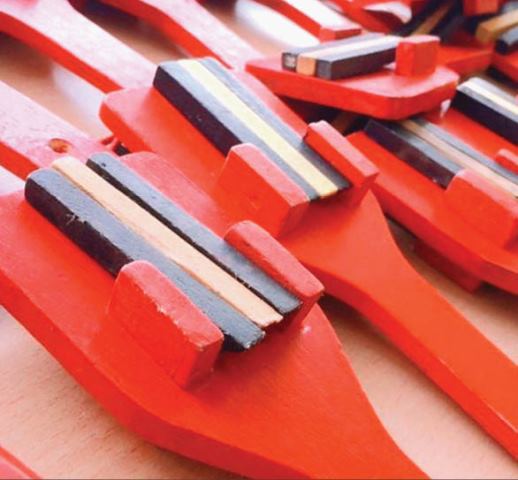
Naruko, the sounding device used to repel birds became the main prop
Once immersed in the melody, from the click of naruko to the youthful, radiant smile, each dancer is a piece of the puzzles to create the burning power of Yosakoi.
That power spreads to viewers, sending and giving them joy, excitement and optimism to overcome life's difficulties. Even the dancers themselves, when immersed in the dance, in the bustling music, then all sadness and worries disappear.
Few people know that, when she was a little girl, the President of Yosakoi Club Nguyen Thi Kieu Loan used to be introverted and timid even with her peers.
“But since practicing this dance, I felt more excited, especially after stressful classes. I open my heart and make new friends. Therefore, Yosakoi to me is not only a dance, it has become a bridge to happiness and an indispensable part of life," Kieu Loan confided.
Currently, Hue Yosakoi Club maintains a stable number of 40-50 members. This dance not only contributes to the promotion of Japanese culture, but also becomes an interesting mark when amateur Yosakoi dancers from Hue appear at most events related to the country and people of Japan that take place in our Ancient Capital.
Thao Nguyen shared: “More than that, we want to exchange and share this interesting dance with everyone. Because Yosakoi is a dance that lifts people’s spirits by its very nature, bringing faith and hope for a brighter future.”
Story: MAI HUE - Photos: Provided by the main character