 |
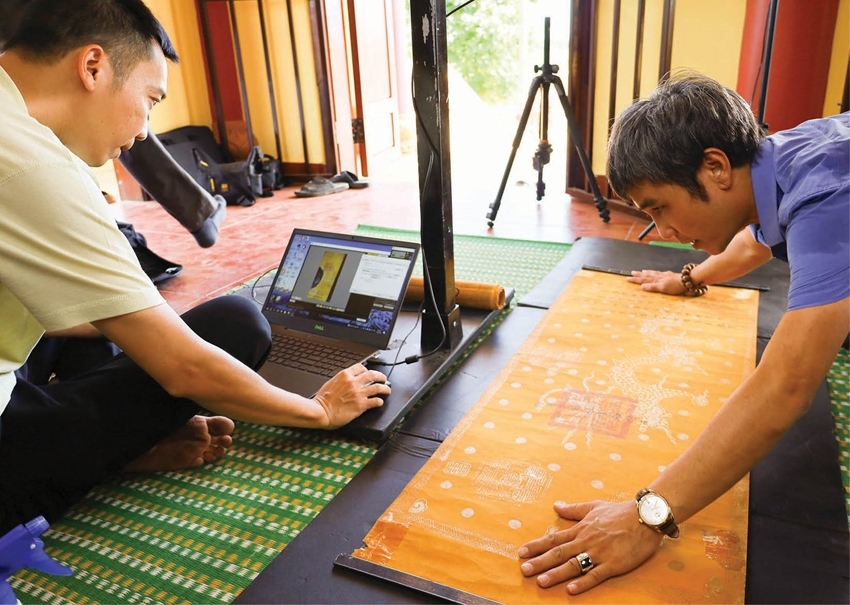
| Master Le Viet Tuan, Head of Professional Affairs and Technology Department at Hue City General Library (right) during a Han-Nom (Sino-Nom) document digitization session with his colleague |
The journey to access Han-Nom documents may seem simple, but it is fraught with countless challenges in many unpredictable forms. Only the dedicated staff at the Hue City General Library can truly understand the difficulties.
Between 2020 and 2024 alone, this team has digitized nearly 131,000 pages of Han-Nom documents. If counted from 2009 until now, the total exceeds 452,000 pages—a figure beyond imagination.
To digitize such a vast number of documents, the team had to travel extensively across villages and communes, visiting hundreds of private residences, family clans, and ancestral estates. According to statistics, the specialists have reached 222 villages, over 1,050 family clans, 22 ancestral estates, and 4 private residences. Among them are famous villages of the Ancient Capital such as Phu Bai, Nguyet Bieu, An Duong, Thuy Yen, and Phu Oc.
Most discovered documents consist of royal edicts, cadastral records, diplomas, petitions, genealogies, ceremonial texts, orders, and decrees. Experts assess that these documents hold great value not only in content but also in areas such as textual studies, history, culture, customs, and traditions.
Of course, accessing and unlocking the wooden chests containing these documents is sometimes straightforward, but in many cases, it is a challenging journey. We once accompanied the team of Han-Nom digitization experts from Hue City General Library and witnessed the invisible difficulties they had to face.
In some places, when rare Han-Nom documents were accessed, they were already severely deteriorated and damaged, making it difficult to determine their basic information. "The primary cause of this situation is the lack of proper preservation methods by the document owners. Improper storage has resulted in the need for extensive processing by experts before digitization. In some cases, certain documents are beyond restoration."
Master Le Viet Tuan, Head of the Professional Affairs and Technology Department at the General Library of Hue City, who has pursued this work for many years, shared that beyond the challenges of document preservation, the digitization process also faces obstacles due to the hierarchical structure and status differences among clans in some villages and communes. In certain villages, unlocking the document chests is not simply a matter of administrative procedures but must follow traditional "village customs."
Therefore, aside from their expertise, the team responsible for digitizing Han-Nom documents also acts as advocates, persuading document owners to understand the significance of preserving the Han-Nom heritage and agree to grant access for digitization.
Additionally, once the documents are in hand, translation requires experts, especially those with a deep understanding of the Han-Nom language as well as the history, culture, and geography of each locality.
Despite the difficulties, according to Mr. Tuan, the advancement of technology has aided the digitization process from classification, and data entry to cataloging in software systems, meeting the demands of data management, searching, and utilization.
Meanwhile, Ms. Hoang Thi Kim Oanh, Director of Hue City General Library, stated that notwithstanding a large volume of Han-Nom documents digitized, there remains a vast amount of undiscovered, uncollected, and undigitized materials. The library plans to continue to provide recommendations and pursue the mission of "reviving" these valuable documents. Alongside digitization, they will select and translate various digitized Han-Nom documents for publication, research, education, and promotion of this cultural heritage.
Throughout this long journey, according to Ms. Oanh, human resource development remains a priority. This is because the process requires experts not only in digitization but also in restoration, translation, and the application of technology in document preservation and processing.
"Beyond human resources, we are also striving to access and apply modern scientific and technological methods in management, storage, and utilization to gradually build a digital collection and enhance the value of the Han-Nom archive," Ms. Oanh said.