 |
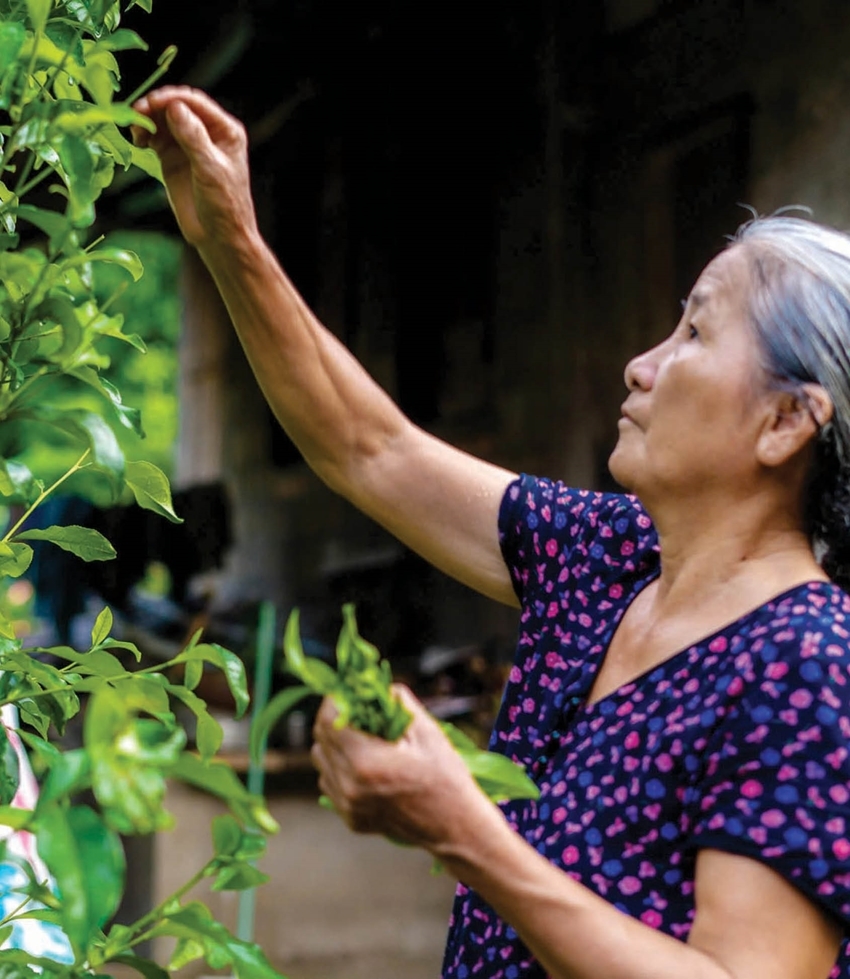
| Mrs. Hoang Thi Yen (in Ha Hamlet, Duong Hoa Commune, Huong Thuy Town) is picking Tuoc Thiet tea in her garden |
Famous Tuoc Thiet tea - national and family treasure
Under the Nguyen dynasty, sipping tea became an elegant pleasure, even ranked first in the list of beverages. The Nguyen kings often ordered porcelain tea sets from abroad. Emperor Minh Mang ordered faience tea sets decorated with his favorite patterns and Chinese characters. The Thieu Tri era ordered porcelain tea sets decorated with plant and flower patterns from Sèvres in Paris (France). Those sets are now still kept at Hue Museum of Royal Antiquities.
In 2007, Mr. Le Van Kinh, after decades of keeping the secret, suddenly decided to show the collection of antique tea sets, along with many other antiques left to him by his grandfather Pham Van Giao, Minister Counsellor of Ceremonies. Among them is the Manh Than tea set over 500 years old, one of the most precious kinds that writer Nguyen Tuan once mentioned in his book Vang bong mot thoi (Once Famous). Kinh said he was angry when he heard someone say Hue has no tea ceremony. “Hue owns national royal tea sets and other inherited family tea sets like ones in my family. Why saying Hue doesn’t have tea ceremony?".
Le Van Kinh is correct. Hue is the place where anyone, old or young, learns by heart the famous poem about tea “Binh minh so tan tra/… Luong y bat dao gia.” What is more, sipping tea in Hue is so well known that there’s the saying, “Lam trai biet danh to tom/ Uong tra kieu Hue, ngam nom Thuy Kieu” (“Only those who know how to play to tom, drink tea in Hue style and recite Thuy Kieu are gentlemen”. In Hue, there are rumors about famous tea sets called Mai Hac with the picture of a crane standing by an old ochna tree and two lines from Nguyen Du’s poetry in Nom demotic script, “Ngheu ngao vui thu yen ha/ Mai la ban cu, hac la nguoi quen.” (“Traveling humming in forests and on mountains/With ochna blossoms being old friends, cranes acquaintances.”)
Ancient Hue also possessed Tuoc Thiet tea (meaning sparrow’s tongue), famous since the 14th century. These tea leaves, even after being processed, are sparrow’s tongues in shape. “Tea grown in Kim Tra District (presently Huong Tra, Hue) is named “Tuoc Thiet". It is grown on the hills and mountains of An Cuu. This tea eliminates worries and ranked first in hundreds of medicinal plants for its efficiency,” wrote Duong Van An in his book O Chau Can Luc.
In the old days Kim Tra was wide, including the hilly area in the west of Hue. That’s why Tuoc Thiet tea was grown upstream of the Huong river. It’s said that Tuoc Thiet completely disappeared after the 19th century. But recently photographer Nguyen Phuc Bao Minh managed to take photos of old women picking Tuoc Thiet tea in Duong Hoa District as described in Duong Van An’s book.
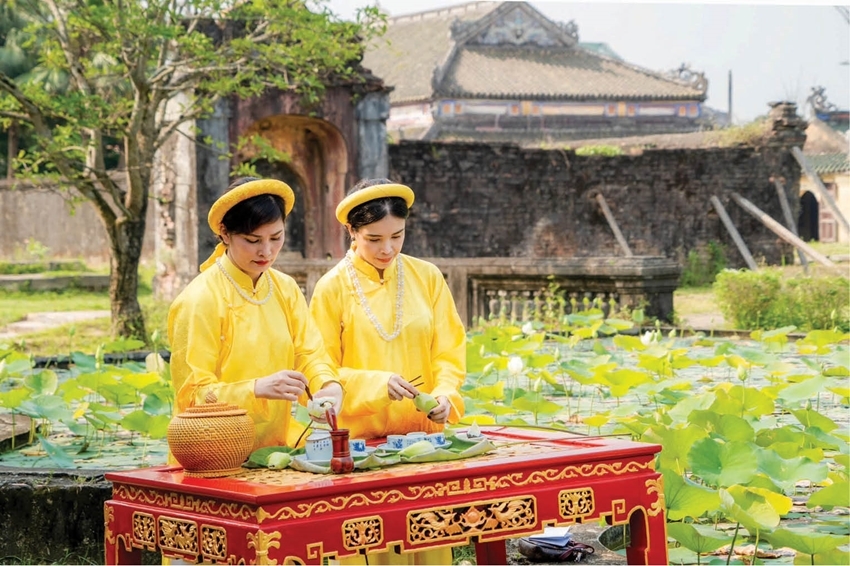 |
| The spring cup of tea |
Hue-styled tea drinking
In ancient China, Luc Vu wrote about how to drink tea, which some people across the globe soon followed. In Hue, people accept those basic principles too, but add something else to make it more “Hueish” (“When in Rome, do as the Romans do”). Ancient Hue people didn’t say drinking tea, but enjoying tea, which shows Hue is different from other places. How to enjoy tea in Hue is also flexible, not as rigid as in other tea ceremonies.
“Hue tea men” always save a space in their gardens, big or small, for their tea houses equipped with tea tables, single, twins, or triples. In other tea ceremonies, when there are more than four people at the tea table, it is called “quan am” (“drinking together”). But Hue is different in a very mischievous way. A group of three is called “tam da”; four is “tu quy”; then “ngu phuc”, “luc phu”, “that hien”, “bat tien”, “cuu long”, etc. It’s called “quan am” only when there are ten people or above.
According to Kinh, Hue-styled tea sipping has its own character. After guests are seated, the host himself soaks the tea cups. On the tea table is a tray of betel and areca, a box of cigarettes, a white bronze spitter, a copper sink, and a red towel. A cup of tea is finished in three sips. The first sip is to feel the heat and the aroma; the second sip is a big one, and the last is to finish the rest. In the first round, the host himself pours out the tea, then holds his cup with two hands up to his eyebrows and invite his guests. Form the second round, the host lets the guest on his right, usually his close friend, make the tea.
Stories around the tea table usually “bloom” after the second round. When pouring out tea, older people never empty the tea kettle, but leave a little bit in it, meaning reminding people that they should always save a little bit of something for their younger generations. So, to older people, sipping tea is not just a conventional habit.
Exquisite cup of tea in spring
Regarding the sophistication of tea making, Pham Van Sau, poet, a native of Hue, composes 4,889 verses depicting ways of enjoying tea. This is what he describes water for making tea, “Nuoc suoi tot nhat dau nguon/ Hung mua mai la, ngoi thuong giua con/ Gieng da ong, chang gian don/ Dao sau mach tot phai hon ca sao/ Nuoc mua lay o cay cau/ Bang gan tau la cot vao goc cay.” (The best water is water upstream/ Get rain water from the leafy roof; if it is a tiled roof, then wait until the middle of the rain/ Get water from the stone well which must be deep/ Tie a leaf at the base of an areca tree to collect water…”
In Hue, people still maintain the habit of collecting drops of dew accumulated on lotus leaves overnight to make tea while tea is wrapped in lotuses so that it absorbs the natural aroma. Besides, Hue people also have the pleasure of sipping “living tea” i.e. putting fresh fragrant flowers such as lotus, daisy, jasmine, mock lemon, chloranthus, etc., directly into the tea kettle then pour in boiling water.
Learning from people of the old days, a tea shop in Hue has now connected tea sipping with the Huong river. The water for making tea is taken upstream by the “tea girls”. The cup of tea then has the fragrance of pure water packed with flavors of flowers and plants in the mountain. On the full moon day every month, “tea girls” perform the ceremony of offering tea and spread flowers on the Huong river.
Interestingly, in the Ancient Capital City, tea is always served with something to eat, usually different kinds of banh in made of lotus seeds, mung beans, or glutinous rice powder wrapped in five-colored paper. On Tet holidays, Hue tea is specially sipped with mut gung (ginger jam). Hot tea and mut gung from Kim Long remind people that the spring is coming not only on the land but also in their hearts.