 |
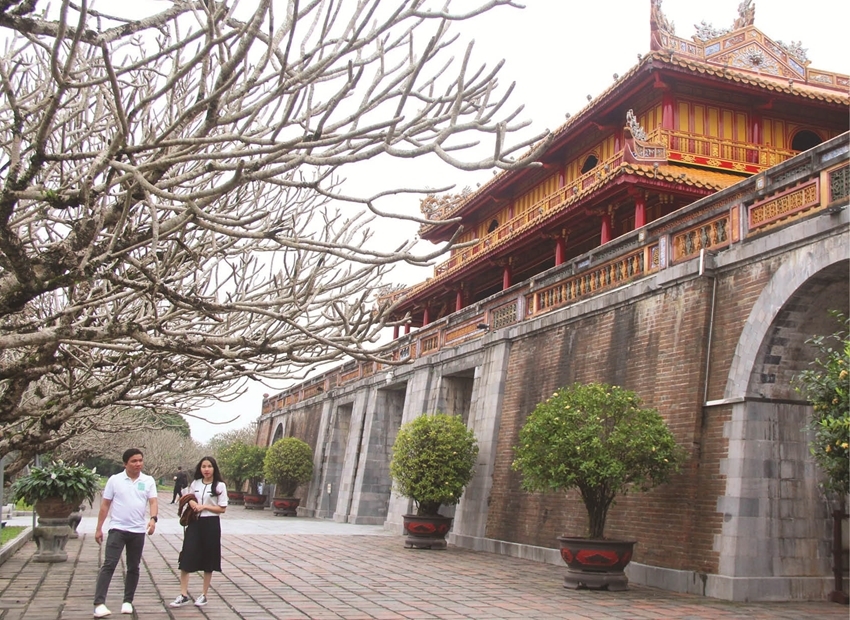
| Hue Imperial City |
Many buildings have been restored
The work of preserving Hue's cultural heritage over the past 50 years, especially since 1993, has attracted and mobilized the participation of many social strata and of all levels of government from the central to local and of a large number of international governmental and non-governmental organizations. And in fact, great achievements have been obtained; the most notable of which is bringing the heritage of Hue Ancient Capital from a state of “emergency rescue” to a period of “stability and sustainable development”.
After the war, facing many difficulties as well as different and inconsistent recognition, perspectives on how to treat the heritage of Hue Ancient Capital were still not appropriate. The arbitrary use of monuments led to many losses and deformations... Until 1981, after a visit to Hue, UNESCO General Director Amadou Mahtar M'Bow issued a call to “save Hue” to launch an international campaign to preserve and restore the values of Hue's Cultural Heritage.
Dr. Phan Thanh Hai, Director of the Department of Culture and Sports, said that from the moment that call was issued, the preservation, restoration, and embellishment of Hue monuments began to operate in the right direction. Up to this point, about 175 large and small relics have been restored and preserved. Typical works include Ngo Mon, Thai Hoa Palace, Hien Lam Cac, The Mieu Relic Complex, Dien Tho Residence, Duyet Thi Duong, and An Dinh Palace...
“This has brought positive economic and social effects, making an important contribution to beautifying the appearance of urban and residential areas, attracting tourists, and increasing tourism and service revenue...,” commented Dr. Hai.
Sharing the same opinion, Assoc. Prof. Dr. Nguyen Van Manh (University of Sciences, Hue University) said that the systematical restoration, embellishment, and preservation of heritage from policies, research, and implementation complied with scientific principles. Therefore, since the UNESCO’s recognition of Hue Monuments Complex as a World Cultural Heritage from 1993 up to present, the work of restoring and preserving the heritage system has been implemented effectively.
And there are challenges
However, according to some experts, along with the development of the market economy and the process of industrialization and modernization in recent years, Hue cultural heritage faces preservation and promotion challenges. In addition to the relics recognized by UNESCO, there are many other relics that are degraded and forgotten... This is due to a lack of appropriate planning, preservation methods, and funding sources.
Talking more about limitations, Dr. Tran Duc Anh Son from Dong A University (former Director of Hue Museum of Royal Fine Arts) commented that there is no comprehensive and harmonious policy for the research, preservation, and promotion of the cultural heritage values of the Nguyen Dynasty in Hue, and a lack of competent relic preservation experts, etc. Dr. Son explained that the process of researching cultural heritages before any restoration, conservation, or exploitation has not been thoroughly conducted, that eventually led to the absence of an optimal plan... Besides, difficulties in finance, human resources, and Hue’s weather and climate are other obstacles.
To minimize that situation, this expert believed synchronous policies should be issued and implemented to preserve the cultural heritage of all periods in Hue, rather than prioritizing the preservation of cultural heritage sites of the Nguyen Dynasty. It is necessary to develop a set of rules on the conservation and restoration of historical and cultural relics in accordance with national and international standards. Using a team of restorers who are knowledgeable about the history, culture, and art of the Nguyen Dynasty for the restoration and embellishment of Nguyen Dynasty relics in Hue is also essential...
Dr. Son believed that, in order to preserve and promote the value of the cultural heritage of the Nguyen Dynasty in Hue, it would be imperative to spread and promote the cultural heritage research and education of the Nguyen Dynasty to the community, especially to the younger generation, as an addition to the efforts of management agencies, specialized agencies, and governments at all levels in Hue. Promoting the cultural heritage of the Nguyen Dynasty systematically and extensively to tourists, helping them understand and appreciate heritages’ values, is also essential.