 |
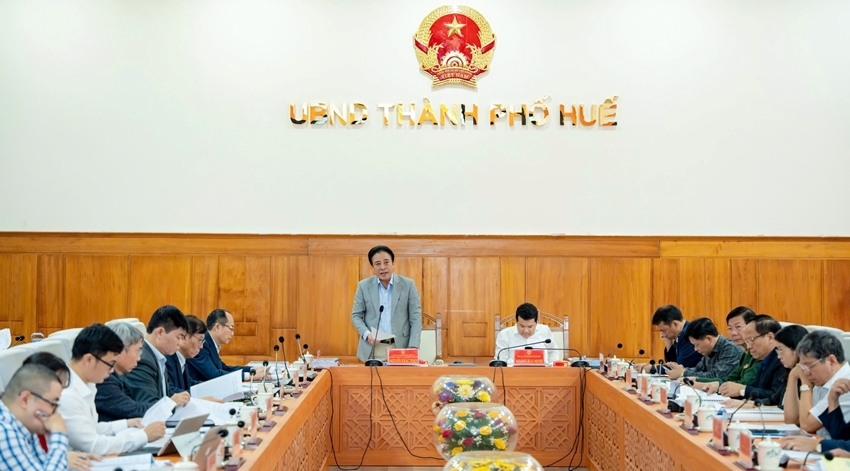
| Chairman of the City People’s Committee Nguyen Khac Toan speaking at the conference |
On the afternoon of February 10, the City People’s Committee held a conference to report on the completion and appraisal of the adjustment to Hue City’s Master Plan for the 2021–2030 period, with a vision to 2050.
The conference was chaired by Member of the Party Central Committee, Deputy Secretary of the City Party Committee and Chairman of the City People’s Committee Nguyen Khac Toan. Also in attendance were Vice Chairpersons of the City People’s Committee, along with representatives of departments, agencies and experts in the fields of construction and tourism.
An important political task
The Appraisal Council listened to a summary report from representatives of the Department of Finance, the agency assigned to prepare the adjustment of the city’s Master Plan, on the process of formulating the revised plan.
Chairman Nguyen Khac Toan emphasized that adjusting Hue City’s Master Plan for the 2021–2030 period, with a vision to 2050, is a crucial and urgent political task to reshape the city’s development space. The plan must reflect Hue’s new position as one of the six centrally-governed cities, together with Da Nang forming two adjacent national-level urban centers within the linkage of the North Central region and the Central economic dynamic region. It must also align with the implementation of major policies and strategies of the Party and the State, in connection with the nationwide administrative unit restructuring and the change in governance model as Hue officially operates under a two-tier local government system.
At the same time, the Master Plan must identify key urban growth clusters and sectoral structures based on a clear recognition of the city’s potentials, strengths and bottlenecks. It must also address flood control, drainage and disaster prevention in line with the orientation toward an ecological, smart urban area capable of effectively adapting to climate change.
The overarching principle of the Master Plan is to develop Hue on the foundation of culture, heritage and ecology; to place people at the center; and to take science, technology, innovation and digital transformation as driving forces. The city is oriented toward becoming a distinctive heritage city of Vietnam and a major center in Southeast Asia for culture, tourism and specialized healthcare, as well as a national hub for science, technology and high-quality education and training.
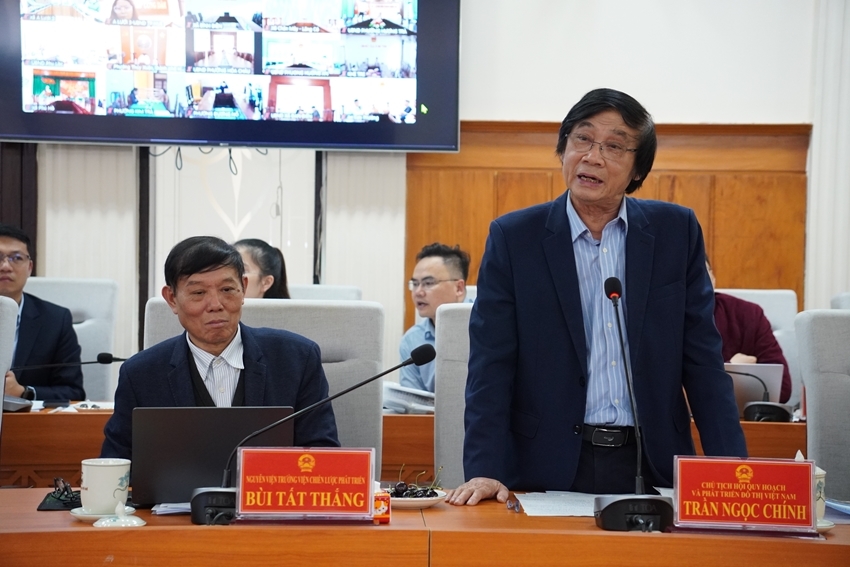 |
| Mr. Tran Ngoc Chinh, President of the Vietnam Urban Planning and Development Association, speaking at the conference |
In order to finalize the adjustment dossier with the highest quality, the Chairman of the City People’s Committee requested members and reviewers of the Appraisal Council to focus their feedback on breakthrough contents that can create strong momentum for Hue’s development, enabling it to stand on par with other centrally governed cities in the new context.
Specifying the adjustments
At the conference, experts and members of the Appraisal Council provided in-depth comments on the draft adjustment of the Master Plan, clarifying its legal basis, feasibility and long-term development orientation.
Mr. Nguyen Dac Nhan, Deputy Director General of the Department of Land Management (Ministry of Agriculture and Environment), expressed general agreement with the contents of the proposed adjustments. He noted that the planning agency has identified development orientations for six key sectors, including industry; trade; services; agriculture, forestry and fisheries; tourism; transport logistics; and the marine and lagoon economy. However, as this is an adjustment to an already approved plan, it is necessary to clearly specify which development orientations for these key sectors are being supplemented or revised. The list of priority projects for investment attraction must ensure feasibility and comprehensively review priority projects across sectors, particularly those directly impacting socio-economic development targets. The plan should also forecast land-use demand and specify the allocation of project areas down to each commune-level administrative unit.
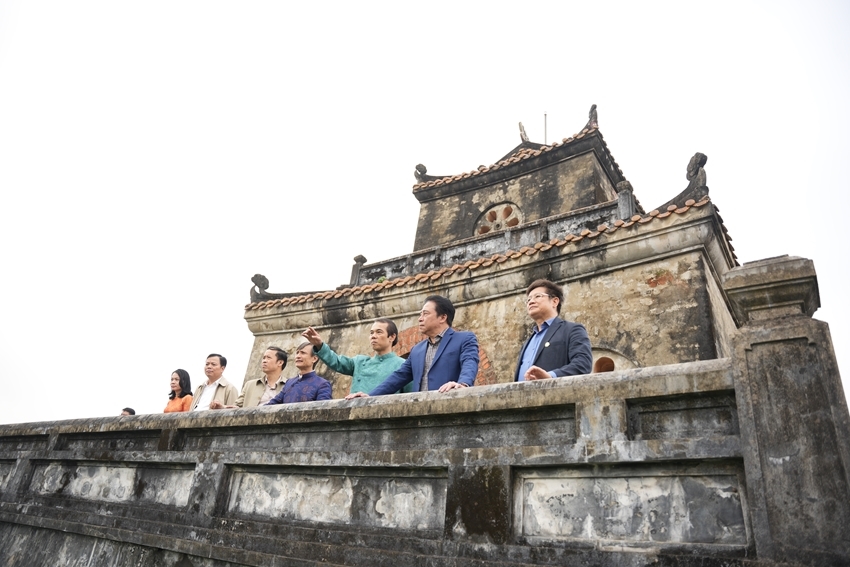 |
| Chairman Nguyen Khac Toan inspecting a number of architectural works |
From the perspective of growth and heritage preservation, Mr. Tran Ngoc Chinh stressed that conserving and promoting heritage values is of utmost importance to Hue. Therefore, the Master Plan must clarify Hue’s linkage and coordination with neighboring localities in developing tourism, services and heritage, and in promoting interregional cultural and natural heritage value chains. He also cautioned against “overheated” urban development and the risk of dispersed infrastructure investment that could undermine heritage values and urban identity. Hue must choose a focused and sustainable development path that preserves the city’s unique spirit and character. In addition, the exploitation of heritage potential for economic development should be more clearly defined in the planning orientation.
Other opinions centered on existing bottlenecks and limitations in economic development; recalculating growth scenarios; identifying priority sectors and development directions; organizing urban spatial distribution; and determining resources and implementation solutions for the Master Plan.
At the conference, the Department of Finance and the consulting unit received and addressed feedback from the Appraisal Council and proceeded to finalize the adjustment dossier in accordance with planning regulations. The Appraisal Council unanimously approved the adjustment of Hue City’s Master Plan for the 2021–2030 period, with a vision to 2050, and agreed to complete the subsequent procedures.