 |
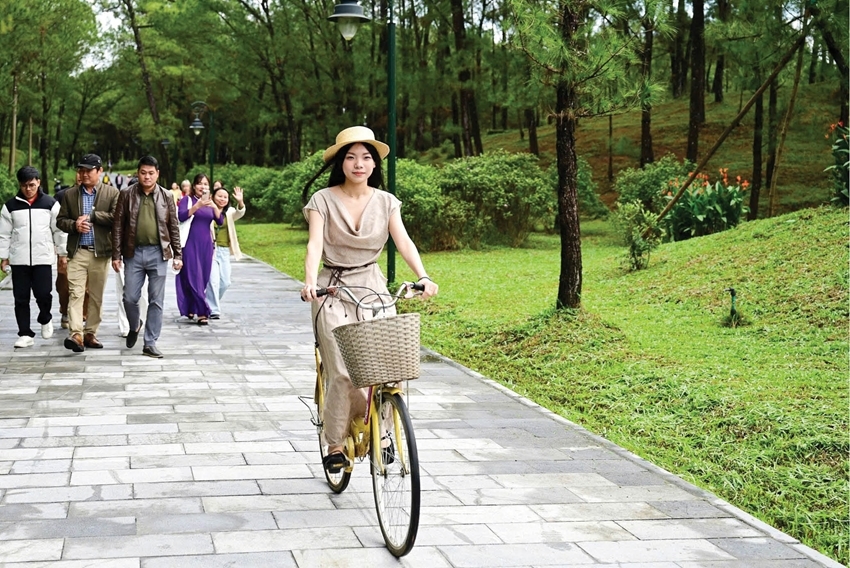
| Travel agencies experienced and surveyed Net Zero tourism destinations in Hue |
York’s regeneration strategy and Net Zero commitment
York, a heritage city with a 2,000-year history in Northern England, is leading the regenerative tourism trend. In June 2024, York announced a Tourism Strategy, aiming to contribute to achieving Net Zero carbon emissions by 2030.
York not only considers green tourism a slogan, but also builds an eight-year roadmap with five priority pillars. Among them, the “Green York” pillar sets a goal for businesses and visitors to jointly reduce carbon emissions. The city welcomes 8.9 million visitors annually, contributing £1.7 billion to the economy and creating 17,000 jobs - figures remarkably similar to those of Hue.
In practice, York has implemented a priority green transport system, green certifications for businesses, and investment in green tourism human resources.
York has restructured its transport system with a “car-lite” vision, where 80% of journeys are made via sustainable means of transport. The historic city center has been freed from cars, prioritizing pedestrians, bicycles, and electric vehicles. Electric bus systems, public charging stations, and dedicated cycling lanes have been heavily invested in, seamlessly connecting tourist attractions.
For Hue, this solution is entirely feasible. The Ancient Quarter and the Imperial Capital’s heritage perimeter can apply this model, turning the area into a “green zone” reserved for public transport, bicycles, and electric vehicles. Expanding pedestrian streets and connecting the Imperial Citadel to the Huong River and various heritage sites will not only reduce emissions, but also enhance visitors’ experience.
York encourages hotels, restaurants, and tourism businesses to achieve green certification through international standards. The city provides technical, financial, and training support to help businesses - especially small and medium-sized ones - make the transition.
Looking at Hue, the city can develop a “Hue Green Tourism Certification Program” with levels ranging from basic to advanced, focusing first on easily implemented solutions such as reducing plastic use, saving energy, and using local food. The city can create incentives by prioritizing promotion and providing preferential loans for certified businesses.
Regarding human resources, York considers this the key to success. The city invests in training programs, internships and commitments to diversity, and inclusion to make the tourism industry a top career choice for younger generations.
In this regard, Hue is fortunate to have tourism training institutions. What is needed is an updated curriculum that integrates knowledge of Net Zero, carbon management, and sustainable tourism. Simultaneously, opportunities should be created for students to practice at pioneering businesses, as well as building networks linking the training institutions, businesses, and regulatory agencies.
Kyoto - Living heritage and sustainable tourism
Kyoto, the Ancient Capital of Japan, with 17 World Cultural Heritage sites, faces challenges similar to Hue: balancing heritage conservation with sustainable tourism development. The way Kyoto addresses these issues provides many valuable lessons.
Kyoto has developed the “Kyoto Tourism Morals” - a code of conduct for three parties: visitors, businesses, and residents. Visitors are encouraged to respect community life, protect natural landscapes, and engage in environmentally friendly tourism.
Hue can learn from this approach by creating a “Hue Green Tourism Code”, expressed in accessible, easy-to-understand language, and widely disseminated at airports, bus stations, hotels, and tourist attractions. Also, creating a unique identity logo for the program will help visitors easily remember and practice it.
Kyoto has faced over-tourism at famous sites such as Kinkaku-ji and Ginkaku-ji temples. The solution has been to promote lesser-known heritage sites, encouraging visitors to stay longer and explore deeper. The “slow tourism” program in the “Kyoto by the Sea” region encourages visitors to experience local culture, learn traditional crafts, and engage in community life.
Meanwhile, Hue has many relic sites, craft villages, and cultural spaces that are not yet fully tapped on. Instead of overcrowding the Imperial Citadel or Thien Mu Pagoda, the city could develop immersive experience tours such as learning to make banh khoai, or exploring the Tam Giang Lagoon, encouraging visitors to stay 3 - 5 days rather than the current 1 - 2 days.
Hotels in Kyoto, such as Ace Hotel Kyoto (renovated from a relic building), and GOOD NATURE STATION, have applied many green standards: using paper water cartons instead of plastic bottles, limiting personal hygiene items, integrating green spaces, and prioritizing local food. More importantly, they turn these practices into marketing highlights, attracting environmentally conscious visitors.
Hue can begin with a pilot group of 20 - 30 accommodation establishments joining a “Hue Green Hotel” program, providing initial technical and financial support for green renovations. After 1 - 2 years, the results can be evaluated and the model can be scaled up.
A specific roadmap for Hue
Based on York and Kyoto, Hue can build a Net Zero Tourism Roadmap for 2026 - 2030, in which the key elements for success are:
First, strong political commitment, leaders must consider Net Zero a strategic priority, with specific resources and responsibilities.
Promoting multi-stakeholder collaboration, closely coordinating government, businesses, training institutions, the community, and visitors based on a triangular commitment: businesses - residents - visitors.
Providing substantive support for small and medium-sized businesses through finance (preferential loans), technical assistance (free consultancy), and training to facilitate their transition.
Regularly measuring and ensuring transparency through a carbon footprint monitoring system, with annual reports publicly disclosed. Both York and Kyoto have public “dashboards” to track Net Zero progress.
Communication and awareness-raising for this campaign need to be long-term and creative, turn Net Zero into a source of pride and a part of Hue's culture.
Most importantly, the journey should begin with small steps, from pioneering businesses and strengthened community awareness. Do not wait for sufficient resources to act; act today with what is possible. As Kyoto: “Preserving heritage is not about preventing development; it is the foundation for sustainable development”.
With its unique heritage, cohesive community, and determination to transform, Hue has every potential to become a model of Net Zero heritage tourism in Vietnam and ASEAN. This is not only a responsibility towards future generations, but also an opportunity for Hue to affirm its position on the global map of sustainable tourism.