 |
| The guarding screen and the gate of Van Xa communal house viewed from inside |
The old crimson flamboyant tree in the yard is in bloom. I enter the communal house through the side gate then sit down for a while on the steps. I’ve been here twice, once with researcher Tran Dai Vinh and the other with Dr. Phan Thanh Binh.
As recorded in old books, at the beginning, the village, founded in about 1471, was named Vo Xa. Later, its name was changed into Van Xa because of the naming taboo. Vo Xa was the posthumous title of The ton Vo Hoang de i.e. Lord Nguyen Phuc Chu. From the first five founders, different surnames unite to form 21 main surnames with more than 70 branches now.
The Van Xa village was well known because it was the maternal side of the Nguyen kings. Tran Thi Dang, the Van Xa-born girl, became the queen (Thuan Thien Cao Hoang hau). She was Tran Hung Dat’s daughter. On a visit to An Du in Quang Tri, Gia Long King’s mother brought the girl to the imperial city to work as an attendant. At 14, she was entitled Nhi Phi. At 24, she gave birth to prince Dam in Gia Dinh, who later became Emperor Ming Mang.
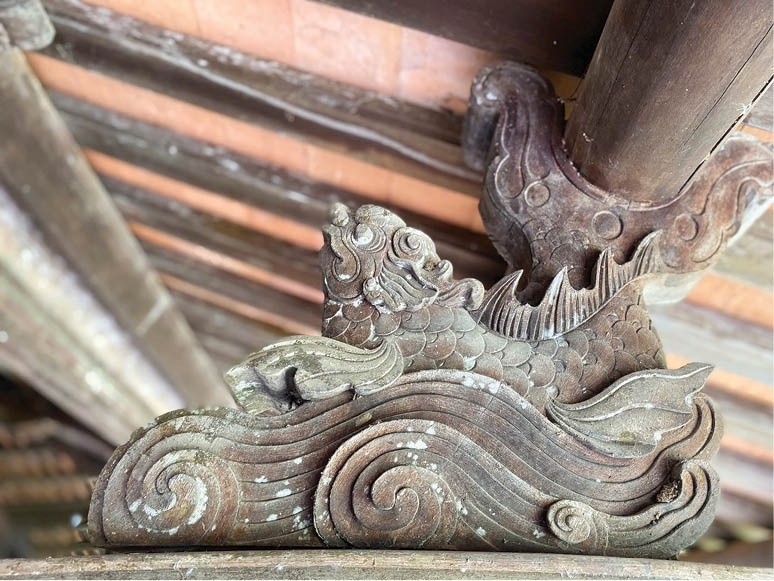 |
| “Carp turning into dragon” |
“Remembering their origin, early Nguyen kings gave Van Xa special interest. Now and then, they exempted the village from paying taxes. Some important constructions such as the communal house, the pagoda, etc., were built by the court. During Gia Long Era, the communal house was just a small thatched house lying on the main axis of the village. In the 10th year of Minh Mang Era, the emperor granted the communal house a horizontal board engraved with the words “So tai sanh huy”, meaning this is where light emits. In 1861 in Tu Duc Era, the communal house was rebuilt with five compartments and two wings to correspond with the place where the queen had been born,” says Tran Dai Vinh.
The communal house was built by the court, so it is decorated, as a priority, with the five-hoofed dragon, which was the symbol especially for the king only.
In terms of aesthetics, folk constructions in Hue are more or less influenced by the court, but Van Xa Communal House is even more special. “There is so much influence of the Nguyen court here, both interior and exterior, with porcelain mosaics in themes such as Four Sacred Animals (Dragon, Unicorn, Turtle, Phoenix) and Four Seasons (Spring, Summer, Autumn, Winter). The guarding screen is carved with the turtle shell symbolizing sustainability like the one in Truong Sanh Palace in the Imperial City where the Empress Dowager and the king’s grandmother resided.”
According to Dr. Phan Thanh Binh, many artifacts here are extremely valuable originals. For example, on the main altar is the image of a five-hoofed dragon with its sparking tail, or the decorative boxes like ones on the bronze cauldrons in the style of Thieu Tri’s and Tu Duc’s eras.
Ho phu (tiger mask) symbolizing power, sustainability, and governing the evil can be found at the front, on the sides and at the back of the altar. This proves the close connection with the court. Carvings on the wooden structures include flowery patterns, “carps turning into dragons,” etc. They are all familiar decorative patterns in the Nguyen court.
"This shows the ample influence of the court on the communal house. Van Xa is a special case in Hue, or probably in the entire Central Vietnam,” stressed Dr. Phan Thanh Binh.
The Van Xa communal house was recognized as a national relic in terms of history, architecture and art in 1999. Many generations, including the Empress Dowager, who came from the village, have left their hearts on every detail in the house. She was portrayed as a woman who led a thrifty life. She even raised silkworms in the court for making fabric as a hobby. Old people passed away, but Van Xa is still here. The communal house is like a small museum as part of the heritage of the Nguyen Dynasty in Hue.