And even before any movement or project existed, any household in Hue that had land - a garden, or even a modest patch of earth - would prioritize planting a yellow apricot tree or two, to welcome good fortune and admire the blossoms when spring and the Tet holiday arrived.
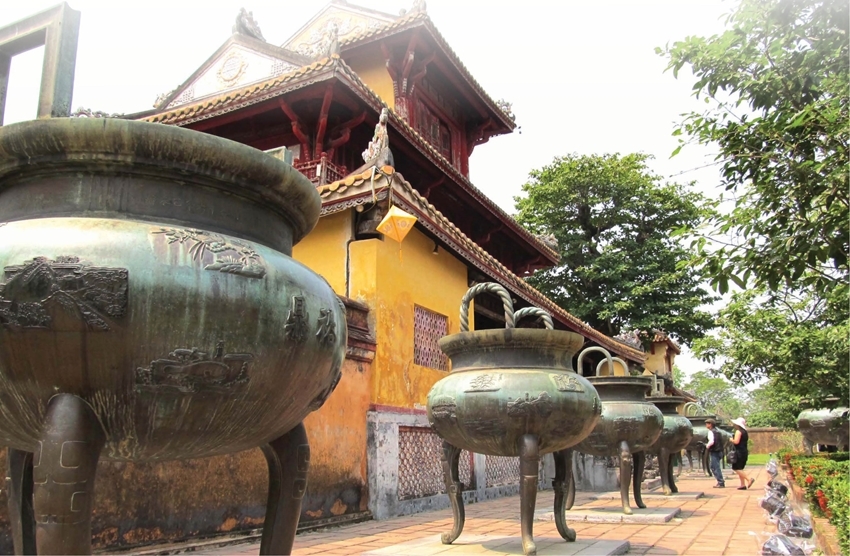 |
| The Nine bronze urns in Hue Imperial Citadel |
I recount all of this to say that the people of Hue have shared a long and loving bond with the yellow apricot, one that only grows stronger with time. And today, it’s not just Hue locals - people from many other regions have also fallen for Hue’s yellow apricot. The yellow apricot tree has never once “lost its prestige” or dropped in value.
And yet… one thing has long nagged at me, something I keep turning over without finding an answer: why, when the Nine bronze urns were created, did the yellow apricot “fail” to make the cut among the flowers chosen by Emperor Minh Mang to be cast onto them?
The Nine bronze urns were cast by order of Emperor Minh Mang in 1835, completed in 1837, and placed in the courtyard in front of The Mieu temple within Hue Imperial Citadel. The emperor himself explained their significance: they were created “to affirm the rightness of the throne and the gathering of destiny; to express the wish that they endure for ten thousand years, passed down through generations.” When commissioning the Nine bronze urns, he also decreed that all species of birds and fish, animals, plants, types of weapons, carriages and boats, as well as astronomical and geographical phenomena - great and small - should be rendered in their likenesses, with “the images of rivers, mountains, and all things not needing to be exhaustive, but with names, titles, and locations clearly inscribed for easy reference.” These images were faithfully cast in relief on the Nine bronze urns by royal artisans following the royal edict, and were recognized by UNESCO as a Documentary Heritage under the Memory of the World Programme for the Asia-Pacific Region on May 8, 2024.
All 153 relief castings on the nine bronze urns before The Mieu temple have been meticulously documented by researcher Duong Phuoc Thu in his book of “Vietnam through the Nine bronze urns”, so I won’t take up the reader’s time repeating that work. I only wish to raise a small… grievance about the flowers selected for casting. Among the nine flowers the emperor chose, one searches in vain for the yellow apricot. The flowers include crape myrtle on the Cao Đinh, lotus on the Nhan Dinh, jasmine on the Chuong Dinh, rose on the Anh Dinh, camellia on the Nghi Dinh, sunflower on the Thuan Dinh, chloranthus on the Tuyen Dinh, hibiscus on the Du Dinh, and finally magnolia on the Huyen Dinh. That’s it.
Some sharp-eyed observers, however, point to a casting on the Nghi Dinh showing a five-petaled flower in full bloom, with a single Chinese character beside it: apricot (梅), and insist, “There it is!” Some have even written rather boldly that the yellow apricot is one of the flowers depicted on the Nghi Dinh, since it symbolizes the brilliance and spirit of the nation. Its yellow color represents nobility and royalty, and its five petals symbolize the “five blessings”: prosperity, wealth, longevity, health, and peace.
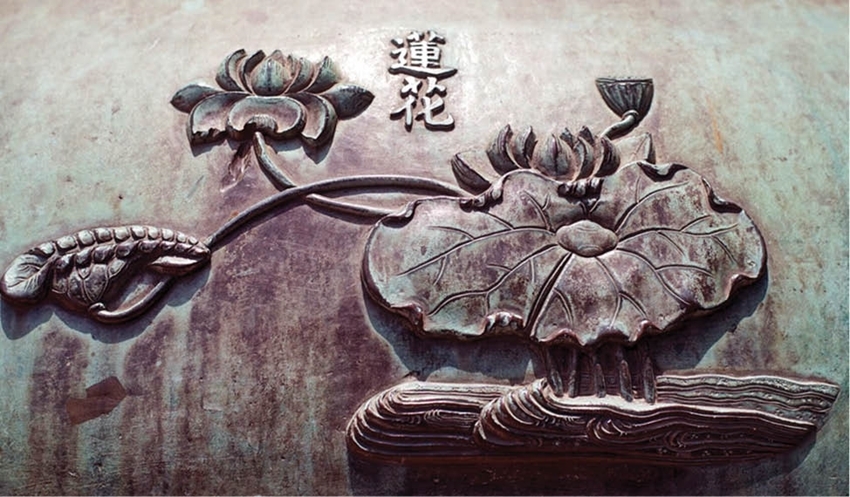 |
| A casting of the lotus on the Nine bronze urns |
But this is actually a “fatally” misleading confusion that very much deserves to be set straight. Here’s why: when Emperor Minh Mang decreed that “images of rivers, mountains, and all things” be selected, each category followed the sacred number nine, as was the custom in Eastern thought. The flowers selected already number exactly nine as listed above. If “apricot blossom” were added, that would make ten. The emperor would have had heads rolling, no question.
In truth, the “apricot” letter on Nghi Dinh is not the yellow apricot at all — it is the plum blossom. Consulting a Sino-Vietnamese dictionary, the character “apricot” (梅), written with 11 strokes, refers to the plum tree. This tree blooms in early spring, in white or red varieties. It flowers before leafing out, and its fruit is sour, turning yellow when ripe. That is why the inscription on the urn uses only the single word “apricot,” whereas the other nine flowers are always labeled with the full term: crape myrtle flower, lotus flower, jasmine flower, rose flower, sunflower flower, chloranthus flower … It is precisely this confusion of plum with yellow apricot that leads many people today to believe that the line “nhat sinh de thu bai mai hoa” (“a lifetime bowing only before the apricot flower”) by the poet Cao Ba Quat refers to the yellow apricot. Scholars have argued that the “apricot flower” in Cao Ba Quat’s poem actually refers to the plum blossom, since it is the plum that grows in the cold, frosty forests of the rugged northern highlands - stripped bare through the bitter winter, looking as though dead, yet bursting brilliantly into bloom come spring. That is the character of a true gentleman, worthy of Chu Than’s lifelong bow. The pampered, temperamental yellow apricot of Hue could hardly claim such a place.
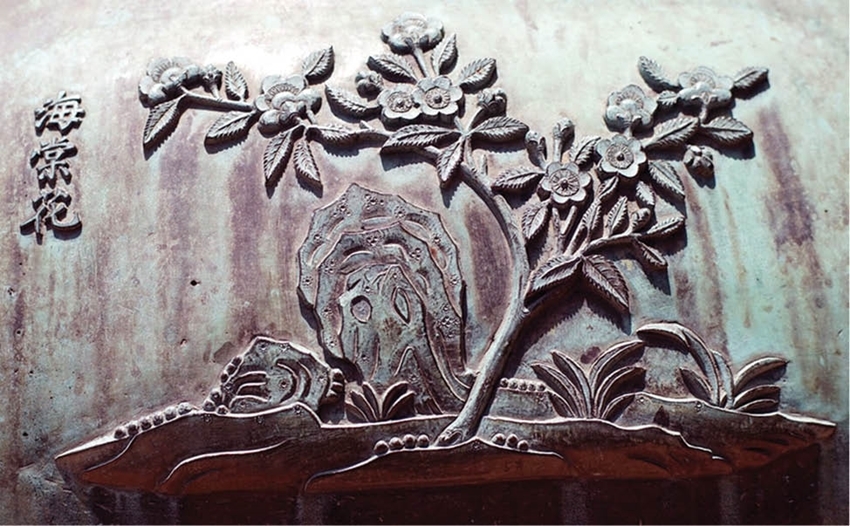 |
| A casting of the rose on the Nine bronze urns |
Some have explained the yellow apricot’s absence from the Nine bronze urns by saying the emperor’s criteria for selecting flowers required beauty, both color and fragrance, wide usefulness, and popularity among the people. It sounds reasonable, but on reflection - at least to us - something still feels off. For beauty, color, fragrance, and popular love, the yellow apricot more than holds its own against the nine that were chosen. Take the camellia, for instance: while some admire it, I’ve heard many people dismiss it as a flower with beauty but no soul - color without scent. Its buds drag on for months, and once it finally blooms, the flowers fall within a day. How does that compare to the yellow apricot? As for the argument that the camellia has medicinal uses - perhaps, but I’ve never seen proof. Meanwhile, people still prize the roots of the yellow apricot tree for soaking in medicinal wine.
The Year of the Snake draws to a close as the Year of the Horse arrives. The yellow apricot tree in front of the entrance has already formed clusters of jade-green buds, promising a brilliant yellow display come Tet. Over a cup of spring tea, I have asked myself many times: perhaps in those days, the yellow apricot was planted so abundantly in the palace gardens that, as is often the case, what is plentiful is not seen as precious - and perhaps that is why the yellow apricot was unlucky enough not to be chosen by the emperor.
A rambling, idle wondering - yet I still hope some learned soul might offer a word of true explanation.