 |
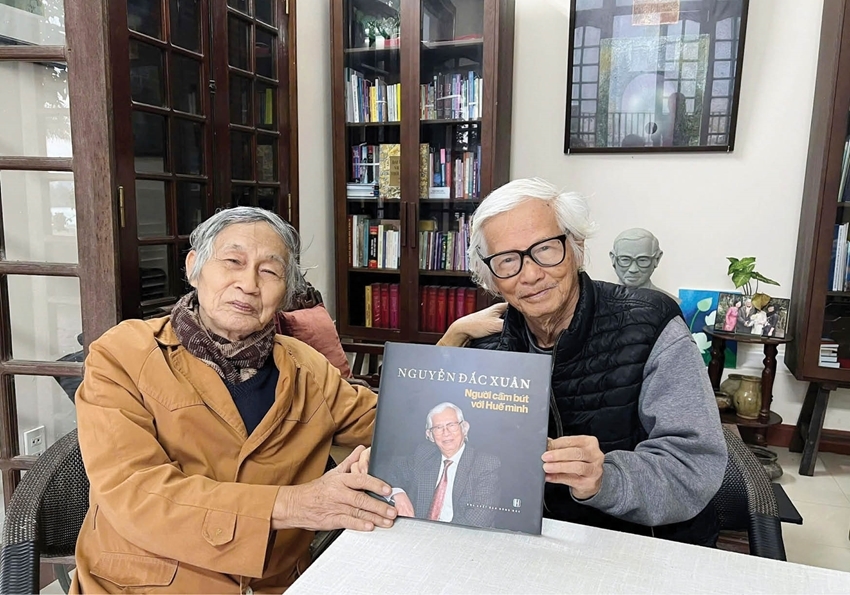
| Nguyen Khac Phe and Nguyen Dac Xuan, a researcher on Hue (right) |
- Whenever you have time, come by for a visit. I’ve just finished a new book…
- I’m glad to hear your voice sounding strong!
That was how I cheerfully replied to my old friend at “Tho Loc Attic.” I was happy because this “old friend” had been hospitalized twice in the past year and even had to undergo difficult surgery. That “old friend” is a figure well known not only in Hue - the researcher and “Hue scholar” Nguyen Dac Xuan. Born in 1937, he has just turned ninety this year by the Vietnamese way of counting age. At such an age, and with such health challenges, he has still managed to publish another book; something truly admirable. It is his 90th book, a particularly special one.
By coincidence, the spring weather in Hue in early 2026 was beautifully sunny, so I rode my electric bicycle down toward Dap Da to visit him.
When I arrived, Nguyen Dac Xuan was sitting upright at a table in the middle of the living room, beside him was his secretary Hoai Linh, who was typing on a computer. His eyesight has weakened, so in recent years the journalism graduate Hoai Linh has helped him read newspapers and books and prepare documents. As soon as I sat down, Xuan told her: “Please go get the book, the new one…”
The owner of Tho Loc Attic said that because in 2025 alone he published three books. Two months earlier he and Vo Ca Dao had planned to launch a new book at the Hue Book and Culture Club, but he ended up in the hospital. The “new book” that Hoai Linh brought out, holding it with both hands, is a massive collection few people could compile. Its title is “Người cầm bút cái Huế mình” (The Writers of Our Hue) - Hong Duc Publishing House, late 2025.
The oversized book (24 × 24 cm), priced at one million dong per copy, is 344 pages long and contains thousands of color photographs, each with captions explaining their origins, the context of historical events, and the circumstances of encounters with notable figures. The book is organized into ten sections: 1 - Homeland, childhood, and family; 2 - Three years of struggle and nine years of resistance; 3 - Writers of Hue; 4 - The path to researching the Nguyen Dynasty and old Hue; 5 - With descendants of the last Nguyen emperors; 6 - Gratitude to teachers and friends; 7 - Kindred spirits; 8 - People who passed through my life; 9 - The Tho Loc Attic Library; 10 - Nguyen Dac Xuan - Major Works.
In Chapter 4, which introduces images and figures connected with President Ho Chi Minh’s childhood in Hue, the author devotes ten pages with great care. These pages not only allow readers to “revisit” two now-historic sites - the house at 112 Mai Thuc Loan Street and Duong No village, where Ho Chi Minh lived as a child - but also introduce readers to people who personally knew the stories of that time. One example is Le Thien (born 1898), a classmate of Nguyen Sinh Cung at the Franco–Vietnamese Dong Ba School (1907) and later at Quoc Hoc Hue (1908).
The author also notes that his book “Uncle Ho’s Childhood in Hue” began to be compiled in late 1975 and has since been reprinted nine times by Tre Publishing House. Photographs of film crews and foreign researchers visiting him to learn about the topic demonstrate the enduring appeal and scholarly value of the subject he devoted so much effort to research.
The years when Nguyen Dac Xuan became active in the urban protest movement and later joined the resistance are illustrated through vivid and rare photographs, for instance, an image of Hue Radio announcer Nguyen Thi To Lien reading an appeal calling on Hue students to gather in support of the student movement in Da Nang in March 1966.
Other photos show Xuan when he served as a Hue City Party Committee cadre, meeting comrades working at grassroots bases in Luong Loc and Thuy Cam (Loc Thuy). Images of him reuniting with Thanh Hai, a poet, and To Nhuan Vy, a writer, on the Truong Son mountains after the signing of the Paris Peace Accords evoke memories of the long, arduous years of resistance.
Through his deep and sustained research on Hue, Nguyen Dac Xuan had the opportunity to meet many remarkable figures who helped illuminate and enrich the history and culture of the former imperial capital over the past century. Among these are descendants of the last Nguyen emperors (Ham Nghi, Thanh Thai, Duy Tan, and Bao Dai) both in Vietnam and abroad (in France and the United States), whom he introduces in detail in Chapter 5. Xuan also had the good fortune to meet and learn from notable personalities such as Zen master Thich Nhat Hanh, musicians Tran Van Khe and Pham Duy, and Nguyen Thi Xuan Yen (Madame Tuan Chi), among many others.
It is impossible to list all the people whom Nguyen Dac Xuan regards as teachers or kindred friends. These rich intellectual exchanges that few writers can match have not only enriched him with knowledge and materials but also added vivid details and revealed hidden aspects of Hue’s history and culture over the past half-century. With such a “treasure trove” of resources, over sixty years of writing he has published ninety books, including monumental works nearly a thousand pages long, such as “700 Years of Thuan Hoa – Phu Xuan – Hue” and “Questions and Answers about the Nguyen Dynasty and Ancient Hue”.
Entering the spring of 2026, even after publishing a book that reflects on his ninety-year life, Nguyen Dac Xuan still cherishes new research ideas and continues to promote and celebrate Hue’s cultural values to wider audiences.
Before I left Tho Loc Attic, Xuan handed me a ten-page draft titled “Hue – Trinh Cong Son – Peace, Love, and the Human Condition,” which he had just completed with Hoai Linh’s help. The document will be submitted to cultural authorities and city officials as part of a proposal to prepare a dossier for UNESCO, seeking recognition of Trinh Cong Son as a Cultural Personality, not as a musician but as “an intellectual artist for peace and humanism” values that resonate with humanity as a whole.
It is a bold yet thoughtful proposal, awaiting support from intellectuals and relevant organizations.