 |
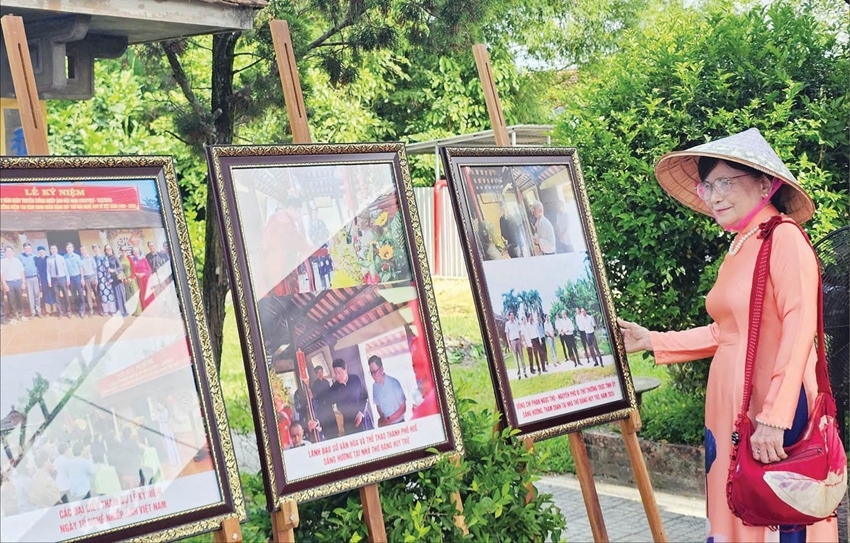
| A corner to display and introduce the life and career of the historical figure Dang Huy Tru |
As a patriotic Confucian scholar during the resistance against French colonialism in the 19th century, and a high-ranking official of the Nguyen Dynasty with reformist ideals, Dang Huy Tru dedicated his entire life to serving the nation and people. At the same time, he was also a writer, poet, politician, economist, military strategist, and diplomat. Moreover, he was regarded as the founding father of photography in Vietnam. Today, the sites and relics associated with this prominent historical figure continue to be preserved and promoted by future generations.
One of the most important historical sites is the Dang Huy Tru ancestral house, located in Huong Xuan of the former Huong Tra Town, now part of Kim Tra Ward. The site includes structures such as a gate, guarding screen wall, courtyard, ancestral house, pavilions, guest house, stele house, a statue of Dang Huy Tru, bas-reliefs, and a traditional well, etc.
It has become a “pilgrimage” destination for photographers from across the country whenever they visit Hue. Each year, on his birth and death anniversaries, local authorities and organizations hold incense-offering ceremonies along with exhibitions and commemorative displays. In addition to the ancestral house, his tomb, located in Hien Si Village, formerly in Phong Son Commune, Phong Dien Town, now part of Phong Thai Ward, has also been recognized as a National Historic Site honoring a prominent historical figure. In Hue City, there are also schools and streets named after Dang Huy Tru.
According to Le Thi Mai Anh, M.A., from the Hue Museum of History, the preservation and promotion of heritage sites associated with Dang Huy Tru’s life play a vital role. She emphasized that local authorities and residents in areas where these sites are located need to collaborate closely to effectively conserve and promote these historical landmarks and integrate them into tourism development.
To achieve this, it is essential to strengthen public awareness and education through all forms of media so that people understand the significance of these heritage values and enhance their sense of responsibility in protecting historical sites. Additionally, collaboration with local travel agencies to design tours that include visits to Dang Huy Tru-related landmarks is encouraged. Local governments should also offer incentives and foster connections with tourism and travel companies to promote and introduce these sites to both domestic and international visitors coming to Hue.
Moreover, it is crucial to continuously promote scientific research on the relics, documents, artifacts, and the surrounding landscape of these heritage sites. The application of information technology in the preservation and promotion of their value should also be a priority. Efforts should be made to digitize the information and images of the sites related to Dang Huy Tru in Hue, providing visitors with innovative and engaging experiences. This not only facilitates easier and more interactive tours but also contributes significantly to the work of preserving and enhancing the historical value of materials and artifacts associated with Dang Huy Tru in Hue.
At present, the ancestral hall still preserves many Han-Nom documents, such as horizontal lacquered boards, parallel sentences, and royal decrees. These are important materials of the Đặng family line, providing current and future generations with the opportunity to better understand the historical roots, culture, customs, and traditions of the Dang lineage in particular, and of the Vietnamese community in general. Therefore, effective measures must be taken to preserve the Han-Nom heritage at the site through elements such as the stele inscriptions, royal decrees, ceremonial banners, hanging scrolls, and parallel sentences.
Mr. Phan Thanh Hai, Director of Hue City Department of Culture and Sports shared that it is necessary to harmoniously balance the relationship between tourism development and the preservation and promotion of the value of relics related to the historical figure Dang Huy Tru. Specifically, it is important to facilitate travel agencies in surveying and developing heritage tours associated with the relic system of Mr. Dang Huy Tru.
Additionally, it is necessary to connect these relics with the Complex of Hue Monuments to attract tourists and scholars interested in visiting and conducting research. “The career and strategic talent of the historical figure Dang Huy Tru are evident in many fields. In each area, he demonstrated unique contributions; therefore, the preservation and promotion of his heritage is a shared responsibility of the entire society. This is also a key factor in building and developing Hue as Vietnam’s first cultural heritage city,” Mr. Hai emphasized.