 |
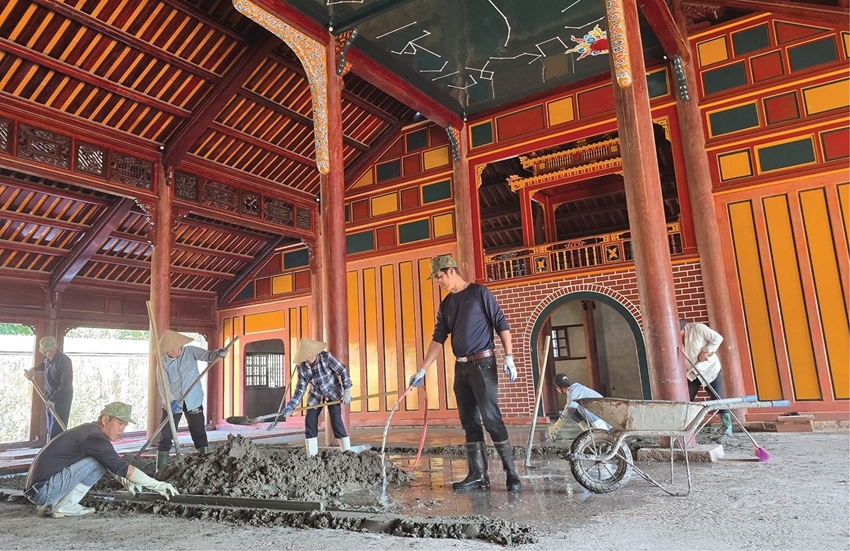
| Floor tiles being laid at Minh Khiem Hall |
Approaching completion
In the final days of 2025, at Khiem Mausoleum, construction teams are diligently laying the last floor tiles. Every operation is carried out with utmost care, as this is not merely a construction project but a site of exceptional historical and artistic value.
According to Mr. Nguyen An, site manager of the Emperor Tu Duc’s Mausoleum restoration project from Hue Monuments Restoration Joint Stock Company, the main components of Minh Khiem Hall have largely been completed. “Structural assembly, roofing, roof finishing, and exterior lacquer work have all been completed. The remaining tasks include floor tiling, touch-up painting, and installation of the door system. Minh Khiem Hall alone has reached approximately 95% completion, while the overall project to restore and rehabilitate the structures of Emperor Tu Duc’s Mausoleum has reached 75-80% completion. We aim to complete the entire project around August-September 2026, more than a year ahead of the original schedule,” said Mr. An.
The restoration work has been carried out strictly in accordance with heritage conservation principles: each component was dismantled, measured, documented, and evaluated by the Scientific Council before decisions were made on preservation, reuse, or replacement. Approximately 60% of the original structural components have been reused, particularly the wooden partition walls and decorative panels; many small details have been preserved almost intact. Only major elements, such as severely damaged wooden columns that no longer met structural safety requirements, were replaced.
Notably, the foundations of the three main structures, including Hoa Khiem Palace, Minh Khiem Hall, and On Khiem Hall (the repository for imperial utensils and personal effects), have been entirely preserved without intervention. Only the wooden frameworks and roofing were dismantled for treatment and reprocessing in strict compliance with conservation standards. All materials used strictly adhere to regulations governing heritage restoration.
Mr. Ho Van Phuc, site supervisor of the Emperor Tu Duc’s Mausoleum restoration project, noted that during dismantling, each component was carefully assessed by specialists from Hue Monuments Conservation Center in coordination with experienced technical staff from the construction unit.
Minh Khiem Hall is expected to be completed before the Lunar New Year, just in time to welcome visitors. Hoa Khiem Palace has currently reached approximately three-quarters completion, while On Khiem Hall is expected to be reassembled around March 2026 due to its smaller scale and simpler architectural details.
Reviving heritage values
Cultural researchers deem Minh Khiem Hall as the oldest surviving theater in Vietnam that remains relatively intact, preserving its original form and architectural details. In 1978, UNESCO expert Pierre Pichard expressed great admiration for the structure, describing it as a masterpiece of architecture and decorative art.
Unlike Duyet Thi Hall (Royal Theater) in the Imperial Citadel – a large theater serving multiple generations of emperors – Minh Khiem Hall was a private theater within Emperor Tu Duc’s Mausoleum, bearing the distinct personal imprint of a ruler renowned for his love of the arts. The structure was built in early 1865, while the emperor was still on the throne, and served as a venue where he enjoyed traditional opera, singing, dancing, and music during his stays at Khiem Palace.
Minh Khiem Hall is part of the Khiem Palace complex, regarded as Emperor Tu Duc’s “second imperial palace,” comprising dozens of palaces, pavilions, and lakes. The theater itself consists of three main bays with two side wings, featuring a raised floor paved with Bat Trang bricks, stone edging, and staircases delicately carved with soft, flowing unicorn motifs. The system of wooden columns, beams, rafters, and decorative panels is intricately carved with motifs such as the Eight Treasures, repetitive geometric patterns, and the swastika symbol.
The most distinctive feature of the theater is its ceiling, where artisans of Emperor Tu Duc’s era created a miniature “cosmos” depicting the sun, clouds, and stars embedded with glass beads. When stage lighting was used during performances, the reflected light created an ethereal atmosphere, blending the stage seamlessly with real life – an exceptionally rare innovation in traditional theatrical architecture.
The interior space of Minh Khiem Hall is carefully arranged, comprising the stage, seating areas for the emperor and his entourage, and backstage areas for performers’ preparations. It was here, during the reign of Emperor Tu Duc – a peak period of royal court tuong (classical opera) – that many performances and court music compositions were staged, enriching Hue’s cultural life in the 19th century.
The Project for the Preservation, Restoration, and Rehabilitation of Emperor Tu Duc’s Mausoleum was approved at the end of 2023, with a total investment of nearly VND 100 billion from the city budget. Upon completion of Minh Khiem Hall restoration, Hue Monuments Conservation Center will recreate exhibition spaces and organize cultural experience activities to further promote the site’s heritage value for visitors.
Emperor Tu Duc’s Mausoleum, constructed between 1866 and 1873, is one of the most representative tombs within the Complex of Hue Monuments, distinguished by its harmonious integration of architecture and natural landscape. However, due to historical upheavals and the harsh effects of time, many structures had severely deteriorated. Since 2014, restoration efforts have been comprehensively implemented, though several important structures had not been fully restored until the current project.