 |
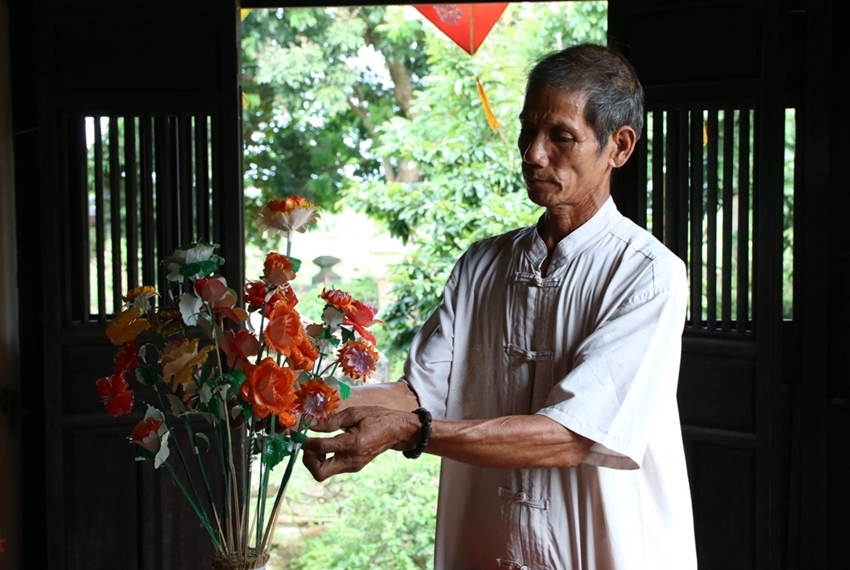
| Colorful Thanh Tien paper flowers |
Amid the culturally rich land of Hue Ancient Capital, Thanh Tien paper flower village stands as a gentle and tranquil highlight along the poetic Huong River. With a history spanning over 4 decades, this craft village is not only known as a place of producing paper flowers for spiritual rituals and festivals, but also for embodying a precious intangible cultural heritage.
Thanh Tien paper flower village is located in the fields of Phu Mau Commune, Phu Vang District, Thua Thien Hue Province, now it is part of Duong No Ward, Hue City. Unlike ordinary decorative flowers, Thanh Tiên paper flowers embody a unique cultural depth. Each lotus, lily, or chrysanthemum is closely tied to spiritual rituals, ancestral worship traditions, and major Vietnamese celebrations such as Tet, full moon days, and various spiritually rich ceremonies. From the skillful and meticulous hands of local artisans, vibrant and refined paper flowers are created, each bearing the distinctive artistic style of this traditional craft village.
To create a paper flower, the artisan must prepare in advance. The bamboo must be selected from the most flexible type, split into small strips, and then dried to make the stems and flower stalks. Colored paper is cut into the shape of petals, glued to form the flower, and the stamens are added to complete each blossom before attaching it to the stem. The process of dyeing the paper is done entirely by hand using natural dyes, following a family recipe passed down through generations.
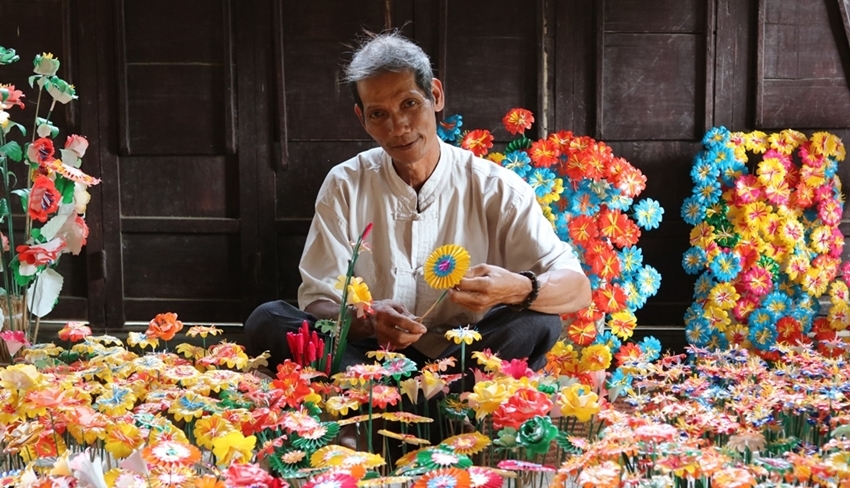 |
| Mr. Tran Phu, 63 years old, a longtime artisan of the flower-making village |
Mr. Tran Phu, 63 years old, is a renowned artisan in the region and the third generation in a family with a long tradition of making paper flowers. He shared: "In the past, making paper flowers couldn't provide a stable livelihood like it does today. We could only sell them during the Lunar New Year, and the rest of the time we had to do farming work to earn extra income. But now, paper flowers are ordered all year round, and many tourists know about them and even join in the flower-making experience”.
Arriving here, we encountered some young people and tourists taking part in the experience of creating real flowers by hand. Some were meticulously folding and shaping the petals, adding delicate creases and curves, while others were assembling the petals into the forms of various flowers such as roses, gladioluses, lilies, and more. I could see the passion and delight on their faces as they immersed themselves in making these flowers.
According to N.T.H. Trang, a third-year student at the University of Arts, Hue University: “Every Tet holiday, I see my mother buying Thanh Tien paper flowers to decorate the house. I’ve always been curious and fascinated by their vibrant and eye-catching colors. That’s why I decided to learn more about the craft village and spend time exploring it, as well as trying my hand at making a paper flower. After the experience and listening to the artisan’s stories, I’ve come to truly appreciate each flower, not just for its beauty, but for the stories behind it and the effort the craftsmen put into making them”.
T. P. Thanh, a final-year student at Phu Xuan University shared: “At first, I just thought of visiting the craft village for fun with some friends. But when Uncle Phu personally guided me through making a rose, I suddenly fell silent. Watching a piece of paper transform into a flower, it felt simple yet strangely sacred. I felt that I had to do something meaningful to help others discover this village. That’s why I often tell my friends about it and even bring foreign visitors to experience the Thanh Tien craft village”.
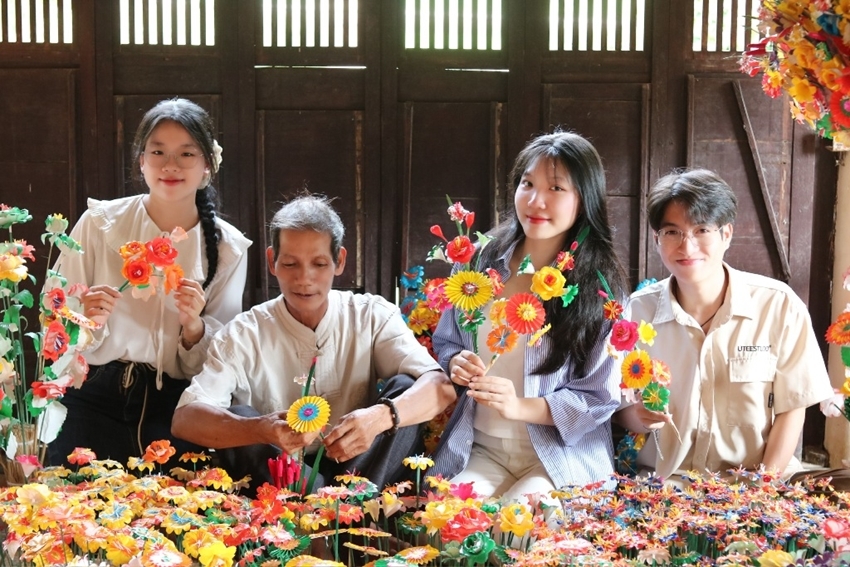 |
| Thanh Tien paper flower village attracting young people |
From there, many students begin coming to the village during school breaks to film and photograph materials, using media to help more people learn about the craft village. Schools at various levels in the city and neighboring provinces also regularly organize field trips for students to Thanh Tien Village throughout the school year. These experiences help the students learn about tradition and develop a deeper appreciation for national identity, through each paper petal, and through the stories shared by the artisans of the village.
Through each frame of film and every photo capturing the journey of crafting paper flowers with their own young hands, these students, who are often thought to be familiar only with books and technology, are in fact quietly preserving the soul of the village and the traditional culture of Thanh Tien craft village.
Uncle Phu added: “When I see more and more tourists, especially young people, showing interest in and learning about the craft village, it brings me great joy. Thanh Tien paper flowers have been with me through every memory, every stage of my life. Making paper flowers isn’t just for selling, it’s about preserving the soul of the village, of our homeland, of our ancestors. That’s what motivates me to pursue and protect this craft all these years”. Those words, which may seem like a simple reflection from an artisan dedicated to his trade, have become a quiet call, guiding many young people onto a path that is both challenging and deeply moving: The journey of preserving Thanh Tien paper flowers.
Preserving a traditional craft village is not something that can be done overnight. Thanh Tien paper flowers still face countless challenges. Yet today, the village remains vibrant and colorful, just as it was hundreds of years ago. What’s even more precious is that it is being revitalized with a new breath of life, the breath of young people full of passion, creativity, and a deep sense of responsibility from each generation.