The year 2026 marks the point at which Hue begins a new term with a clear objective: to build a green, smart, and identity-rich city, one where economic development is closely linked with heritage conservation and the improvement of residents’ quality of life. With major strategies already taking shape, Hue’s most important task at present is to translate vision into action, connecting the three pillars of development into a unified driving force for breakthrough growth.
 |
|
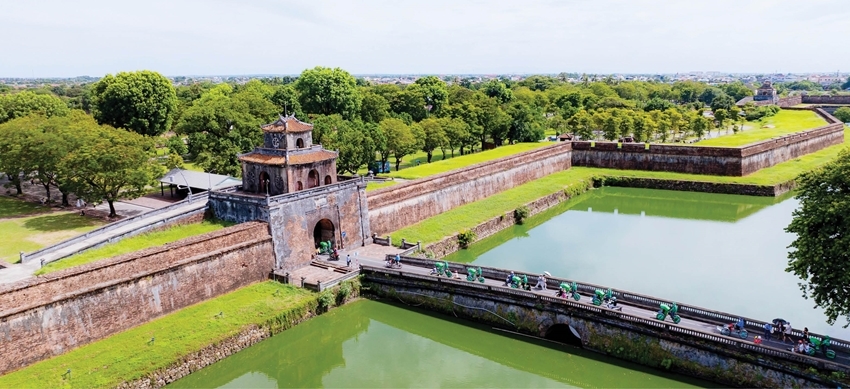
Green and romantic Hue. Photo: Dinh Hoang
|
Starting a new term with a grand vision
Hue enters the 2025 - 2030 term with renewed momentum, a fresh vision, and a strong aspiration for development. As resolutions, strategies, and key programs have been completed, the immediate requirement is to transform vision into concrete action and the first step is defining a clear direction: building Hue into a green, smart, and identity-rich urban center.
It’s a political commitment by the city’s Party Committee and authorities to Hue people for a sustainable, in-depth development model, one that embraces integration without losing the values that make this land distinctive. This approach stems from practical reality: Hue is a heritage city growing within the currents of modernity, where nature, culture, and people blend into a unique identity.
The city has been identified as a center for culture, tourism, and advanced healthcare; it possesses strong potential in science and technology, with urban space expanding toward the sea and surrounding areas. These factors form the foundation for Hue to confidently enter a phase of acceleration. Alongside these opportunities, however, come new demands: development must be fast but not rushed; modern but without losing its core essence; integrated yet still retaining Hue’s characteristic tranquility.
Within this overall picture, “green” has been chosen as the primary development axis. In Hue, green is not merely the color of the landscape, but a strategic choice, a way for the city to protect itself against climate change and growing environmental pressures. Mr. Nguyen Xuan Hoa - a researcher, emphasized: “Hue’s natural environment is a special heritage. The system of rivers, mountains, and lagoons constitutes the soul of the city. Preserving open spaces, breathing spaces, is just as important as conserving architectural monuments”.
 |
|
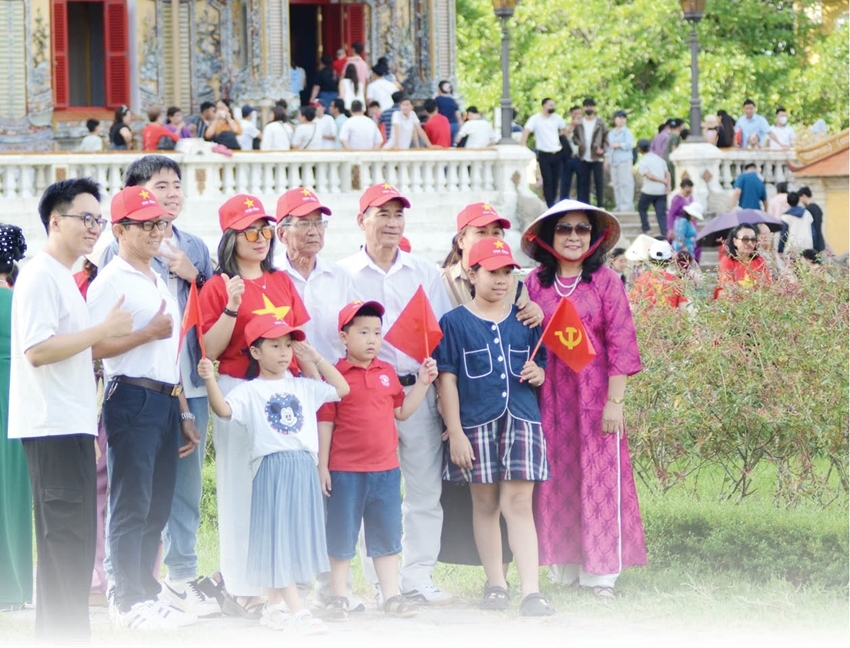
Visitors exploring Hue’s heritage
|
Smart to break through, green to sustain
Entering a new phase, Hue understands that relying on heritage alone is no longer sufficient to achieve a breakthrough. “Smart” has been identified as a vital requirement if the city is to rise into the group of urban centers with high competitiveness nationwide. A smart government system is being rolled out in a comprehensive and synchronized manner. Administrative reform is being advanced on digital platforms, with data connectivity and standardized service processes to ensure speed, transparency, and efficiency for citizens. The smart urban monitoring system supports the management of construction order, traffic, security, and more… placing citizens’ interests at the center.
Hue is also oriented toward becoming a science, technology, and innovation hub. As Hue University moves toward a national university model, the city will gain significant advantages in training high-quality human resources, attracting technology enterprises, and promoting an innovation ecosystem.
At the same time, Hue is making major investments in disaster-response infrastructure, including dikes and embankments, reservoirs, flood drainage systems, and early-warning applications. These measures not only protect the city from extreme climate impacts but also help ensure quality of life.
On the sidelines of the 17th City Party Congress for the 2025 - 2030 term (October 2025), Standing Member of the City Party Committee and Standing Vice Chairman of the City People’s Committee Nguyen Thanh Binh stated that the city is prioritizing investment in key transport routes, coastal roads, ring roads, digital infrastructure, logistics, and tourism, in order to establish a comprehensive foundation for the smart city model. Hue’s goal is to operate the city based on data, ensure transparency, and place people at the center of all policies.
Preserving Hue’s identity and opening new opportunities
No matter how fast it moves, Hue must not lose itself. “Rich in identity” has therefore been identified as the third pillar, and the most fundamental one, in the development vision. Hue’s heritage, with its system of imperial architectural works, pagodas, garden houses, and a rich treasury of intangible cultural values, is an invaluable asset, not only to be preserved, but also to generate new growth momentum.
Hue focuses on heritage preservation through modern approaches, combining original conservation with digital technology to create high-value cultural and tourism products. Heritage spaces are not merely places to observe, but spaces for creative experiences - where people can live with Hue culture in new ways.
Cultural industries are regarded as an important driving force for development. Hue Festival, four-season festivals, artistic streets, and creative spaces will be organized in a professional, market-oriented manner, aiming to position Hue as a “cultural capital” of Southeast Asia.
According to the researcher Nguyen Xuan Hoa: “Hue is a land of distinctive values, and what is distinctive is not something every locality possesses. Hue once missed the opportunity to have the Huong River recognized as a natural heritage of humanity, but a new opportunity is opening up. The most important thing is to successfully build a model of a modern heritage city without losing the essence of Hue, civilized yet deeply imbued with memory”.
Mr. Nguyen Xuan Hoa also believes that Hue’s heritage city must serve as a model for architecture and landscape, where buildings are integrated with nature, open spaces are preserved, parks are interwoven, and communities live harmoniously without overcrowding. Such is the very essence of Hue!
The year 2026 opens a new term filled with confidence and great expectations. From resolutions to action, from vision to outcomes, Hue is steadily turning its aspiration of becoming a green, smart, and identity-rich city into reality, worthy of its position as a heritage land within the nation’s development trajectory.