 |
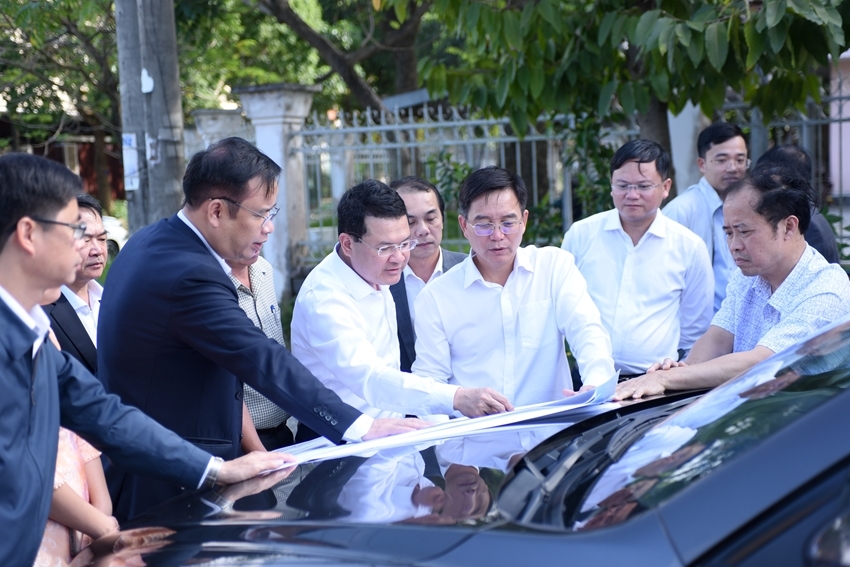
| The delegation reviewing maps of the proposed site for the bridge crossing Con Hen |
Joining the delegation were Standing Deputy Secretary of the City Party Committee Pham Duc Tien; Member of the Standing Committee of the City Party Committee and Vice Chairman of the City People’s Committee Hoang Hai Minh; along with representatives of relevant departments, agencies, and local authorities.
Connecting and Unlocking Development Potential for Con Hen
According to the orientation set out in the Master Plan for Thua Thien Hue Urban Area (now Hue City) to 2045, with a vision to 2065, approved by the Prime Minister, the bridge crossing Con Hen plays a key role in completing the regional transport infrastructure, strengthening connectivity between the two banks of the Perfume River, and fundamentally addressing residents’ travel needs, especially those of Con Hen, an “islet” within the urban area.
At present, Con Hen is connected to surrounding areas by the only Phu Luu Bridge on Ung Binh Street. The bridge is narrow, about 3.28 meters wide, has a limited load capacity of 5.5 tons, and has severely deteriorated after many years of use. It no longer meets traffic safety requirements or the needs of urban development in the new phase, with its Bailey steel truss spans being heavily corroded, cracking appearing in in its abutments, piers, and piles and the rebar getting exposed.
Investing in a new bridge crossing Con Hen, connecting Truong Gia Mo Street to Nguyen Gia Thieu Street, will not only replace the overloaded and deteriorated old bridge but also open up development space, creating momentum for the formation of the Con Hen urban area oriented toward eco-tourism and community-based development, associated with preserving river landscapes and Hue’s cultural identity.
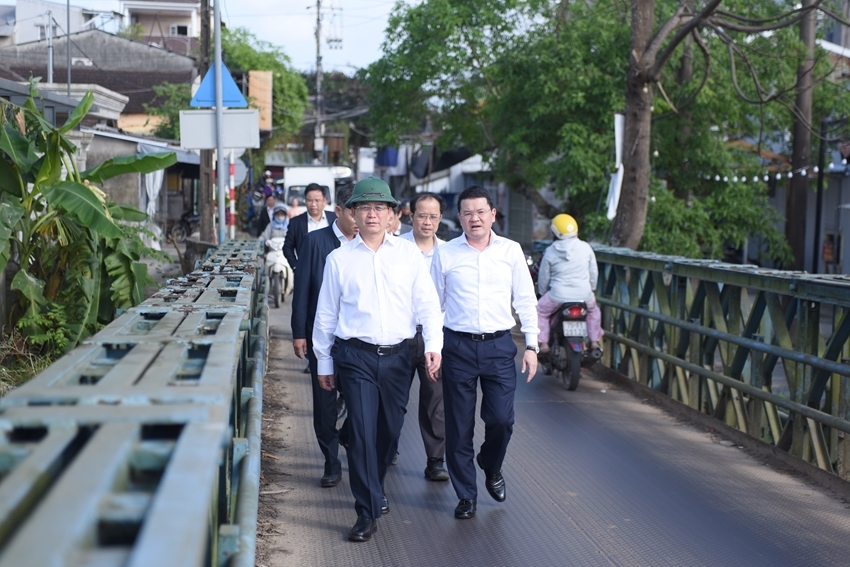 |
| Secretary of the City Party Nguyen Dinh Trung and the delegation conducting an on-site survey at Con Hen |
Under the proposed plan, the project starts at the intersection of Truong Gia Mo Street and the extended Le Duc Anh Street (Vy Da Ward) and ends at the intersection of Nguyen Gia Thieu Street and Ho Quy Ly Street (Phu Xuan Ward). The total route length is about 2.76 km, including two bridges crossing Con Hen with a combined length of approximately 400 meters. The road is designed to inter-district road standards, with a design speed of 60 km/h, ensuring safe, convenient traffic and compatibility with the existing infrastructure system.
Notably, the Con Hen bridge is identified as an important structure and an architectural landmark in Hue’s urban space. Under the 2019 Architecture Law, an architectural design competition must be organized to select the optimal solution for the project, which ensures harmony among technical requirements, aesthetics, landscape, culture, socio-economic efficiency, and environmental protection.
In addition to the Con Hen bridge project, the delegation also heard reports on several adjustments to the Ring Road 3 project, focusing on updating elevations and drainage systems according to the new plan; adjusting weak soil treatment solutions; adding resettlement areas for site clearance; and completing cross-sections and traffic organization plans at the intersection of the North-South railway with National Highway 1A.
Ensuring the Progress of the Project
According to Mr. Nguyen Dang Truong, Director of the City’s Transport Construction Investment Project Management Board, the Con Hen bridge project is expected to receive approval of its investment policy soon. In 2026, site clearance for the road section and the architectural design competition will be carried out; construction is expected to begin in late 2026 or early 2027. The project aims to be completed and put into use by late 2028 or early 2029.
For Ring Road 3, the section south of Nguyen Hoang Bridge has completed contractor selection but is still facing site clearance issues. The Nguyen Hoang Road project is expected to be completed in 2026. The entire Ring Road 3 is targeted for completion during the 2028-2029 period.
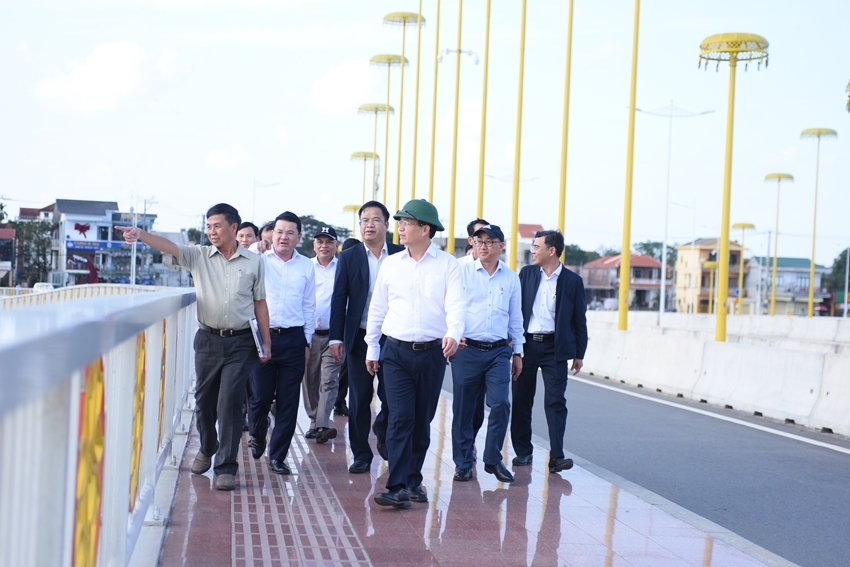 |
| The delegation surveying the implementation of the Ring Road 3 project |
After the inspections and on-site surveys, Secretary of the City Party Nguyen Dinh Trung emphasized that these are strategically significant projects, playing an important role in concretizing Hue’s urban development orientations under the approved master plan; contributing to the gradual completion of infrastructure systems, expanding development space, and enhancing Hue’s urban image in the new phase.
He requested that relevant departments, sectors, and local authorities continue to closely coordinate and carefully review planning, architectural, technical, environmental, funding, and scheduling factors, paying special attention to design quality, infrastructure synchronization, urban spatial connectivity, and the long-term operational effectiveness of each project. Implementation must comply with legal regulations and the set timelines, avoiding delays and prolongation.
In particular, the Secretary of the City Party called for strong focus on site clearance, the key stage that directly determines project progress and effectiveness. Site clearance must be proactively, systematically, and rigorously carried out, in accordance with prescribed procedures; at the same time, communication, public outreach, dialogue, and timely understanding of residents’ legitimate concerns must be strengthened to build broad social consensus.
He also noted that units must clearly define the responsibilities of each agency, local authoritiy, and individual in charge; proactively coordinate and promptly resolve difficulties and obstacles arising during implementation. Projects must be carried out on schedule, with assured quality, maximizing investment efficiency, creating spillover momentum for socio-economic development, strengthening urban and regional connectivity, and contributing to Hue’s rapid and sustainable development as a centrally governed municipality.