 |
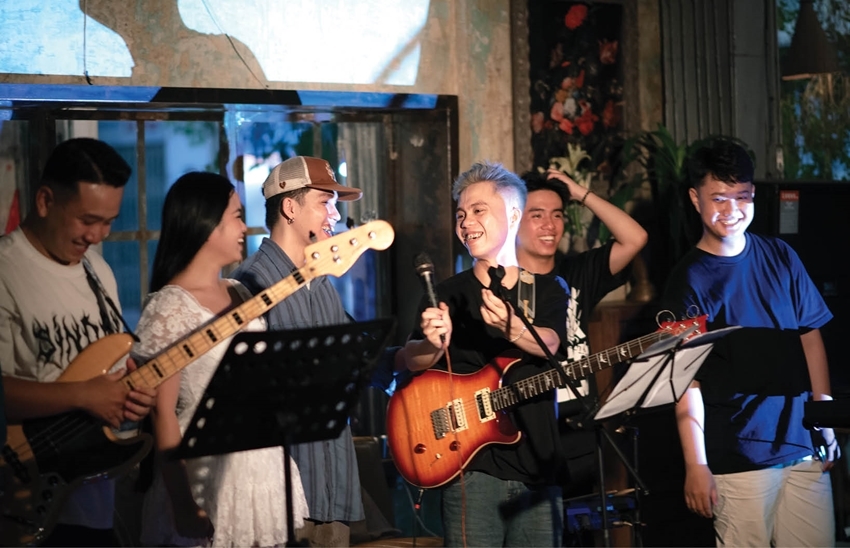
| Very young members of the music group |
Young people’s activities at Hue Academy of Music are examples. Students there learn to analyze lyrics, harmonize, and feel melodies through his songs. In their eyes, Trinh Cong Son was not just a musician; he was the poet of sounds, the philosopher of music, and an endless source of inspiration.
Young people are passionate about Trinh’s music not only because of his deep melodies and lyrics full of philosophy, but also because they can access his music in a different way. Many young people sing his songs in acoustic, lo-fi, jazz styles or combine them with rap, which gives Trinh’s music some modernity familiar with the temporary taste. This innovation doesn’t spoil Trinh Cong Son's spirit, but brings his music to young audiences.
Recently, a young music group called NOKAR gave a little performance but full of emotion and personalization. The band consists of 7 members, Do Le Dinh Nguyen, Le Thi Huyen Tran, Ton That Thien Nhan, Le Minh Trung Kien, Bui Huu Tam Thai, Dang Kim Thien Nhan, and H La Vi Bkrong. They’re very young but their enthusiasm for music is evident and profound. (The oldest is Dinh Nguyen, born in 1999; the youngest is Huyen Tran, 2008)
At the performance NOKAR sang many songs of which the four famous, “Diem xua”, “O tro”, “Nang Thuy tinh” and “Quynh Huong” were remixed with “Diem xua” inspired from Trinh Trung Kien’s testing version.
According to Dinh Nguyen, head of the group, they didn’t do so to attract attention, but to prevent young people from forgetting Trinh’s music. As for Nguyen, remixing is a way to "rejuvenate" his music, but still retain the calmness and the inner self of Trinh's music. The balance between inheritance and innovation is something that NOKAR is always aware of.
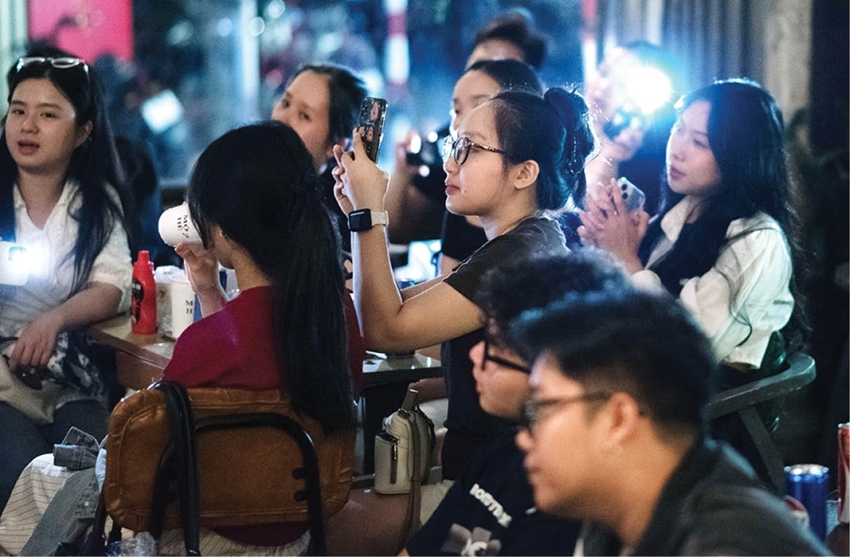 |
| Young audiences got excited when they heard Trinh’s music in the new style |
Huyen Tran, the young singer who sang “O tro” says that it was her first time singing a Trinh Cong Son’s song on stage. She felt happy and excited because the lyrics are profound and meaningful, and she truly put her emotion into every word as she sang. With the new arrangement, it was as if the old familiar song had been put on different clothes, more vibrant and closer to the Gen Z while still keeping the original beauty. Tran said though she sang a new rendition, she always remembered the original melody, which had been in the memory of many generations of Hue people. “We can renew it, but we shouldn’t blur its original beauty. The new arrangement helps me feel a stronger connection with the song - as if it were a conversation between the past and the present,” said Tran.
As for Trung Kien, the rapper who remixes “Quynh Huong”, singing that classic song brought him a wonderful feeling. “Simply speaking, art is inherited and developed. Performing a Trinh’s song in my own way is what every singer desires,” said Kien. As for Kien, his rendition is not to replace the original, but “a different picture of the same theme” on which the young singer paints his feelings. “The original version is modest and profound. Mine is more personalized, showing the style which I have been pursuing since high school. No version is better or worse; each is beautiful in its own way.”
A very special thing is that in Hue people don’t have to make an effort to preserve Trinh’s music because it’s deeply rooted in the land and people’s soul. Somewhere in the sounds of cicadas singing or a rainy afternoon in the ancient town is a certain familiar melody like a whisper of the past. The emergence of the young artists like NOKAR shows that Trinh's music is not forgotten over time, but gently transforms through generations.