Once he shouldered ammunition and carried the wounded across the Truong Son during the resistance war, then “shouldered” the gift of literacy to villages after peace was restored. Now, in the twilight of his life, he quietly continues to “shoulder” love and aspirations for a prosperous, peaceful village.
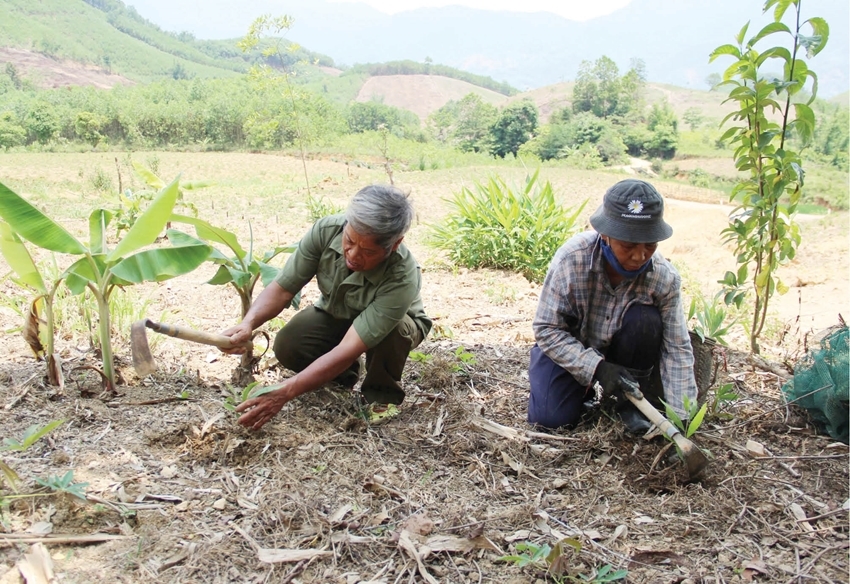 |
| Despite their age, elder Trinh and his wife toil diligently |
A heart devoted to the village
The sun had climbed to the tops of the trees. Along the wide road from Ra Looc – A Soc Hamlet up toward the upland fields, a truck now and then came back down, loaded with freshly cut acacia, its resin scenting the air. On the broad hillside of corn and cassava, an old couple had just gathered up their hoes. Sweat soaked their shirts and streamed down their faces, yet elder Nguyen Van Trinh and his wife cheerfully turned their gaze toward the road, savoring the serene, soothing landscape.
In the stilt house by the fish pond, amid the fields, the laughter of the elderly couple flows as warmly as a spring at its source as they recall the years when the State launched a campaign urging people to donate land for road construction and build a new countryside in this remote borderland. Elder Trinh and his wife gave up several hectares, topping the list of contributors in the community. Wherever the road cut across or widened, elder Trinh never hesitated to offer both his farmland and his garden.
 |
| Elder Trinh and his wife rest after work |
When the authorities called for land donations, many people hesitated, reluctant to part with it. At that time, elder Trinh, the village head and a trusted figure, not only led the way but blazed the trail. What he gave was not just garden plots or hillside land, but a piece of his heart to the community. He went from house to house, explaining, persuading. People believed him—not only because his words carried warmth and sincerity, but because they saw the way he lived, the way he gave, and followed his example. Even the most reluctant were won over, choosing to join in. Gradually, every household affected gladly gave land and trees so the roads could be cleared and widened to welcome the sunlight. And hearts, too, opened wide to embrace the shared joy,” said Nguyen Van Deo, head of Ra Looc – A Soc Hamlet.
His eyes turned once more toward the road linking Ra Looc – A Soc Hamlet to the upland fields, where trucks now and then rumbled past with loads of acacia and melaleuca bound for the town. In a quiet, unadorned voice, Trinh said: “This road runs through two kilometers of my land, four meters wide. The acacia and melaleuca trees weren’t yet ready for harvest, but I cut them all so the State could build the road. With this road, it’s easier for everyone—trucks can reach the upland fields, and people no longer have to haul cassava and corn down the mountains on their backs.”
The spacious fish pond in elder Trinh’s garden, along with fruit trees heavy with ripening fruit, gave way to a broad, freshly paved road cutting across his land.Yet elder Trinh and his wife never felt a pang of regret. “Keeping the land while people had no road, my heart wouldn’t rest. There must be a wide, proper road for the village to thrive,” said Ho Thi Huong, elder Trinh’s wife, as she peeled a sweet melon freshly picked from the upland field to offer her faraway guests.
Community cohesion
Perhaps hearing the unspoken question in our minds—how anyone could give up several hectares of land, trees, and all that property so easily—the Pa Co village elder smiled gently: “During the anti-American resistance, I served as a civilian porter on the front supply line. I trekked through the mountains, shouldering ammunition, carrying the wounded, and cutting paths so the troops could march. When the soldiers fought, we supported them. When they fell, we carried them back. So many of our finest sons and daughters shed their blood in these mountains—for the villages here, for independence, freedom, and the peaceful life we have today. With peace won, how could I begrudge land or property and not act for the common good?
 |
| Village elder Nguyen Van Trinh |
Steeped in the breath of mountains since birth, elder Trinh loves this borderland like flesh and blood. “Pa Co life flows with the life of the forests, of these villages,” he said. “So in wartime, I bore ammunition, bore the wounded—adding my strength to the fight for freedom. And when peace came, at the Party’s call, I roamed the forests to “carry letters” to remote hamlets, battling the enemy called illiteracy.”
“Back then, the roads were unimaginably harsh,” elder Trinh recalled. “From A Dot to Huong Nguyen, I had to trek an entire day to get there, and I came home only once every few months. Every big and small matter in the house, she bore alone. That’s one reason we fully supported the opening of roads for development,” he said, his eyes soft with affection for the woman who understood—and shared his devotion to the community.
According to Nguyen Manh Hung, Party Secretary of A Luoi 2 Commune, Elder Trinh is like the thread that binds the community together. Villagers hold him in trust and affection, and the local authorities feel reassured knowing they have respected elders like him by their side. After retiring from the classroom, he never allowed himself a day of rest. For nearly 15 years, as Chairman of the Association for Disabled People of the former Hong Bac Commune, he has worked tirelessly to connect kindhearted donors and benefactors, offering both material aid and emotional support to those less fortunate.
Through elder Trinh, many people with disabilities have gained access to preferential loans, giving them the means to improve their livelihoods and take control of their lives. A case in point is Le Van Ngan from Le Ninh Hamlet, who was able to buy a rice mill, pigs, fish, and breeding cattle to expand his livestock farming and rise to prosperity. Sharing these stories of perseverance and humble love, elder Trinh said the villagers’ success is also his joy.
Elder Trinh said he lives a quiet life, like a tree in the forest. But that day, when we reached his hillside plot under the boundless noonday sun, a sea of green stretched before us—acacia, melaleuca, cassava, and corn. Cucumbers were heavy on the vines; yard-long beans and green beans dangled from the trellis; gourds and squash were bursting into bloom; and in the pond below, carp and grass carp stirred the water.
That scene deepened our understanding of the Ra Looc - A Soc Hamlet chief’s words: Elder Trinh stands like a towering tree, rooted in the trust and affection of the village—not only for his many contributions to the community, but for continuing, even in the twilight of his years, to be a shining example that inspires the people here to reach for their aspirations.