 |
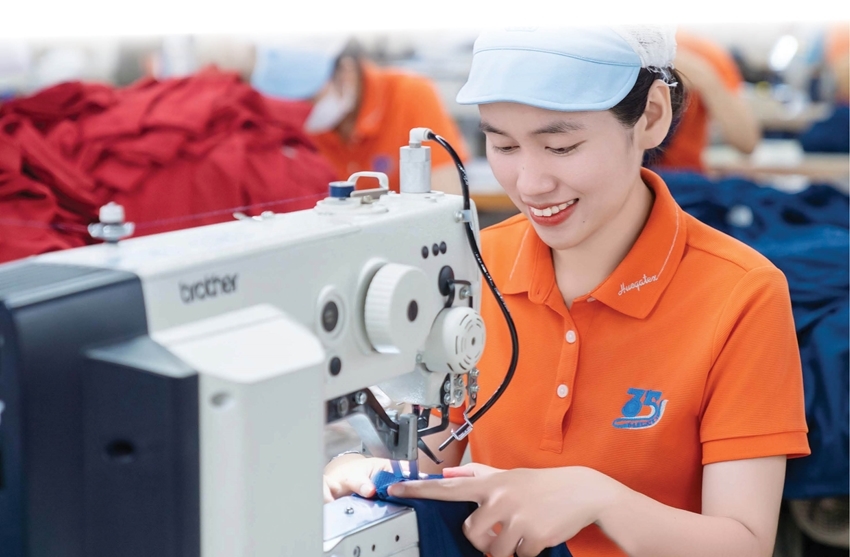
| Hue Textile and Garment Joint Stock Company is aiming at making products from organic and recycled materials |
Development with responsibility
In many interviews, Nguyen Van Phuong, Deputy Secretary of Hue Party Committee and Chairman of Hue City People’s Committee, often mentioned his concerns about the relationship between development and conservation. To him, Hue is unique as the only ancient capital city which still retains its ancient architecture and cultural depth. That is an asset.
The master plan for Thua Thien Hue (now Hue City) in 2045 with a vision to 2065 identifies the three main sectors for development; they are heritage-based economy, tourism economy, and circular economy. All of them “take the heritage as the foundation, and the green growth as the driving force.”
“Hue won’t pursue development at any cost. We say no to projects that negatively impact the landscape, the environment, or the cultural identity of the city,” stressed Nguyen Van Phuong.
And that mindset has been translated into action. Some projects with potential risks of polluting or disrupting the landscape have been rejected. Instead, the city gives priority to projects that employ advanced environmentally friendly technology.
One typical example is Kim Long Motor Joint Stock Company. In June 2025, this company signed a contract to supply 3,000 EV electric buses, and YUCHAI buses per year to Cho Thavee in Thailand. The vehicles with modern engines are manufactured in Hue in more than 90% of automation. This is not only a milestone in commerce but also an evidence for green high-tech manufacturing ability - a strategic direction for the city.
The wave of green transformation is also spreading to traditional businesses like Hue Textile and Garment Joint Stock Company. Under the global pressure for transformation in textile industry, Hue Textile emerges as one of the pioneers in promoting green manufacturing. It built the solar energy system and smart factories, and is researching into making products from organic and recycled materials. “We aim for 100% of new investment projects in the coming time to meet green and circular production standards,” said Nguyen Tien Hau, Deputy Director of the company.
A good move
In 2024 the city approved 36 projects with a total capital of over VND 12,500 billion. That figure is not only big in quantity but also of high quality when Hue proactively selected investors with a priority to environmental friendliness in alignment with the aim of building a heritage city which is green, smart and modern.
The investment keeps growing during the first half of 2025. Notable projects include the Creanza High-Tech Quartz Factory, the Dat Phuong Glass factory, and the Chan May Logistics Center, … or cooperation agreements with major corporations such as Vingroup. Those all share the two key features: high economic value and clear-cut environmental commitment.
“We choose Hue not just because of its potential, but also the responsibility, professionalism and sustainable vision of the leaders of the city,” said Le Thu Thuy, Vice Chairwoman of Vingroup, during a meeting with city leaders.
The city not only waits to welcome but also actively seeks international green capital. During business trips to the U.S., Canada, Japan, and South Korea, city leaders directly invited investors in such fields as high-tech industries, smart urban development, clean energy, logistics, and eco-tourism. At a forum in Vancouver (Canada), the message “Hue - preserving the heritage while staying in step with the times” left a strong impression.
Legal framework is a solid foundation
Behind the impressive numbers is an institutional foundation that is gradually taking shape. Hue does not see regulations as barriers, but rather, as an adhesive that connects the local government with investors. The legal framework is becoming transparent, friendly, and sustainable.
Right from the planning stage, industrial zones and economic zones are required to be designed in a closed and synchronous manner with waste treatment systems, lands for trees, especially they won’t spoil the ecosystem of the area. Many plans have been adjusted to avoid badly affecting sensitive ecological areas and heritage sites.
The infrastructure at economic and industrial zones such as Chan May-Lang Co, Phu Bai, La Son is also “greened.” Criteria such as “no disruption to land, water, and forest”, “no pressure on core urban infrastructure” are mandatory.
In addition, Hue is leading in applying digital technology to manage investment effectively. A software for managing off-budget projects is employed to supervise the whole process. Investors can keep track of the progress and report issues without having to contact departments directly.
The perspective of the city is that investment is sustainable only when all concerned parties work with responsibility. The local government selects investors based on criteria about technology, working environment, and business ethics. In return, entrepreneurs coming to Hue will receive meaningful support from the local government of all levels.
The long-term vision of the city is the harmony between economy and social environmental responsibility. The models of ecological technical zones, green city, and community-based tourism in relation with the heritage are seen as foundation for development.
Each area in Hue is a piece of the whole green mosaic. Its great inspiration is Hue will become a green venue for people in Southeast Asia which attracts funds with responsibility and which people can live in and be proud of.
“In the coming time, we’ll try to maintain and improve PCI, PAPI, PAR Index, and DTI, support entrepreneurs in their digital transformation, call for investment, and speed up the implementation of projects which have been approved,” affirmed Nguyen Van Phuong, Chairman of Hue City People's Committee.