 |
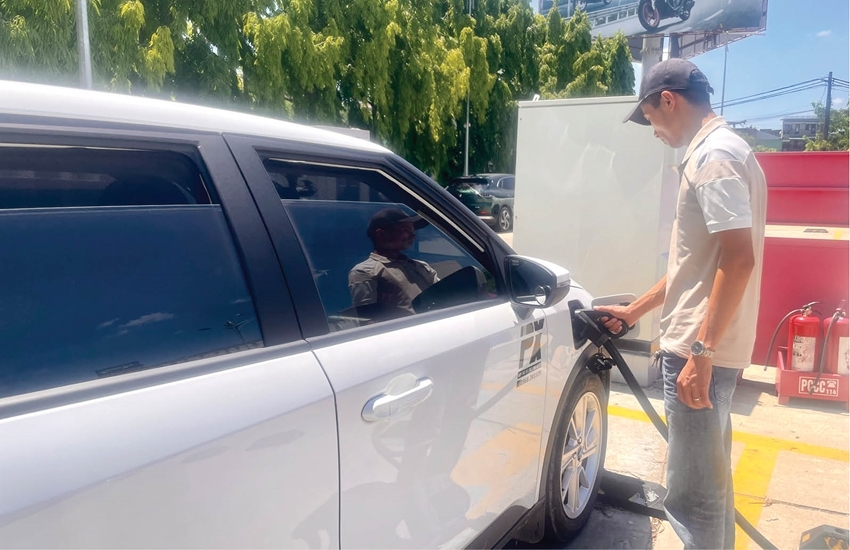
| Electric cars for a green environment in Hue City. Photo: MINH ANH |
Suitable choices to move faster
It is no coincidence that on many major streets, residents have begun to get accustomed to electric taxis, emission-free buses, and the GCoo smart bicycles. “The pleasant air, with fewer car horns, really makes me feel like I’m in a Northern European city,” shared an international tourist after walking on the streets. This perception is not just praise, but evidence of Hue’s gentle yet decisive movement in the journey of green transportation transformation.
While major cities like Ho Chi Minh City and Hanoi are struggling with infrastructure and pollution problems, Hue, with its flat terrain and interwoven density of heritage sites and parks, has advantages to shape a model green urban prototype. Instead of investing in widespread “mega projects”, the city chooses to approach each key component systematically, such as progressing toward investing in charging stations covering all central wards, electric bus lanes along the Perfume River, smart parking lots, digital platforms for personalized journey management...
Recently, the City People’s Committee issued the Plan 305, dated July 16, 2025, on transitioning to electric car use for public passenger transport routes by bus and intra-provincial buses in the city for the period 2025-2030, setting a target that by 2030, at least 60% of taxis and 30% of intra-provincial buses will be electrified. This is considered a practical starting step, creating a foundation for the green transportation infrastructure project for 2025-2030, aimed at reducing greenhouse gas emissions in the transport sector.
Accordingly, the development strategy extends well beyond “vehicle replacement” to encompass a comprehensive system reorganization, which includes planning green parking lots, integrating charging stations, developing public bicycles, and non-motorized corridors.
The green transportation model has also been implemented by some countries and has shown effectiveness. Typically, the Netherlands, with 17 million people but owning more than 20 million bicycles, is a model for organizing non-motorized, efficient, and sustainable transportation. People in this country do not use cars if they only travel under 7.5km. With more than 35,000km of bicycle paths and electric taxi companies like Connexxion and TCA, this country has proven that a clean environment and clean transport can coexist with urban economic efficiency.
In Hue City, models of GSM electric taxi, Phuong Trang electric buses, and GCoo bicycles continue to expand, earning strong community support. Accordingly, a city where residents find it convenient to give up motorbikes, businesses benefit from using electric vehicles, and tourists can travel in tranquility is truly a city worth living in.
Redesigning living habits
Green transportation is not just a technical problem, but a matter of reorganizing urban behavior. From cities like Copenhagen (Denmark) to Freiburg (Germany), Oslo (Norway), all prove that quality of life, community health, and urban longevity depend directly on emission density, the proportion of non-motorized space, and green transport infrastructure. For Hue, a city regularly affected by climate change, green transition is no longer a trend, but an inevitable condition. This urgency intensifies as the city pursues a smart city model built on low emissions and sustainable climate adaptation.
From a practical perspective, Mr. Le Xuan Trong from the Institute for Transport Strategy and Development (formerly under the Ministry of Transport) recommends: “To promote sustainable green transportation, it is necessary to simultaneously research and apply simple technological solutions to facilitate public bicycle use, expand walking spaces, and strengthen urban order control on street routes.” Mr. Trong also highlights the potential of "bicycle culture" as a viable solution for short-distance travel, particularly when integrated with existing public transit networks.
In reality, a portion of Hue’s residents have already transitioned. Mr. Nguyen Duc Luong, a citizen of Thuan An ward, said that after using gasoline vehicles for some time, he decided to switch to electric vehicles because he recognized many clear benefits: “I thoroughly researched the features of electric vehicles and found them suitable for new trends, with quiet engines suitable for inner-city travel. Moreover, as Hue is building a green city, I want to be among the first to respond, both contributing to environmental protection and fitting with the city’s landscape and traffic culture.” He added that supportive policies from manufacturers are also factors creating motivation for the transition.
Urban restructuring can not be achieved through appeals alone. From solar-powered parking lots to bicycle corridors connecting heritage sites, the city is reorganizing urban rhythm through specific changes and social consensus. When tourists can book electric buses through apps, cycle along the Perfume River, or walk under green canopies, Hue showcases a clear evidence of a green, civilized, modern city.