 |
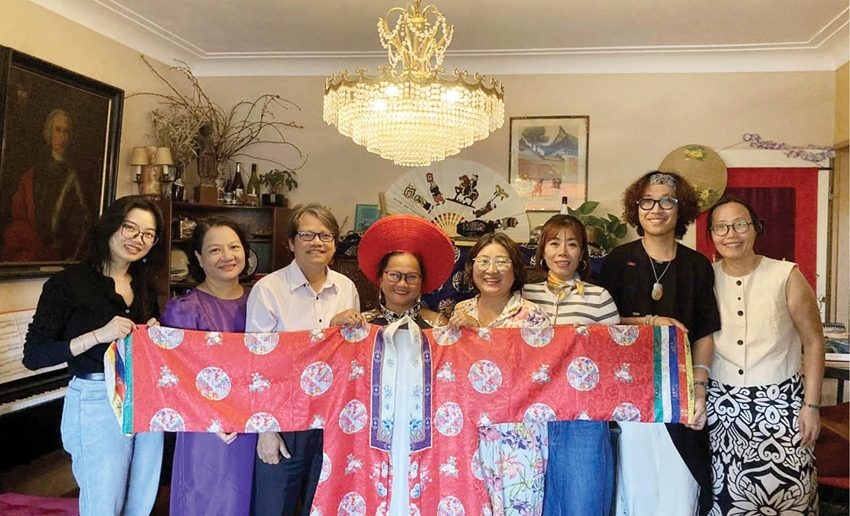
| Taking commemorative photos in Nhat Binh robe (a traditional ceremonial robe of Vietnam’s Nguyen Dynasty) |
We set foot in Europa in the early days of autumn 2025. Geneva (Switzerland) was immersed in a week of fine drizzle. As I roamed through the moist stillness, the scent of pho suddenly wafted along Rue de la Servette. A Vietnamese had carried pho to this distant place, opening “La Maison d’Asea” so that people could savor it.
More fascinating still, I encountered Hue here in numerous photographs of paintings by artist Mai Trung Thu, works he created while teaching at Quoc Hoc School from 1930 to 1937, including “Thiếu nữ Huế” (Hue Maiden), “Thiếu nữ chơi đàn Nguyệt” (Maiden Playing the Moon Lute), “Chân dung cô Phương” (Portrait of Miss Phuong), and “Người phụ nữ đội nón lá bên sông” (Woman Wearing a Conical Hat by the River), among others.
Savouring Vietnamese pho in rainy Geneva, we were unexpectedly moved to hear songs about Hue drifting through the air, such as “Mưa trên phố Huế” (Rain on Hue’s Streets), “Ai ra xứ Huế” (Who Goes to Hue?) by Chau Ky, and “Người em Vỹ Dạ” (The Girl from Vy Da) by Minh Ky.
I strolled along the shores of Lake Leman while drizzle drifted across Geneva, as gently as the faint toll of a bell, recalling sounds that once echoed here — the flute of a patriotic Vietnamese. Vo Thanh Minh, known as Hong Son Da Ma, once sat by the lake playing his flute and undertaking a hunger strike to demand peace and reunification for Vietnam.
In a small house in Brussels (Kingdom of Belgium), my wife Thu Huong guided poet Quynh Iris Nguyen de Prelle, founder of the Intercultural Vietnam–Pacific Center (IVB), in preparing bun bo Hue (Hue-style beef noodle soup), complete with fermented shrimp paste and lemongrass brought from Hue. In a city renowned for its frites and gaufres, the aromas of shrimp paste, lemongrass and chili lingered gently in the air. Quynh learned swiftly, and in about an hour that morning, Hue’s bun bo with pork knuckles was passed on. She ladled the noodles herself for her gentle husband Bertrand and their two delightful children, Helene and Alexandre. The Belgian family was delighted to enjoy bun bo and pork knuckles from Hue, cooked for the first time by their mother in their own kitchen.
Upon hearing of my arrival, Quynh and several young friends organized a program titled “Poetry and Heritage.” The event featured poetry readings, an introduction to the royal ao dai ( Traditional Vietnamese long dress) of Hue, and discussions on cultural themes. Quynh arranged the space beautifully, infusing the living room with the cultural spirit of Hue and Vietnam. An embroidered cloth with floral motifs was laid diagonally across a table, on which rested poetry collections by various authors from Vietnam. The Tac robe (a traditional ceremonial garment of Vietnam’s Nguyen Dynasty) that Huong had carefully brought over was ceremoniously spread out in the center of the room. The Nhật bình robe I had presented the previous year — later introduced by Quynh in several European countries — was displayed beside where we sat to read poetry. I recited to young poetry-loving expatriates works connected with Hue’s heritage, including “Gánh cơm hến đi trong sương” (Carrying Clam Rice through the Mist), “Biệt cung” (The Secluded Palace), and “Bình minh” (Dawn).
In the second half of the program, Thu Huong introduced the royal ao dai of the Nguyen Dynasty, embodied in the Tac and Nhat binh robes. In the center of Brussels, these garments were not simply layers of fabric; they echoed Hue — a dynasty, its rituals, and the breath of everyday life. Their presence in Brussels meant that Hue — Vietnam — was present in its own quiet yet proud beauty. It was a way for Vietnamese culture to enter the world, through silent threads stitching together memory and pride, brought to life by the dedication of Quynh and the young participants.
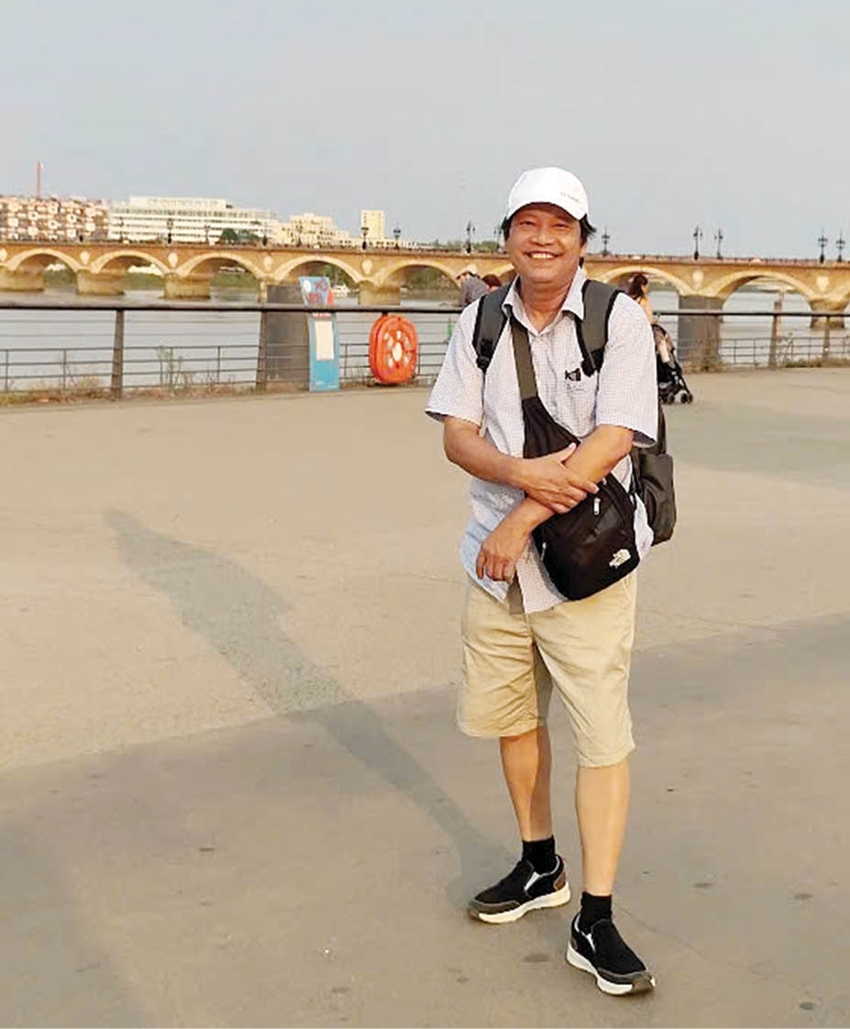 |
| Behind the author stands the Saint-Jean railway bridge, built by Gustave Eiffel in Bordeaux, France |
At that instant, I suddenly felt as though I were sitting somewhere along the banks of the Huong River, where the sound of oars still echoes from distant times. Poetry and the Hue ao dai — two undercurrents of culture — found each other in the heart of Europe like two arms cradling memories of home. Quynh shared that Hoang Hanh, a Hue native, had also purchased a set of the Tac and Nhat binh robes as a gift to the Vietnam Ao Dai Heritage Club in Belgium. The set was presented at the program “Autumn Peace Gathering,” organized in Europe by the Vietnamese Women’s Association in Belgium, the Vietnam Ao Dai Heritage Club in Belgium, and the General Association of Vietnamese in the Kingdom of Belgium. Quynh was also involved in organizing the event.
In Bordeaux, France, Tran Hong Que — a former literature-specialized student of Quoc Hoc High School — a resilient yet romantic daughter of Hue, welcomed us with her ever-present smile and accompanied us throughout our visit. Having worked there since 1998, she knows almost every corner of the city by heart. As we strolled along the banks of the Garonne River and took a few keepsake photos beside the Saint-Jean railway bridge spanning the river — built by engineer Alexandre Gustave Eiffel — I was unexpectedly reminded of Hue. In 1937, the Eiffel company undertook a major restoration of the Truong Tien Bridge, giving it the elegant silhouette it still bears today. The company was later invited back in 1953 to reconstruct the bridge after the ravages of war.
In the Netherlands, at Majetic café, we encountered veteran poet Cao Xuan Tu from Hue, whose well-known line about Amsterdam reads: “Land lower than the sea — a human lifetime.”The verse touches upon the quiet sense of smallness and transience of human life in the face of nature’s destiny.
If Amsterdam in the Netherlands must shoulder the weight of the sea, Hue must endure the torrents rushing down from the Truong Son range. The most profound association lies in the words “a human lifetime” — a burden of resilience carried across generations. With each flood season that recedes, the people of Hue quietly rise again, rebuilding their livelihoods. Their love and attachment to the former imperial capital are not merely a source of pride, but an enduring epic of life.