 |
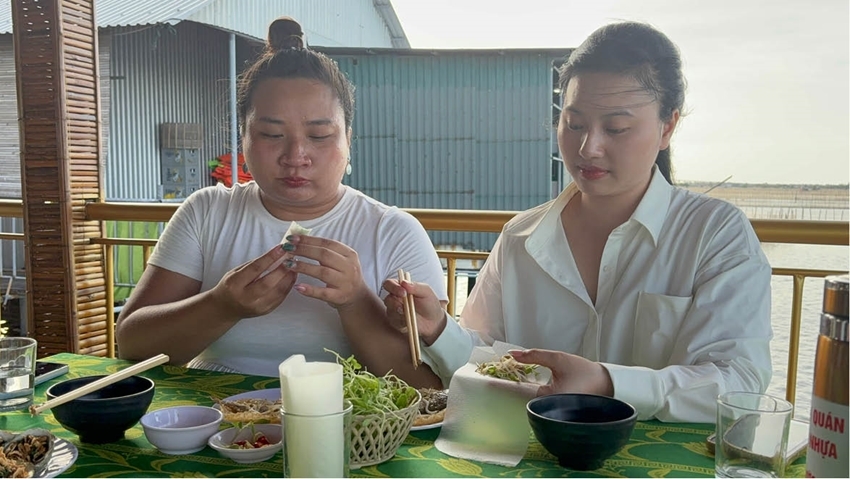
| Tourists enjoy rabbitfish khoai cakes in Hue |
During the tourist season, it is common to bump into groups of young travelers holding their phones, checking maps, and making their way to eateries recommended on social media.
“Our three-day itinerary is pretty much all about food,” said Doan Khanh Linh, a visitor from Ho Chi Minh City, with a laugh. She and her friends had a long list of must-try dishes during their stay in Hue, including Hue beef noodle soup, mussel rice, beo cakes, nam cakes, loc cakes, grilled pork skewers, Hue-style sweet soup, and salted coffee…
Khanh Linh shared that short videos featuring Hue’s local cuisine on social media platforms such as TikTok, Facebook, and Instagram had sparked their desire to ‘travel for food’. Images of steaming bowls of Hue beef noodle soup, golden khoai cakes, or colorful glasses of sweet soup…. had made Hue more accessible and enticing than ever.
After nearly two weeks in Hue, Laura, a visitor from France, spent her time discovering the cuisine of the former imperial capital. She noted that many of Hue’s popular eateries are tucked away in small alleys rather than along major streets. Finding a good bowl of Hue beef noodle soup, a shop serving thick noodle soup with snakehead fish, or a plate of authentic pressed cakes may require navigating narrow alleyways. Yet it is this very journey that makes her experience of discovering Hue’s culinary scene so enjoyable.
“I don’t mind walking or riding a few extra kilometers. Some eateries may look quite ordinary, but their food delivers an explosion of flavor that stays with me long after,” Laura said. She was also impressed by the warmth and friendliness of Hue’s people. Many eatery owners were happy to explain how to enjoy their dishes and recommend other places favored by locals.
With its distinctive imperial cuisine reflecting the historical and cultural heritage of the former imperial capital, Hue was recognized by Agoda, an online travel platform, as Asia’s most unique destination for traditional cuisine. The recognition also highlights the growing appeal of Hue’s culinary offerings among travelers. A clear example was the ‘Hue - Culinary Capital 2026’ program, themed ‘Hue Beef Noodle Soup Day’, held late last July, which attracted approximately 48,000 visits.
Video recordings of food tours in Hue have attracted hundreds of thousands, and even millions, of views. This growing popularity has created new opportunities for local businesses. Many small-scale food businesses have taken steps to upgrade their dining spaces and signboards, introduce bilingual menus, and adopt cashless payment methods to accommodate the rising number of visitors. Meanwhile, some young people in Hue have launched food tours on foot or by motorbike, guiding visitors to local eateries that remain hidden gems known mainly by the locals.
Mr. Dang Hien, tour guide at Nu Cuoi Hue Trading and Tourism Co., Ltd., shared that many tour groups visiting Hue today are interested not only in sightseeing but also in exploring local cuisine as part of their itineraries. Beyond tasting the food, many visitors want to learn about the origins and ingredients of each specialty, as well as the stories behind it. These experiences help them gain a deeper understanding of Hue’s culture.
As experiential travel grows in popularity, cuisine is becoming one of the key tourism offerings that contribute to extending visitors’ stays and increasing their spending in Hue. More and more travelers are coming to the former imperial capital not only to admire its heritage but also to enjoy the distinctive flavors of this land.