 |
|
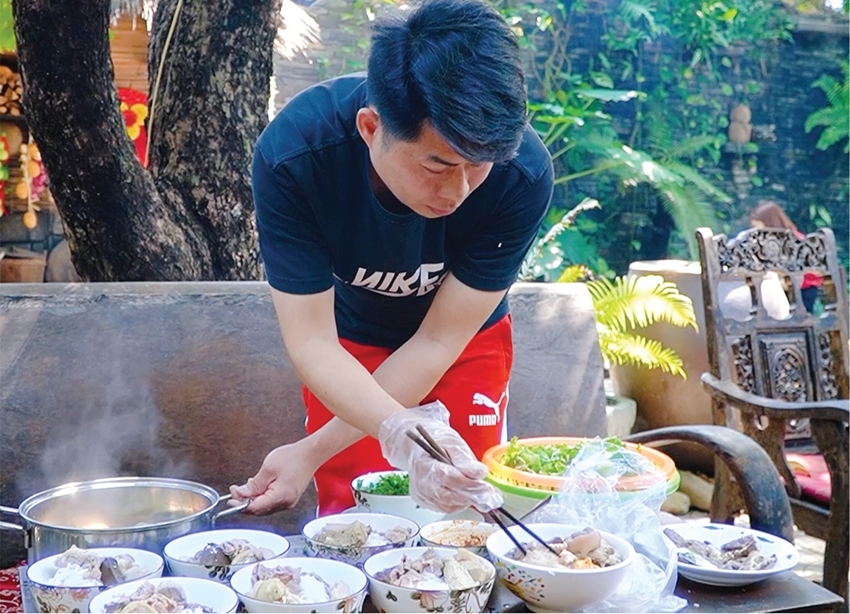
Chef Tang Lanh Kiet from China’s Guangxi Province comes to Hue to learn how to make bun bo Hue
|
At 39, Mr. Tang Lanh Kiet, a Chinese chef, traveled from Guangxi Province to Hue to learn the secrets of making bun bo Hue. He first fell in love with the dish several years ago, when he tasted it for the first time after arriving at Hue Railway Station. The dish won him over when he learned that bun bo Hue was among the Top 100 Asian dishes recognized for their culinary value by the Asian Record Organization.
Mr. Kiet enthusiastically shared: “Bun bo Hue is served with a variety of fresh herbs, while both the beef and noodles are delicious. I want to learn how to prepare it and introduce this dish to people in China. I believe it will be well loved by people in my country, too”.
Many international visitors have fallen in love with Hue through the memorable experiences they have had while exploring its cuisine. They are often surprised to learn that Hue still preserves around 700 traditional dishes, ranging from royal cuisine to local fare. Beyond the famous bun bo Hue, each dish has its own distinctive flavor and tells a story of the history, people, and cultural identity of Hue.
As one of Hue’s cultural symbols, Dong Ba Market offers an array of traditional goods and local specialties. For many international visitors, the market is also a gateway to discovering Hue’s culinary culture. Ms. Son Juyeong, a South Korean national who currently teaches at the University of Foreign Languages, Hue University, described Dong Ba Market as a culinary paradise, with its wide selection of Hue-style cakes, sweet soups, lemongrass pork skewers, grilled pork with rice vermicelli, and other local delicacies. The rich variety of dishes and flavors is a key part of what makes Hue such an appealing destination.
“I’m very fond of Hue cuisine. Once, when I was traveling elsewhere, I still made sure to have a bowl of bun bo Hue before heading to the airport. I also enjoy mussel rice, nam cakes, it cakes, and loc cakes. I think many Koreans would enjoy these dishes as well,” Son Juyeong said.
Whenever he visits Hue, Stanley Lyons, a former teacher from the United States, always makes a point of enjoying Chuon Village’s rabbitfish xeo cakes. He is fascinated by the sight of local women carrying on the generations-old tradition of making xeo cakes. He particularly enjoys the hot, freshly made cakes dipped in fermented shrimp fish sauce, drawn to their simple, rustic flavors that evoke the charm of village life.
Stanley enthusiastically shared: “Xeo cakes are something really special. You go to the fish vendors behind the market and pick out your fish. After paying, you take it to the woman making the cakes. She sits there and cooks eight or ten at a time, and she makes it incredibly fast. She just keeps making cake after cake. Everything happens so quickly, but there’s hardly any fuss. It’s like watching an orchestra performance, almost like they’re playing music. I’ve never seen anything like it anywhere else.”
Beyond its savory specialties, Hue’s vegetarian cuisine offers visitors another way to discover the city. These simple, familiar dishes are made for everyday enjoyment, using mostly plant-based ingredients such as tofu, mushrooms, and an assortment of vegetables… Yet it is Hue’s own culinary traditions and cooking techniques that set these dishes apart. For foreign visitors, choosing vegetarian dishes is not simply about enjoying light and unusual flavors, but also about experiencing Hue’s rich culinary culture.
From a bowl of bun bo Hue and the traditional cakes at Dong Ba Market to the Chuon Village’s rabbitfish xeo cakes, each culinary experience leaves visitors with a lasting memory of Hue. Through its distinctive cuisine, Hue is bringing the city’s culture and people closer to international visitors.