On Hinh Nguyen Vo's Facebook page, I read some sad news: "How sad! An old bodhi tree on Le Duan Street, opposite the communal house of Phu Thanh village, was no longer standing after the storm Noul (No. 5/2020). Now, this ancient bodhi tree is only a memory”. I surfed Facebook and there were many sad news about green trees in Hue after the storm No. 5.
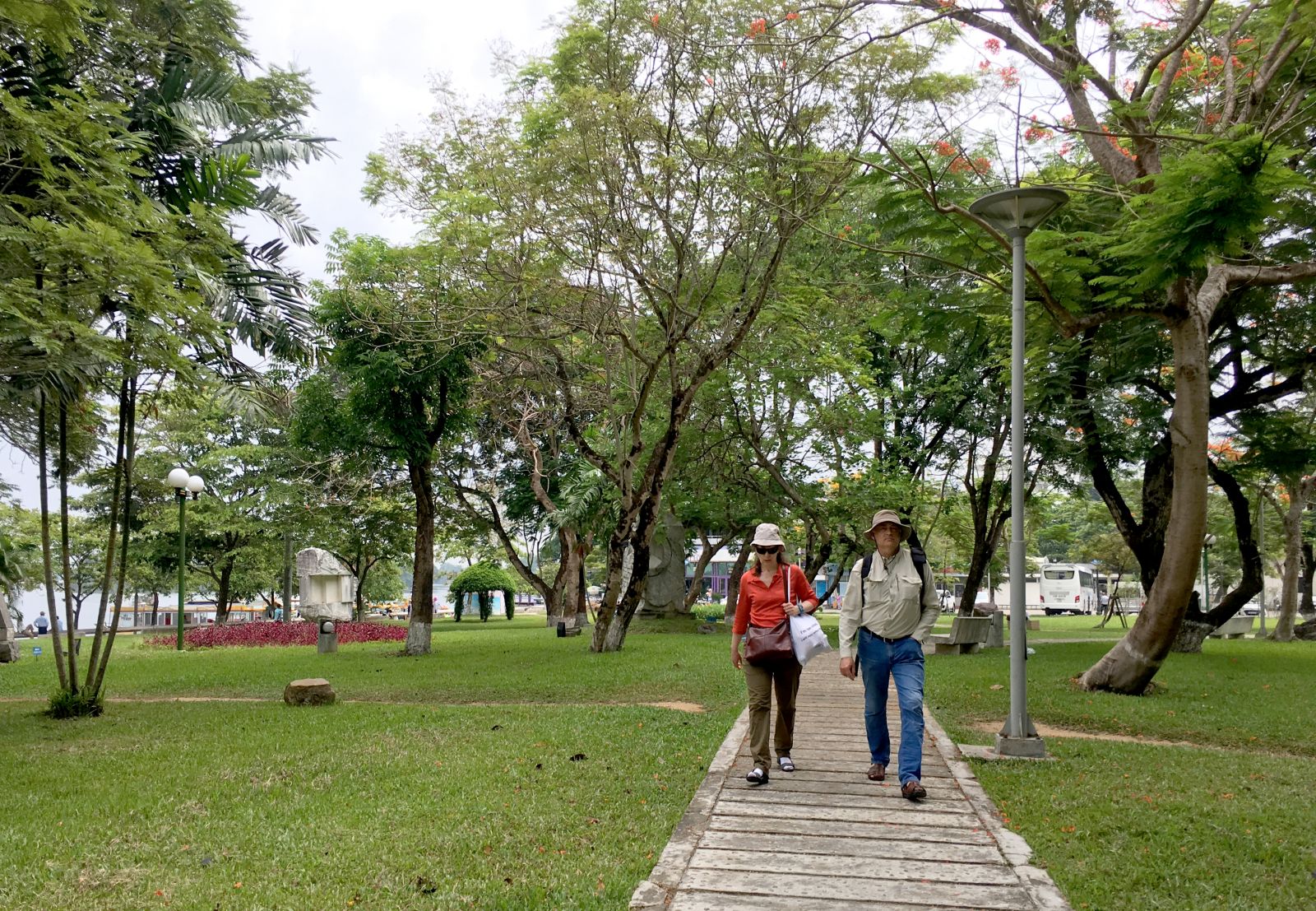
Trees are a kind of "national soul and national spirit" for the people of Hue. Illustrative image: Quang Thieu
I suddenly remembered the late writer Nguyen Tuan. The historic storm No. 8 (storm Cecil) that landed in Hue in 1985 uprooted 3,000 large trees. The people of Hue considered the tragedy caused by this storm to be a "great funeral" of the trees and the late writer Nguyen Tuan, who was very loyal to Hue living at that time in Hanoi, was shocked for a long time.
In an interview with Song Huong Magazine shortly thereafter, he said: “The number of more than three thousand old trees that had fallen in the storm made a strong impression on me. I thought immediately that there must be an action to help the people in Hue ”.
Nguyen Tuan was heavily shocked, and for me and my Facebook friend Hinh Nguyen Vo’s, it was an indescribable sadness. I understand, for Hue people, trees have long been their friends and flesh. Many streets lined with trees have become Hue's unique feature.
In Hue, there are many roads with no sidewalks to plant trees. Instead, the people planted trees in their family garden so that the shade can reach into the street, relieving pedestrians from the harshness of the sun. And, the trees here are not simply planted for shade.
If a family has funeral, Hue people would not forget to tie to the trees around the home mourning cloths. What’s more, Hue also has streets that have been written in poetry and music with their famous trees, such as "the road of flamboyant petals" in a song by the talented musician Trinh Cong Son.
Nam Giao Esplanade is the place where Nguyen kings worshiped the heaven. It was set up in An Ninh village in 1803, under the reign of Emperor Gia Long. In 1806, the esplanade was moved to the south to Truong An ward, Hue city.
The story goes that, when the esplanade was built, an isolated cluster of pine trees were planted to the south of the esplanade, representing Emperor Gia Long. At this space, the royal family members and mandarins of the court each planted a tree.
On each tree hung a bronze or stone card engraved with the planter’s surname, title, and the date, month and year of planting. The mandarins had the duty of taking care of their pine trees. If they die, they must plant another tree.
In 1834, on a Te Giao ceremony, Emperor Minh Mang himself planted 10 pine trees in Trai Cung. The king hung a bronze sign engraved with the card written by the king himself on each tree. Trees have become a kind of "national soul and national spirit" for the people of Hue.
The number of 15,000 trees that had fallen in the storm No. 5 is 5 times more than 35 years ago. Thus, it is a loss that is hard to compensate for, and of course, brings a lot of sadness. It also calls for the people of Hue to act and effectively protect and preserve this invaluable asset against the frequent threats of storms.
By Dan Duy