 |
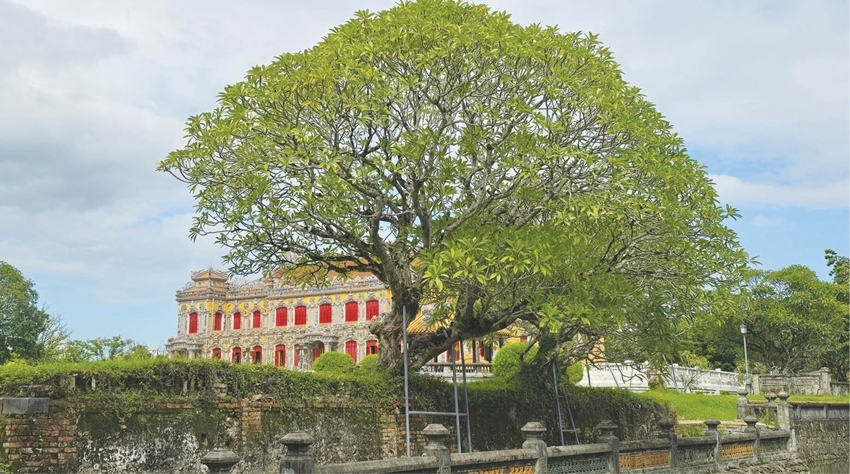
| Ancient frangipani trees in front of Kien Trung Palace are supported by steel columns to prevent them from falling during storms |
The pressure
As the storm season arrives, heritage sites in Hue enter a “state of readiness.” Hundreds of staff members at Hue Monuments Conservation Center are stretched to their limits during this “peak season,” implementing the “4 on-site” principle to ensure the safety of heritage sites, artifacts, and tourists.
This season, Hue Nam Palace (Hon Chen Temple) receives only a few visitors coming to offer incense and enjoy the scenery. Walking along the footpath from the parking lot to the palace, Mr. Tran Cong Thuyet, Head of the Security team at Hue Nam Palace, explains that when floods come, the road to the palace is submerged under more than one meter of fast-flowing water, leaving the palace isolated.
The heritage complex consists of nearly 10 structures located right on the riverbank, with treacherous terrain posing high risks of landslides and subsidence. In particular, the area behind the main Minh Kinh Palace adjoins a sheer cliff face with many large boulders that can easily roll down during heavy rains and floods. In 2023, a landslide occurred here, washing away soil and rocks and affecting the structural integrity of the buildings. While awaiting a long-term solution, conservation forces urgently reinforced the area with cables and steel cages and erected a 10-meter-high steel fence to prevent rocks from falling onto the main palace. To ensure safety, the Hue Monuments Conservation Center also built a storm shelter on the sandbank outside the compound and opened an auxiliary path from the palace to the refuge. The seven-person security team works in two shifts, on duty 24/7, regularly pruning trees, inspecting roof tiles, and preparing generators and supplies to respond to emergency orders. “We're most afraid of landslides during the storm season, so the team is always on standby. Center leaders also frequently calls to check in and remind us about our work,” said Mr. Thuyet.
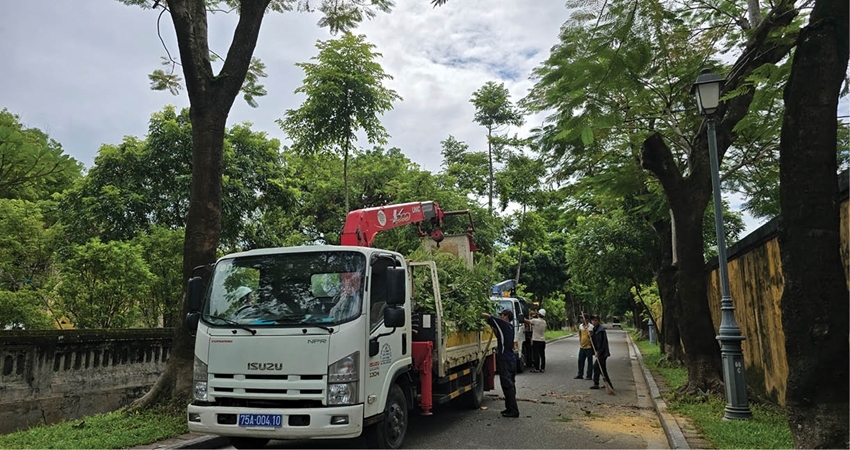 |
| Forces cleaning up greenery after pruning in the Imperial City area |
Hue currently has 43 heritage sites managed by the Center, most of which are monuments within the Complex of Hue Monuments, recognized by UNESCO as a World Cultural Heritage Site, and national heritage sites. These include nearly 500 wooden architectural structures, many buildings hundreds of years old currently undergoing restoration, as well as structures in deteriorated condition that have not yet been repaired, making them highly vulnerable to natural disasters.
Mr. Tran Dinh Than, Head of the Center’s Security Department, said that to date, tall structures such as Hien Lam Cac Pavilion, The Mieu Temple, Phu Van Lau Pavilion, Nghinh Luong Dinh Pavilion, and Ngu Phung Castle have been secured with steel cable systems to ensure safety. Ancient trees at risk of falling at Gia Long Tomb, Tu Duc Tomb, and Minh Mang Tomb have also been pruned and supported by forces from the Landscape and Environment Department.
“Protecting heritage sites is already difficult, but protecting them during the storm season is an even greater challenge,” said Mr. Than. “A single roof tile blown off by strong winds or a broken tree branch not only causes material damage but also results in the loss of the heritage’s original value.”
Developing site-specific plans
As for Mr. Le Cong Son, Deputy Director of Hue Monuments Conservation Center, the Center has developed specific disaster prevention and mitigation plans for each heritage site, closely adhering to the “4 on-site” principle. Beyond protecting structures and deploying standby forces, the Center also has plans to ensure the safety of tourists and staff during natural disasters. In recent years, thanks to thorough and timely preparation, damage to heritage sites has been minimized as much as possible. During Storm No. 10 at the end of September, although Hue was affected, the entire heritage system remained safe.
Work to protect assets and artifacts inside the structures is also prioritized. The Center has plans to ensure the safety of over 11,000 artifacts and antiques currently kept at Hue Royal Antiquities Museum and various heritage sites. In parallel, it coordinates with local authorities to review households living within heritage areas that have not yet been relocated, to have storm response and support plans. More than 20 key heritage sites have forces on duty 24/7, maintaining regular contact with Center leaders and local authorities to respond quickly to any situation. Restoration projects are also required to protect work sites, cover structures, and ensure the safety of workers.
Beyond protecting structures and people, Hue Monuments Conservation Center also sets high standards for post-storm landscape restoration. As soon as the weather stabilizes, specialized forces quickly clean up and make rapid repairs so that heritage sites can reopen to visitors.
“For Hue, every roof tile, every ancient tree bears the mark of history. Protecting them from storms is not just a professional duty but also a responsibility to the nation’s heritage. Keeping heritage sites safe also means preserving Hue’s image as a heritage city and green tourism destination,” shared Mr. Than.