 |
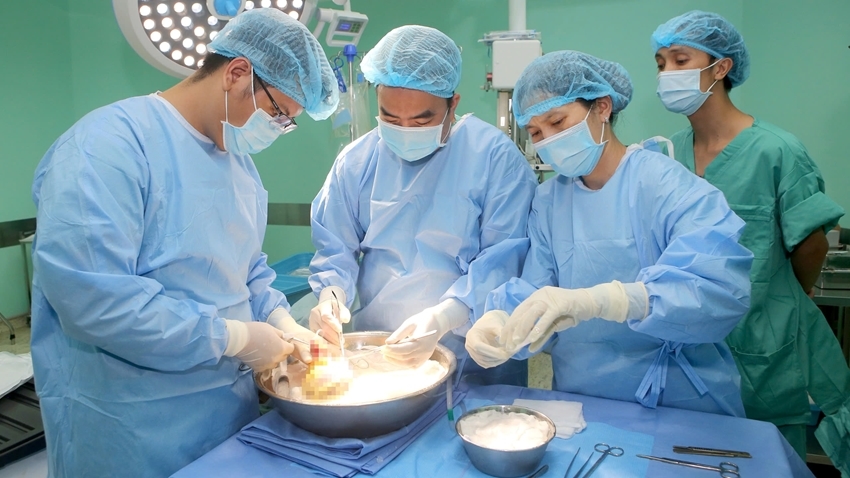
| The surgical team that performed the heart transplant for patient N.T.T.K |
Passing through the “narrow gate”
In early May, a 50-year-old man suffered brain death after a work-related accident. After unsuccessful treatment at Bach Mai Hospital (Hanoi), doctors persuaded his wife and children to donate his organs.
On May 8, following the third confirmation of brain death, the organ retrieval team transported the donated heart, liver, kidneys, and corneas to recipients at Hue Central Hospital, Viet Duc Hospital, Bach Mai Hospital, the National Eye Bank, and Hanoi Eye Hospital No. 2.
“While still alive, I once told my husband that if I were to pass away, I would want my body to help others, and I hoped my family would support that wish. But in the end, he was the one who left first,” the wife tearfully shared about her decision to donate her husband’s organs to help patients on the brink of life and death.
The first challenge arose when there were no convenient flights from Hue to Hanoi. The organ retrieval team had to travel over 100 km by car to Da Nang to catch flight VN7090 at 2:40 PM. Meanwhile, a doctor from Hue Central Hospital stationed in Hanoi was assigned to bring the donor’s blood sample back to Hue for HLA compatibility testing as soon as the flight landed.
Within 30 minutes, the entire heart coordination plan was activated.
There are a total of 29 anti-HLA antibody markers, which indicate the recipient’s immune sensitivity to the donor’s HLA type. This is a crucial part of preparing for any organ transplant, especially kidneys, liver, heart, or lungs. If the crossmatch test returns positive, the transplant cannot proceed.
Dr. Nguyen Duc Dung, Head of the Cardiovascular–Thoracic Surgery Department at Hue Central Hospital, recalled:
“The crossmatch step was incredibly stressful because the patient had blood type AB and many HLA antibodies. The chance of finding a compatible donor was extremely slim, and it felt like passing through a narrow gate. Fortunately, the result was negative!”
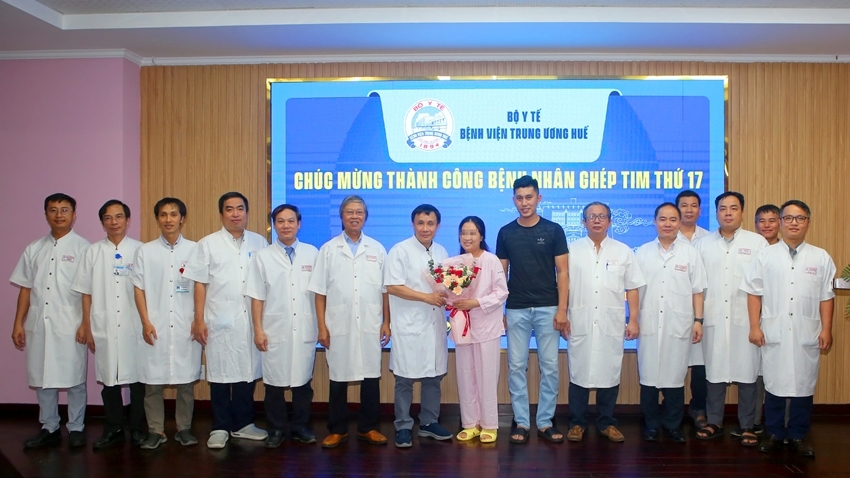 |
| Hospital leaders and doctors congratulate the patient upon discharge |
Just before 6:00 PM, the donated heart was flushed. At 6:15 PM, the heart was removed and stored in a transplant container. Due to rush hour traffic, transportation to the airport was complex. Fortunately, traffic police helped escort the organ and clear the road, so the heart arrived at the airport on time. At 9:00 PM, the heart landed at Hue airport. At 9:30 PM, the transplant surgery began. By 10:22 PM, the heart beat again for the first time.
A “miracle” of human kindness
Patient N.T.T.K. (born 1991), residing in Da Nang, had long suffered from dilated cardiomyopathy and had been waiting for a heart transplant. The 34-year-old woman had been scheduled for a transplant four times, but each attempt failed due to positive HLA crossmatches. On one occasion, she was even on the operating table waiting, but “luck” still did not smile on her. This fifth chance was rare, and this time, the transplant succeeded. After 4 hours and 27 minutes, the heart of a man from the North reignited life in the chest of a stranger from the Central region.
In the days that followed, the patient struggled to be weaned from extracorporeal circulation (ECC). Doctors had to use three heart-support medications along with an intra-aortic balloon pump (IABP) and provide an additional 90 minutes of external circulation after the heart restarted. During the post-op recovery phase, doctors closely monitored her hemodynamics to optimize the transplanted heart’s function. After two days on a ventilator, T.K. was fully conscious and stable. The breathing tube, heart meds, and IABP were gradually reduced and removed as her heart function improved, with an ejection fraction of about 55%.
Not only K., but three other lives across the country were saved, and two others regained vision thanks to the “miracle” born from profound human compassion.
Mr. Tran D.Q., a mechanic and the patient’s husband, shared: “When I heard about the transplant, I was incredibly nervous. My wife, a saleswoman, developed heart disease after giving birth to our second child and had spent long stretches in the hospital. After missing four chances, she remained optimistic and kept waiting. This time, fortune finally smiled on us. Our children can now laugh and play with their mother again, instead of living in silence and sadness as before.”
According to Hue Central Hospital, over 2,500 successful tissue and organ transplants have been carried out to date; including 17 heart transplants (16 of them cross-country) and 3 liver transplants.