 |
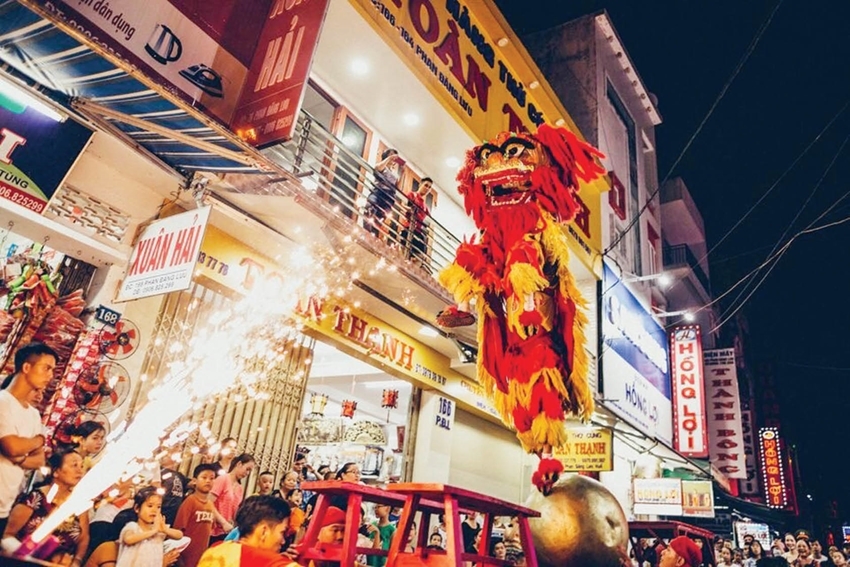
| Thai Nghi Duong Unicorn Dancing Troupe is performing unicorn dancing |
We had an appointment with Mr. Ho Van Thai Son, Head of Thai Nghi Duong Unicorn Dancing Troupe at his house on Phan Dang Luu Street, one of the most ancient and busiest streets in Hue. It is also the shop of the same name Thai Nghi Duong, producing and selling anything that is related to unicorn dancing .
In the 1930s of the last century, Phan Dang Luu was the street where many Chinese Vietnamese lived and did their business. Unicorn dancing originated in China thus became popular in the ancient capital city of the country.
“My father, Ho Van Nghi (i.e., Thai Nghi,) was a martial artist of Thieu lam Bach ho. Though he was Vietnamese, he had special relations with the Chinese Vietnamese in the street. They taught him how to make unicorn heads and unicorn dancing,” said Ho Van Thai Son, a martial artist too, about the founding of Thai Nghi Duong.
Though learning unicorn dancing from the Chinese Vietnamese, when founding Thai Nghi Duong in 1937, Nghi made many crucial alternations to make his unicorn dancing become very Hueish and very Vietnamese.
“The most prominent difference between Hue unicorn dancing and Chinese unicorn dancing, (specifically the Chinese Vietnamese’s in Chợ Lớn (Big Market,) in Ho Chi Minh City) is the rhythm of drums that accompany dancing. The drum sounds of the Chinese are strong and continuous while the drum sounds of Thai Nghi Duong are gentle, up and down, and deep,” said Ho Van Thai Son.
Another difference is the stories. If Chinese stories are mostly about characters in Romance of Three Kingdoms, the stories of Hue unicorn dancing are tales about a heavenly dog which was sent to the earth as a punishment for its wrongdoing, including 7 parts: Than linh xuat dong, Bat bo lien hoa, Phuc lan, Lan linh chi, Lan tranh chau, Lan ly kieu and Lan hoi son.
Another difference comes from the fact that Thai Nghi Duong uses Thieu lam Bach ho, a traditional Vietnamese martial art while the Chinese unicorn dancing emphasizes elements of martial art, and dancers therefore have to move quickly at elevation (usually dancing on iron poles) Thai Nghi Duong, on the other hand, stresses charm and flexibility; especially it pays more attention to making the unicorn lively.
“The unicorn must look real.”
Following his father Ho Van Thai Son is currently head of Thai Nghi Duong and the Chairman of Hue Folk Unicorn Dancing Club with more than 100 experienced martial artists.
In addition to Hue traditional unicorn dances, Son researched and revived many other ancient dances such as Doc chien ngao dau performed on important holidays, Song hy at weddings, Tam Tinh at longevity anniversaries, Tu quy hung long at opening ceremonies, Ngu phuc lam mon at housewarming parties.
As a result, while many traditional arts as well as traditional craft villages are dying, Thai Nghi Duong Unicorn Dancing Troupe keeps developing with year-round shows at events, small and big, not only in Hue but also in neighboring areas such as Quang Nam, Da Nang, Quang Tri, Quang Binh, etc.
With more than 86 years of establishment and development, Thai Nghi Duong today is a brand name in Hue. In the years 2000, 2002, 2004 and many years after Thai Nghi Duong were invited to Asian Unicorn Dance Festival in Okinawa (Japan), then the festivals in China, France, etc., and Thai Nghi Duong has been so far only second to China, which helps creating the reputation for Vietnamese unicorn dancing.
“Every time we brought our unicorn dancing out of Hue, especially abroad, we always keep in our minds my father’s words when he was alive that in order to stay longer with our career, besides maintaining our unique characteristics, the unicorn must look real. And “We should play for people to know what Hue is” has been so far our philosophy as well as our vow on our journey of preserving and promoting the identity of Hue unicorn dancing,” recalled Ho Van Thai Son.
Story: Hoang Van Minh. Photo: Ho Van Thai Son