 |
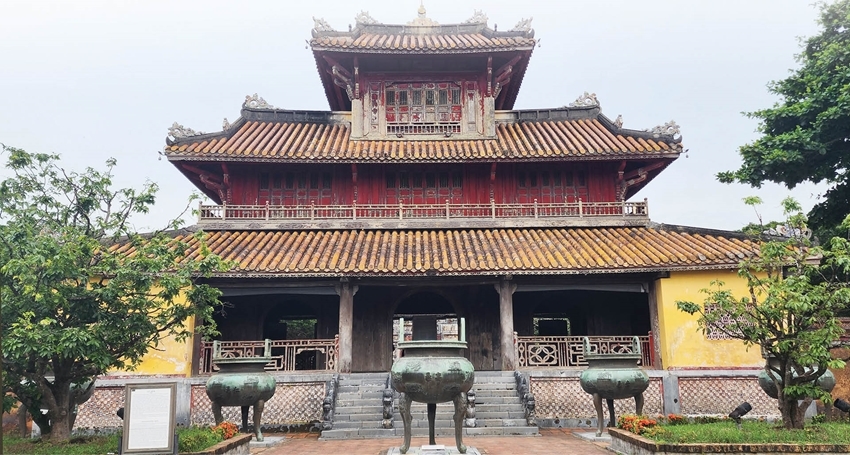
| Three of the nine urns were ordered to be cast by Emperor Minh Mang in 1835 at The To Temple (Hue Imperial Citadel) |
Thus, as of now, "The Engravings on the Nine Dynastic Urns of Hue Imperial Citadel" is Hue's fourth UNESCO-listed documentary heritage, following the Nguyen Dynasty Woodblocks (2009), the Nguyen Dynasty Official Documents (2014), and the Poems and Inscriptions on Hue Royal Architecture (2016).
The nine bronze urns (Cuu Dinh) were ordered for casting by Emperor Minh Mang from 1835-1837 to symbolize the longevity of the dynasty, the beauty and unity of Vietnam's territory. With the exquisite bronze casting skills of Vietnamese artisans, the 162 reliefs with various themes on the urns, and the profound values they encapsulate, the Nine Dynastic Urns have transcended national significance. After nearly 200 years, they remain intact and original. In 2012, the Nine Dynastic Urns were recognized as a National Treasure.
According to Mrs. Le Thi Hong Van, Acting Director of the Department of Cultural Diplomacy and UNESCO, Ministry of Foreign Affairs, and Secretary-General of the Vietnam National Commission for UNESCO, the recognition of "The Engravings on the Nine Dynastic Urns of Hue Imperial Citadel" is a joy not only for Thua Thien Hue but also for all Vietnamese people. This recognition increases Vietnam's total UNESCO honors and heritage titles to 68, surpassing the goals of the "Cultural Diplomacy Strategy to 2030."
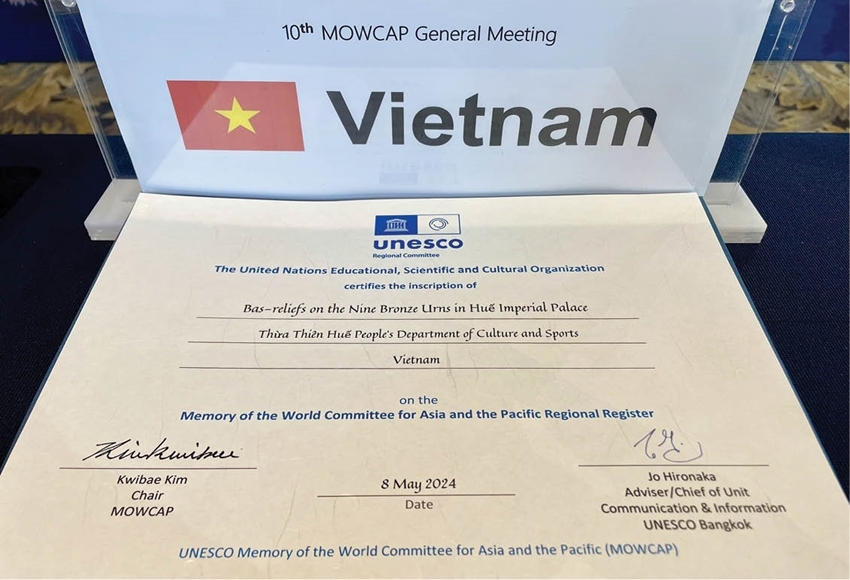 |
| "The Engravings on the Nine Dynastic Urns of Hue Imperial Citadel" is Hue's fourth documentary heritage listed by UNESCO. Photo: HMCC |
"The recognition reflects the trust and acknowledgment from regional and international communities for Vietnam's efforts in preserving and promoting documentary heritage values. The addition of another UNESCO-recognized heritage in Thua Thien Hue will help the locality further engage in and expand exchanges, share preservation experiences, and enhance skills in approaching documentary heritage in the region," said Mrs. Le Thi Hong Van.
Mrs. Le Thi Thu Hien, Director of the Department of Cultural Heritage under the Ministry of Culture, Sports, and Tourism, also noted that this achievement is well-deserved for Vietnam's efforts in preserving cultural heritage values. This recognition will be a new resource for promoting potentials, attracting tourism, and fostering international cooperation, contributing to the sustainable development of Thua Thien Hue.
Present at the conference in Mongolia with the Vietnamese delegation, Deputy Director of Hue Monuments Conservation Center Le Cong Son expressed his happiness: "The event marking 'The Engravings on the Nine Dynastic Urns of Hue Imperial Citadel' as a Documentary Heritage of the Asia-Pacific Memory of the World Program is truly an honor for Thua Thien Hue, having its eighth recognized world heritage. This affirms the importance of Hue's cultural heritage in the province's long-term development strategy. Especially, this will be a significant motivator to soon turn Thua Thien Hue into a centrally governed city based on the preservation and promotion of Hue's heritage and cultural identity."
|
|
| The Memory of the World (or World Documentary Heritage) is one of the types of heritage recognized and honored by UNESCO. Currently, Vietnam has nine recognized world documentary heritages, including three at the global level: Nguyen Dynasty Woodblocks (2009), Doctoral Steles at the Temple of Literature in Hanoi (2010), Nguyen Dynasty Official Documents (2014); and six at the Asia-Pacific regional level: Vinh Nghiem Pagoda Woodblocks – Bac Giang (2012), Poems and Inscriptions on Hue Royal Architecture (2016), Phuc Giang School Woodblocks – Ha Tinh (2016), Hoang Hoa Su Trinh Do (The Vietnamese Envoys' Journeys to China) – Ha Tinh (2018), Han-Nom (Sino-Vietnamese Demotic) Documents of Truong Luu Village (2022), and Ma Nhai Inscriptions of Ngu Hanh Son (2022). |