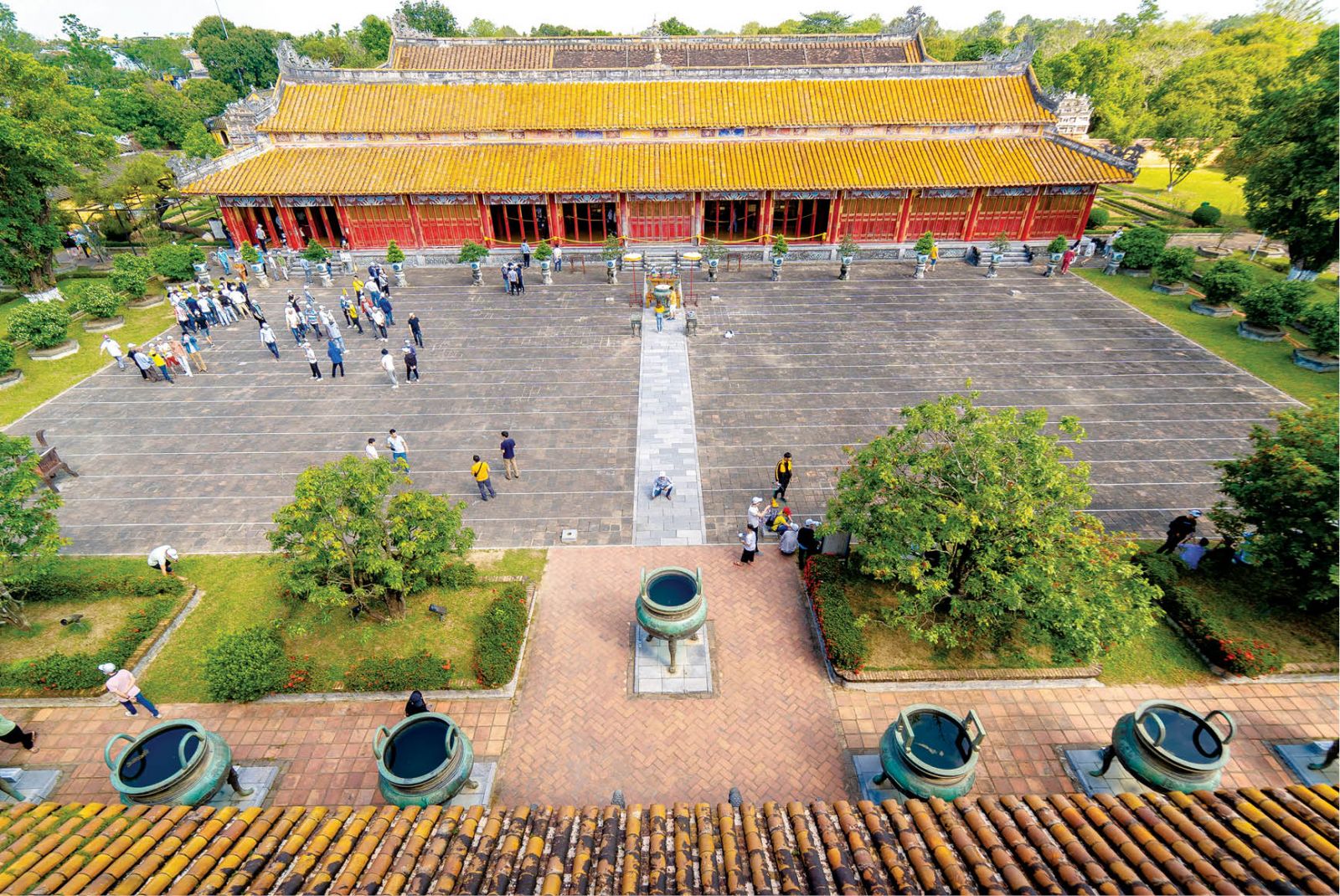
The Nine Dynastic Urns are regarded as an encyclopedia about Vietnam in the early 19th century. Photo: BAO MINH
Authentic and outstanding value
The Nine Dynastic Urns were cast in Emperor Minh Mang’s Era (from October, 1835 to January, 1837). They were placed in front of The Mieu Temple, (where the kings of the Nguyen Dynasty are worshipped,) symbolizing the career of the emperors. As requested by Emperor Minh Mang, they were named after the posthumous names of the emperors. The Nine Dynastic Urns are a sacred treasure which embodies the eternity of the dynasty and demonstrates the power and strength of a unified dynasty.
According to Hue Monuments Conservation Center, the Nine Dynastic Urns are like a picture encyclopedia with 162 delicately embossed patterns. Artisans in Minh Mang’s era portrayed the landscape diversity of the country and typical objects of each region of the country such as stars, mountains, rivers, seas, gates, trees, flowers, animals, weapons, vessels, etc. The patterns on the urns are both royal and folk, familiar with most Vietnamese people.
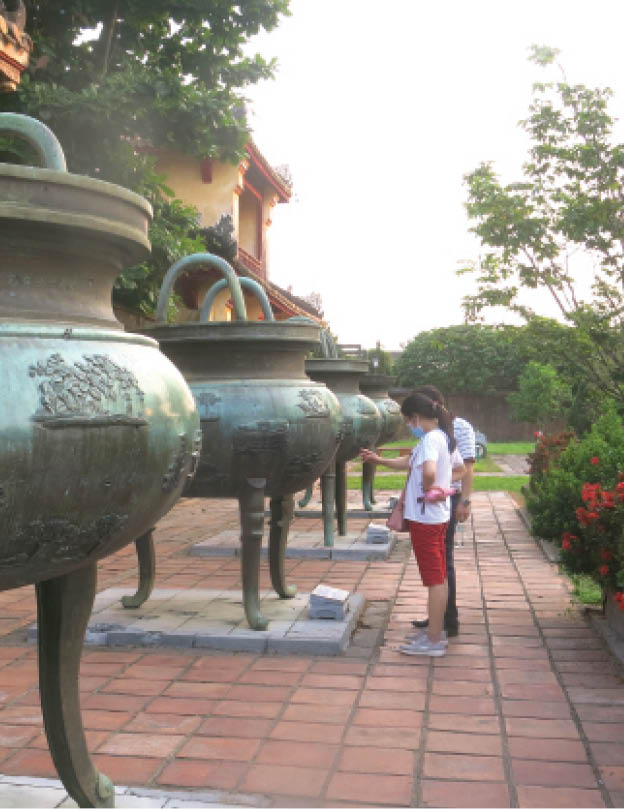
The Nine Dynastic Urns. Photo: MINH HIEN
The Nine Dynastic Urns in Hue are like a geography book of unified Vietnam in the early 19th century. The images of seas and islands embossed on them (the East Sea on Cao Dinh, the South Sea on Nhan Dinh and the West Sea on Chuong Dinh) serve as a valuable document about our sovereignty over Hoang Sa and Truong Sa Archipelagoes. They also show that the kings of the Nguyen Dynasty were all committed to protecting and exercising the sovereignty over the seas and islands of the country.
Despite wars and harsh climate, the nine urns survive intact at their original location and were recognized as National Treasure in 2012. Hue Monuments Conservation Center is presently preparing documents to request UNESCO to recognize them as World Documentary Heritage with a view to affirming their values at the international level, thereby contributing to their preservation and promotion in the future.
Unique in the world
The Nine Dynastic Urns are special heritage and the embossed patterns on them are valuable documents. They are typical artifacts of the art of traditional bronze casting in Hue and Vietnam. They prove not only artisans’ talent, but also the boundless pride of a powerful and wealthy country of Vietnam.
“So far, we have not found any other country which have similar urns. Besides having international significance, the urns almost fully meet the criteria stated in the general guidelines for protection of documentary heritage about time, location, people, form and style,” said Ms. Le Thi An Hoa, Head of Scientific Research Department of Hue Monuments Reservation Centre.
"The Nine Dynastic Urns are unique and irreplaceable. It is a valuable diverse collection of embossed patterns, calligraphy, and fine art works. They are immortal great monuments about Vietnam in the early 19th century. They prove the talent of our ancestry. For those values and significance, Hue Monuments Conservation Center is taking steps to complete documentation to submit to UNESCO so that they will be recognized as World Documentary Heritage,” said Mr. Vo Le Nhat, Director of Hue Monuments Conservation Center.
The Nine Dynastic Urns are really a living museum about Vietnam in the early 19th century and invaluable heritage that the Nguyen Dynasty left for next generations. They deserve to be honored by UNESCO as World Documentary Heritage.
Story: MINH HIEN