 |
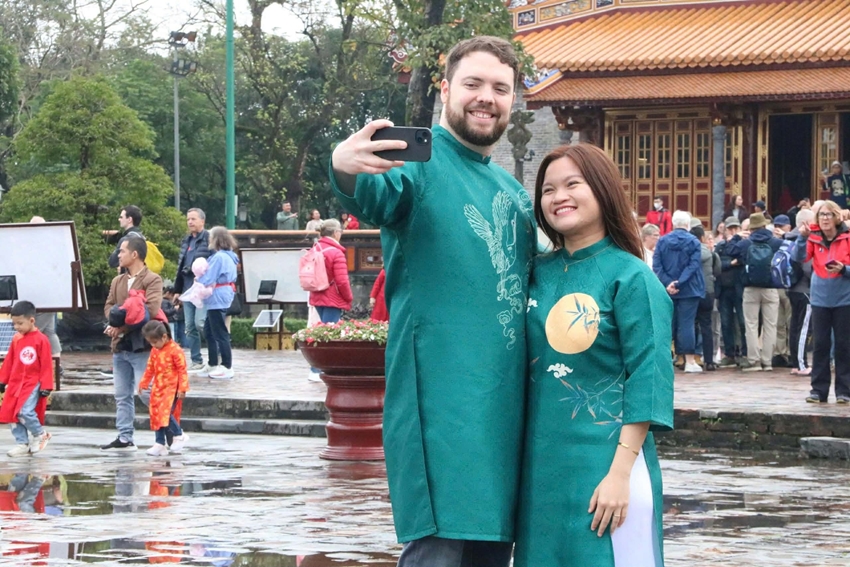
| A German husband and his Vietnamese wife in traditional ao dai. Photo: Minh Tam |
Ao dai - A Keeper of Memory
By the row of traditional costume rental shops outside Hue Imperial Citadel, Ms. Marie stood transfixed by the vibrant hues of Nguyen Dynasty ao-dai and other heritage garments. Her hand brushed each flowing panel, gliding slowly as if they were afraid of disturbing the layers of time woven into the fabric.
Dressing in a yellow ao-dai, Ms. Marie stood quietly before the mirror. The moment was brief, yet long enough for the lively European woman to appear as though she had stepped out of a classical painting. Half in jest, half in earnest, the guide remarked, “You look like a princess from another time”. Ms. Marie laughed, but her eyes lingered on her reflection. Turning to her friends, she said: “We’ve seen these outfits online, but wearing one in person feels entirely different, the beauty, the feeling… everything.”
Not only Ms. Marie, along the path leading into Hue Imperial Citadel, but many visitors also lingered to observe, to listen, and to experience a culture they had previously known only through film. On one occasion, I met Mr. Patrick, a German visitor, walking hand in hand with his Vietnamese wife. Both wore matching green ao-dai. Mr.Patrick kept adjusting the flowing panels of the garment, then laughed at the unfamiliar yet strangely intimate sensation. Through his wife’s translation, he shared: “I came to Hue to glimpse an ancient capital, yet I found so many here still vividly alive. Wearing ao dai, I feel as though I am stepping into a story lovingly preserved by the Vietnamese people”.
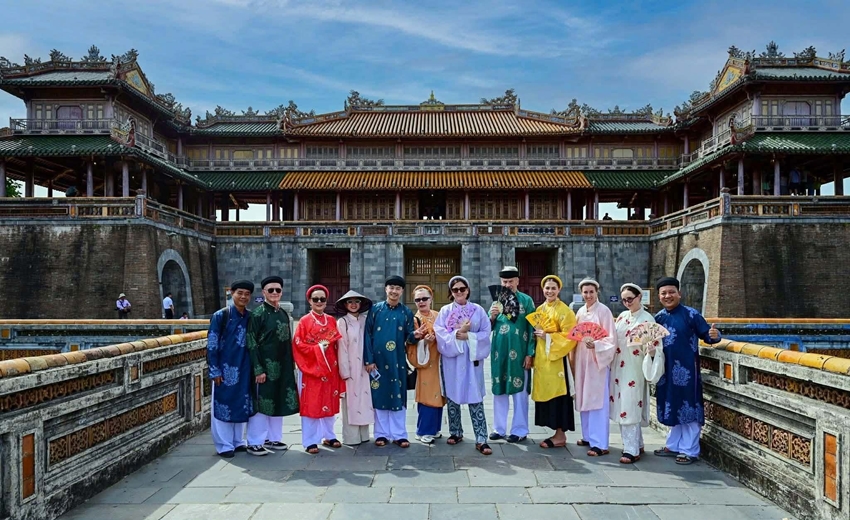 |
| Foreign tourists experiencing dressing in traditional ao-dai. Photo: Hoang Hai |
Patrick had 5 sets of ao-dai in his suitcase, all purchased over 3 trips to Hue.
His wife, Ms. Tuong Vy, said with a smile: “Wherever he travels, he always insists on packing 1 or 2 sets of ao-dai”.
Tracing Steps Back to the Past
During my days on the roads, I met Mr. Lucas, a Dutch photography enthusiast who could spend hours searching for the perfect frame. In Thuy Xuan Incense Village, he sat on the ground, quietly observing an elderly woman’s weathered hands as she shaped each stick of incense. Her movements were slow and gentle, as though she were recounting the story of her craft in a voice soft and husky like drifting agarwood smoke. Though he could not understand every word, Lucas held a bundle of incense with care and closed his eyes to take in its fragrance. “Hue’s incense is like a story you can feel without language”, he said softly.
Trying to roll an incense stick himself for the first time under guidance, Lucas broke it several times. But he laughed it off and said: “It doesn’t have to be perfect. What matters is that I now understand why you preserve this craft. Around the world, the most beautiful things are often the easiest to lose”.
For many Western visitors, Hue captivates them with a rhythm of life that moves slowly and serenely from day to day. In Hue Imperial Capital, they encounter not merely historic monuments, but heritage that continues to live. In one way or another, that vitality reveals itself in the drifting incense smoke of traditional craft villages, in the refined techniques of phap lam artisans, and in the gentle folds of ao-dai gliding through the streets.
Ms. Ly recalled that once, before leaving Hue, a Western visitor told her: “I am not taking home landscapes. I am taking home the feeling that I have lived within a culture with its own rhythm of breath. Amid the pace of modern life, this ancient culture still breathes, still resonates, still awaits those who know how to cherish it.”
Recounted through the tour company director’s story, the visitor’s words brought back vivid images for me: Ms. Marie standing quietly before the mirror in Vietnamese court attire, Mr. Patrick adjusting the flowing panels of his ao dai, Mr. Lucas closing his eyes to breathe in the scent of incense. In such moments, travelers arriving in Hue from distant places suddenly seem close, familiar, as though bound to this land by an unspoken connection.
Perhaps, that’s what makes Hue different!