In attendance were Party Central Committee Member and Chairman of the City People’s Committee Nguyen Khac Toan; Standing Member of the City Party Committee and Permanent Vice Chairman of the City People’s Committee, Head of the Hue Festival Organizing Committee Nguyen Thanh Binh; along with representatives of departments and agencies, artists, poetry lovers, local residents, and visitors.
The program, part of Festival Hue 2026 and the Hue Poetry Festival, added a highlight to the Spring Festival series “Xuan Co do” (Spring in the Ancient Capital), while bringing audiences back to the treasury of court poetry – an exceptional heritage of the Nguyen Dynasty.
The poetic imprint of emperors
The literary legacy of the Nguyen emperors has long been regarded as a distinct current within the flow of Vietnamese literature. Beyond ruling the country, many emperors were prolific authors who left behind vast bodies of work reflecting their governing philosophy, cultural vision, and the mindset of a head of state in times of national change.
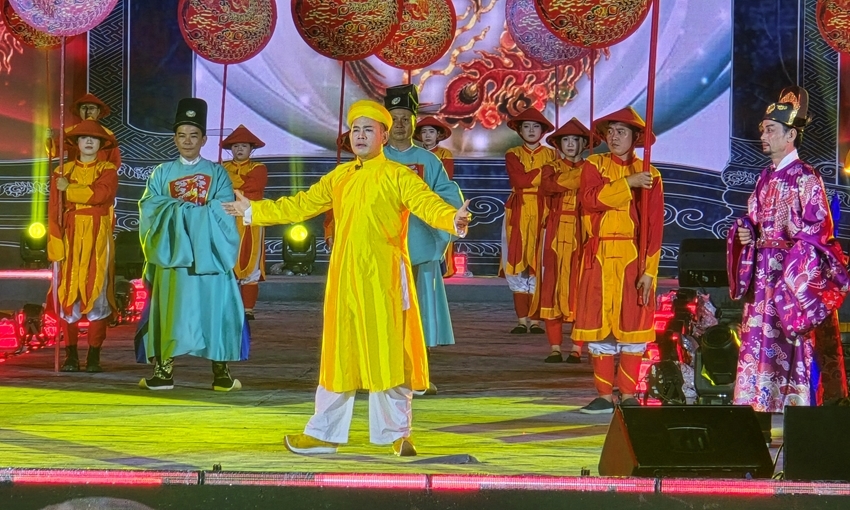 |
| The literary legacy of the Nguyen emperors has long been regarded as a distinct current within the flow of Vietnamese literature |
According to Deputy Director of Hue Monuments Conservation Center, Nguyen Phuoc Hai Trung, during his lifetime Emperor Minh Mang composed around 4,200 imperial poems; Emperor Thieu Tri wrote about 3,700; and Emperor Tu Duc wrote approximately 4,600. Emperors such as Dong Khanh, Thanh Thai, and Khai Dinh also left behind valuable works in classical Chinese.
According to Mr. Trung, for these emperors, poetry was not merely a refined pastime but a medium to express aspirations and reflections on their times. This is the essence of “ngon chi” – to articulate one’s will, ambitions, and responsibility toward the nation.
Inspired by that spirit, “Thi di ngon chi” was staged as a ten-act theatrical epic, recreating a panorama of 19th-century Vietnamese society in the former imperial capital of Hue.
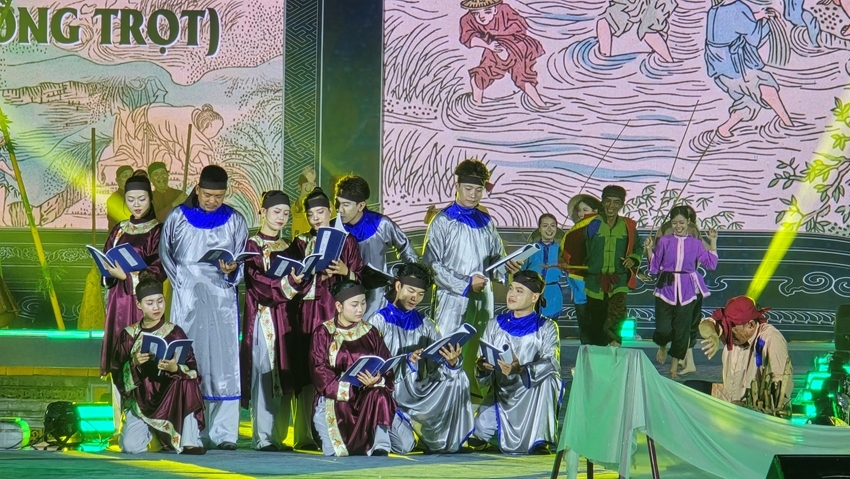 |
| With “Thi di ngon chi,” the imperial poems are strung together into a richly symbolic narrative |
The program opens with the act “Ngu xuan hoa van” (Imperial spring harmony) – a spring poem by Emperor Minh Mang at Thai Hoa Palace, portraying the sovereign’s contemplation of spring’s arrival:
“Mùa xuân đến sớm nơi nào đây
Xuân đến muôn hình vật đổi thay
Nắng sớm theo hoa tươi rực rỡ
Đất trời gieo xuống khí lành thay.”
(Where has spring arrived so early
With spring, all forms of life transform.
Morning sunlight follows blossoms in radiant bloom,
Heaven and earth sow blessings upon the land.)
The spring atmosphere continues in the acts “Le hoi mua xuan” (Spring festival) and “Duyet binh ngay xuan” (Spring military review), recreating the vitality of the royal court and the heroic spirit of safeguarding the nation. In the past, the court held the Ky Dao (military deployment) ceremony to honor guardian deities of the army. There were flag rituals, cannon salutes, deployment orders, and troops practicing swordsmanship, rowing, elephant and horse riding, archery, and firearms. The emperor personally reviewed the formations. During a military review at Nam Dai, Emperor Minh Mang composed:
“Cao xanh khoáng đãng tạnh mây quang,
Ngự đến Nam Đài với kiệu loan
Hùng dũng quân binh hào khí dấy,
Rừng rừng giáo mác sáng loà vang.
Nghiêm minh kỷ luật thuần từ trước,
Huấn luyện bước đi có lớp lang.
Tuy lúc hưng văn, thôi luyện võ,
Phải luôn phòng bị, sẵn muôn hàng.”
(High blue skies cleared of clouds,
The imperial palanquin arrives at Nam Dai.
Valiant troops surge with heroic spirit,
Forests of spears gleam in resounding light.
Strict discipline long upheld,
Training ranks move in ordered steps.
Though we now esteem letters over arms,
We must always be prepared in countless lines.)
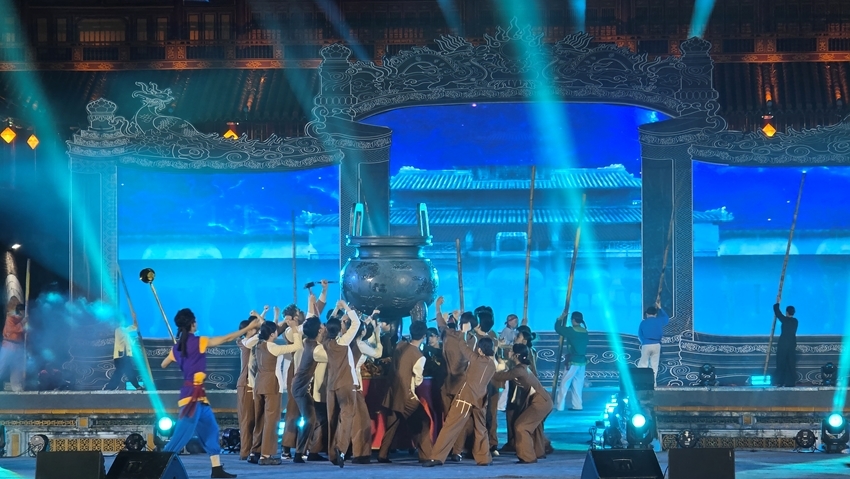 |
| The performances feature a combination of music, dance, acting, and lighting effects |
The acts “Ngay mua han hoan” (Joyful harvest day) and “Phong vi dan sinh” (Flavors of civil life) weave the rhythm of labor into court poetry. Under the Nguyen dynasty, society was divided into eight classes: scholars, farmers, laborers, merchants, fishermen, woodcutters, guards, and herders. In 1845, after a tour of inspection, Emperor Thieu Tri composed poems praising these eight groups:
“Bên song thong thả lần văn sách,
Ngoài cửa ân cần phơi sử kinh.
Nghèo khó đừng nên dang dở học,
Thành công hãy nhớ gắng chăm rèn.”
(By the window, calmly turning pages,
Outside, carefully airing the classics.
In hardship, never abandon your studies;
In success, remember to persevere in self-cultivation.)
In the segments “Ngu gia xuong hoa thi” (Imperial poetic exchanges) and “Kinh do thang canh” (Capital landscapes), the cultural beauty of the ancient capital emerges through its rivers, mountains, temples, and citadels. In “Ngu de danh thang do hoi thi tap,” Emperor Thieu Tri ranked the twenty most beautiful sites of the capital:
“Ôm lấy kinh đô nước uốn dòng,
Thả thuyền ban sớm nhẹ thong dong.
Dòng xuân sóng lặng trùm hơi khói,
Nhịp mái thuyền xuôi phủ gió rung.”
(Encircling the capital, waters curve and flow,
Boats drift lightly in the early dawn.
Spring currents lie calm beneath misty haze,
Oars dip gently, stirred by the breeze.)
The program concludes with “Thai Hoa kien thiet” (Building harmony), “Bao vat muon doi” (Treasures for eternity), and “Rang ro mua xuan” (Radiant spring) – a choral ode to aspirations of prosperity. In the spirit of Nguyen Tieu (the Lantern Festival), Emperor Thanh Thai wrote in 1900:
“Nguyên tiêu trăng sáng, thoảng mùi hoa
Chín chục thiều quang, cảnh mượt mà
Vầng nguyệt tầng không, mây vần vũ
Ba xuân khí tốt, ngập trời xa.”
(Nguyen Tieu night, bright moon, faint scent of flowers,
Ninety days of springtime glow in gentle grace.
The moon soars high amid swirling clouds,
Auspicious spring air fills the distant heavens.)
Bringing heritage closer to the public
In “Thi di ngon chi,” imperial poems are woven into a narrative enriched by music, dance, drama, lighting, smoke, and pyrotechnic effects. Ngo Mon at night becomes both solemn and luminous, transporting audiences back to a golden era of the imperial capital.
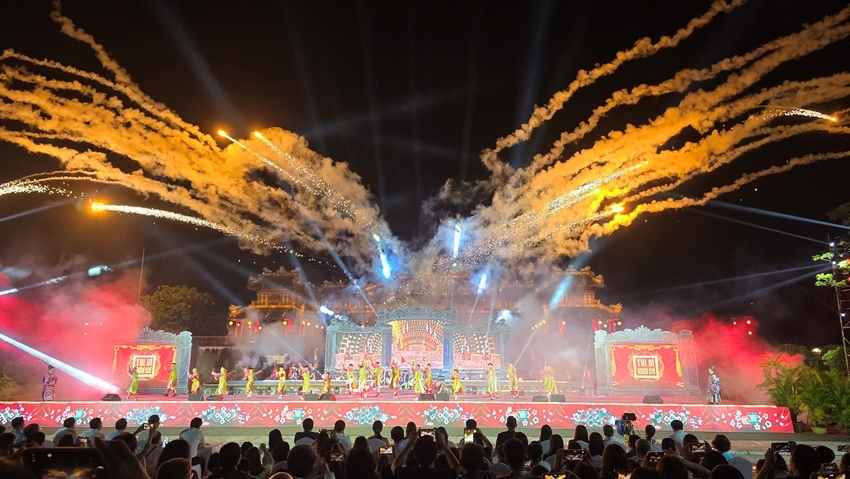 |
| The show brought a wide range of emotions to the audience and the public |
Ms. Tran Mai Anh, a visitor from Hanoi, shared: “I had read the poems of the Nguyen emperors in books, but seeing them staged at the Imperial Citadel was completely different. The poetry was no longer dry words on a page; combined with vivid images, sound, and light, it became splendid and deeply moving, helping audiences better appreciate Hue’s cultural depth.”
By blending preservation with creativity, “Thi di ngon chi” not only honors the value of court poetry but also opens a new artistic way of narrating history through contemporary performance. Through each act, spring appears in festivals, military strategy, labor, and construction: from solemn court rituals to simple daily life, from sacred rivers and mountains to the aspiration of nation-building.
According to the organizers, staging imperial poetry represents a new approach to heritage preservation and promotion. Rather than limiting it to exhibitions and academic research, the heritage is retold through contemporary artistic language, making it more accessible, especially to younger generations.