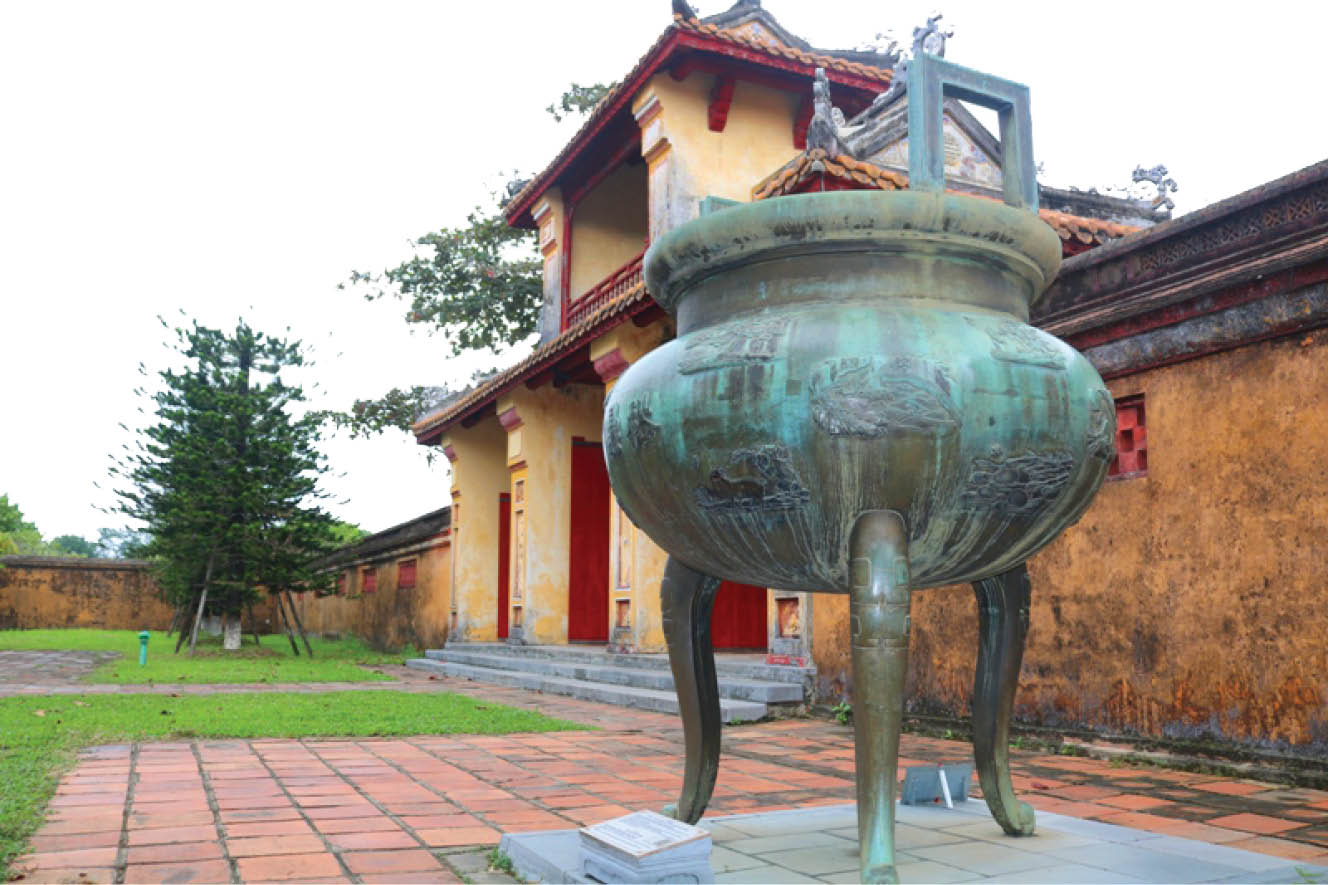
Du Dinh (Du Urn) on which the pine tree was embossed
Growing pine trees _ a good custom
Pine growing was started in the fifth year of Gia Long’s era (1806) when Nam Giao Esplanade was built. But the value of this custom was not the fact that the first emperor of the Nguyen Dynasty did grow pine trees from a very early time at the sacred esplanade of Nam Giao, but that the successive kings made it a good custom.
When writing about the pine forest in Nam Giao, Léopold Cadière, editor-in-chief of Bulletin des Amis du Vieux Hué, noted the pine trees grown at Trai Cung, where the emperors purified themselves before ceremonies, but not the ones outside.
Every time a pine tree was grown, the king himself tied a bronze plate with the date on it. Afterwards mandarins from the fourth rank and above, and those from other provinces coming for Nam Giao Festival all planted pine trees there.
What urged emperor Minh Mang to do so? It was Léopold Cadière who asked the question, then answered himself. Growing pine trees by themselves, emperor Minh Mang and his mandarins signified the conservation of the forest. Pine growing became a duty and emperor Minh Mang could ensure himself about the existence and development of the pine forest at Nam Giao. Every mandarin took it an honor to plant a pine tree at that sacred place with his name on it.
This custom looked trivial, but it showed king Minh Mang’s interest, and his way of protecting the pine trees would become precious directions for agricultural and forestry offices.
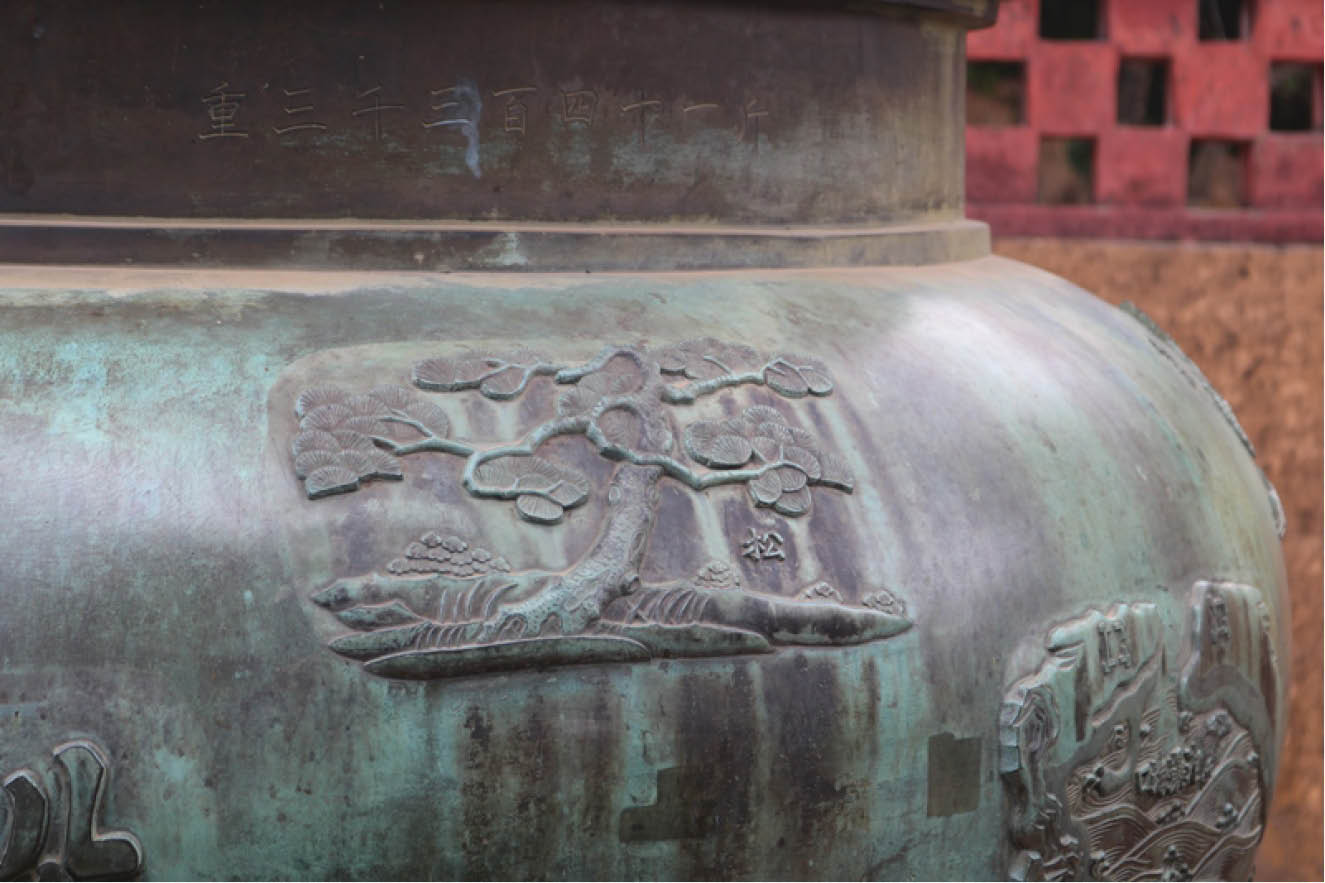
The pine tree on the Nine Dynastic Urns
In the Nguyen Kings’ era, besides Nam Giao Esplanade, pine trees were also grown at other sacred places such as Ngu Binh Mount, mausoleums, communal houses, temples and pagodas. The habit of attaching a bronze plate on the tree that people grew was started in Minh Mang’s era (1834.)
Through the time, there had been some changes in size and weight of the plate. Besides bronze plates, stone ones were also used with the same function.
Many tourists to The To Temple (Temple of Generations) spend time watching the 200-year-old pine tree. It is said that it was emperor Minh Mang who planted the tree when the temple was built to worship emperor Gia Long and the Queen, which is now worshipping the kings of the Nguyen Dynasty. The old pine tree is among the few witnesses of the changes of the history.
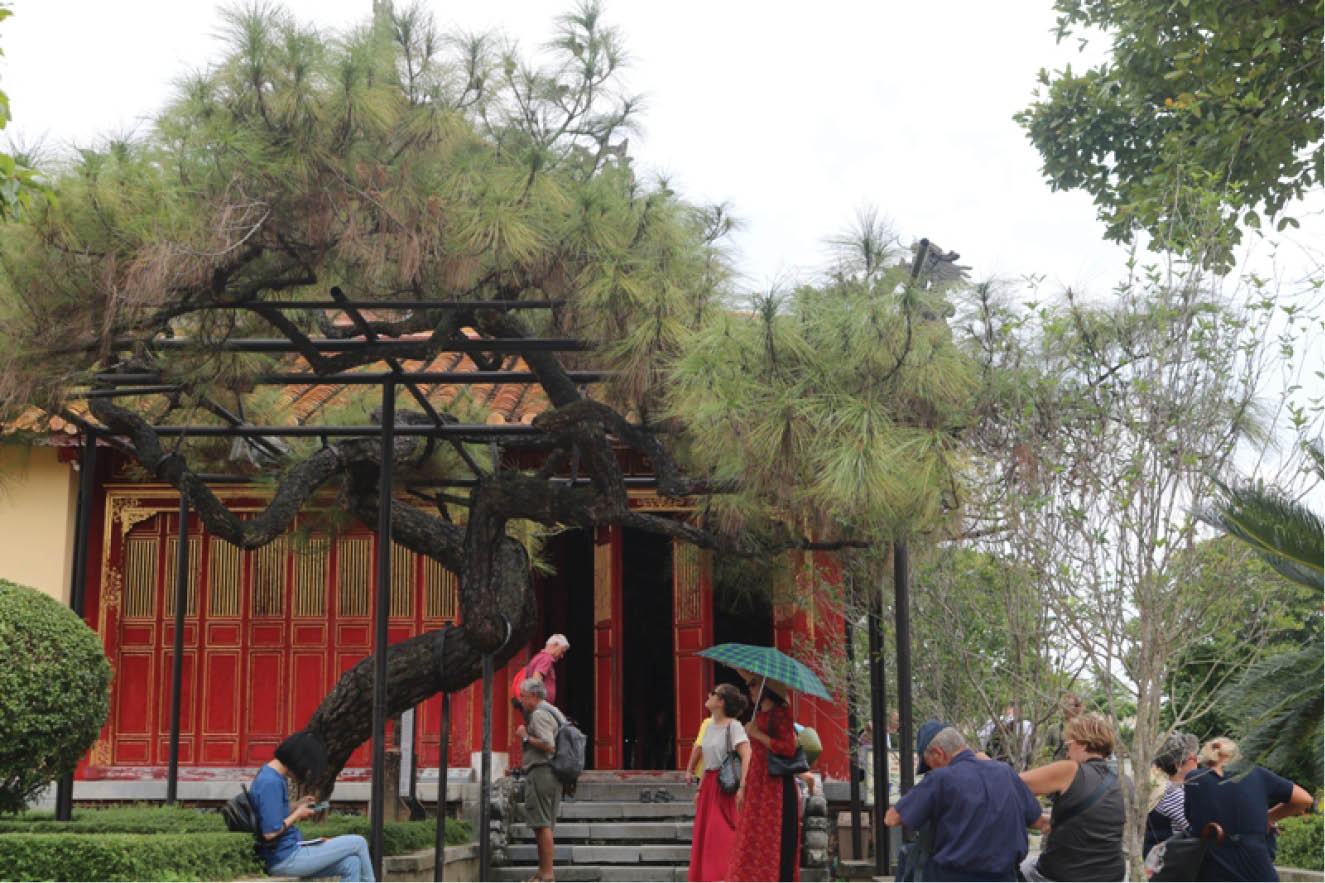
The old pine tree at The To Temple in the Imperial City
Sacredness and Hue spirit
With a special interest in tree growing, the Nguyen kings made many institutions about planting, protecting and taking care of trees. It became a regular demand and a nice behavior. However, the climate change and the urbanization risk decrease the number of trees and the amount of green space in Hue.
What the city should do now is continuing the tradition of protecting and developing green zones. They make the former capital city look ancient but still in harmony with a typical heritage city which is green, clean and modern.
According to Dr. Tran Dinh Hang, head of Vietnam National Institute of Culture and Arts in Hue, it is necessary to grow pine trees and firs on the hills and mountains that the Nguyen Dynasty considered important such as Ngu Binh Mount and Long Tho Hill.
“Since the Nguyen’s era, Long Tho Hill, Thien Mu Pagoda, Hon Chen Temple, Vong Canh Hill, etc. have been considered sacred spots in Hue. Traditionally, they formed the feng shui axis that connected heaven and earth, and it was the tree and stone that supplemented the sacredness and increased the ability to receive the energy from heaven and earth, and the pine tree symbolized the sacredness. Hue must keep that axis. Pine forests will maintain the sacredness and prosperity for this land,” said Dr. Tran Dinh Hang.
Le Quang Thai has another perspective on the verse “Pine trees are grown in Van Thanh; terminalia catappa, in Vo Thanh, / If one looks at Xa Tac Esplanade, one will see two rows of poon trees” in his book ‘Hue, New Stories from Old Legends’.
According to Le Quang Thai, the line “Pine trees are grown in Van Thanh,” is just symbolic about the awareness of a standard and profound education in the Nguyen’s era. In their over-400-year reign, the Nguyen lords and Nguyen kings built National school, the premise for the National University in Phu Xuan providing knowledge and training personality for the people.
Among hundreds of trees, pine trees are considered precious and noble. Old pine trunks are used to make frames for houses, symbolizing foundation and talented people of the country. Tree growing as well as human education are policies of every family and country.
Prof. Dr. Tran Huu Dang had the same idea when he cited: “Pine trees are grown in Van Thanh, terminalia catappa, in Vo Thanh,...” “Hue must bring pine trees back to Van Thanh, Thien An, Ngu Binh, etc., and to life. Besides beautifying the landscape, pine trees symbolize the Hue style and way of life recalling the culture of Phu Xuan,” said he.
Story and photos: Dong Van