 |
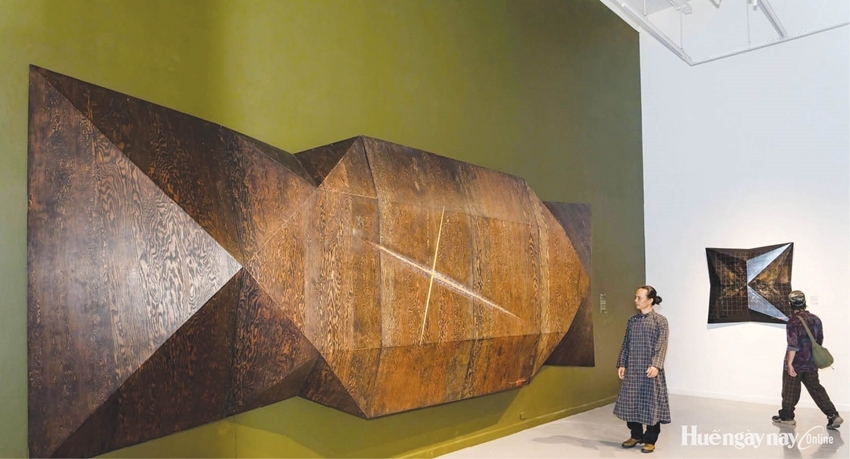
| It is the folds of paper airplanes and boats He incorporates into his art that have become a conversation |
From Childhood Memories
Although He has established a name for himself through his artistic journey, this marks his first solo exhibition, featuring over 20 lacquer works inspired by the childhood art of paper folding and offering a different perspective on post-war memories.
Growing up in Hoa My War Zone in Phong Dien, Mr. He was deeply affected by the scars left by war. The sound of bombs left behind from the war became a source of fear that stayed with him throughout his childhood. Those memories have remained with him ever since, continuing to shape his artistic journey even years later.
“Those folds quietly found their way into my subconscious and became my language,” Mr. He said. They have driven the artist to tell the story of how a child grew up amid the remnants of war and use his imagination to transform them into a space of hope and healing.
The folds of paper airplanes and boats in Mr. He’s art become a conversation between brutality and innocence. He uses plywood salvaged from former field bases and boards from ammunition crates as materials, combining them with lacquer and layering the surfaces to create a sense of depth, allowing light and time to unfold across his paintings.
According to Mr. He, it took several months, sometimes up to half a year, to complete a work.
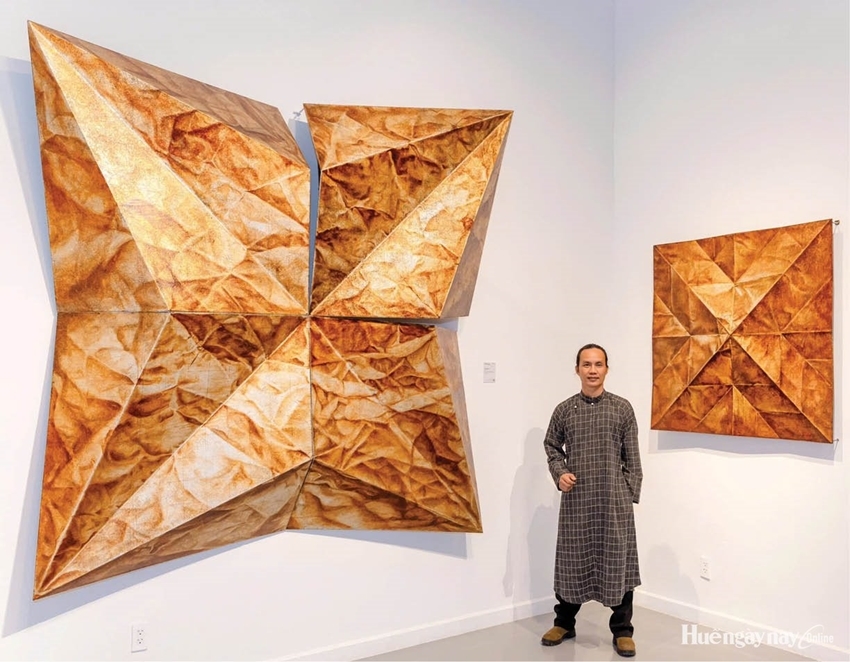 |
| Artist Nguyen Van He by the works created from his memories |
Making Conversations with Works
Initially, Mr. He used a wide range of colors, including brown, green, red, and yellow, along with traces of wood, rust, fire, and lacquer, to recreate a relatively specific space of memory. Over time, however, he realized that what he was seeking was not to depict memories, but to reach the essence of memory itself.
“I began by stripping back the colors, simplifying the forms and retaining only what was truly essential. Empty spaces, folds, light, lacquered surfaces, and the natural texture of wood became the primary elements of my visual language. I want viewers not merely to see a paper airplane, but to sense the space, the silence, and the memories it carries,” the artist shared.
The streaks of light cutting through the surface of the works are not cracks left by war, but rays of hope. They suggest the possibility of healing, where art does not erase the past but transforms memory into light, allowing people to look toward the future.
“Beyond literally seeing just war or childhood, I hope my viewers feel the human capacity for renewal. Even after experiencing loss, we can still find a way to rearrange and rebuild our lives,” Mr. He shared.
At the age of 45, Mr. Nguyen Van He, a graduate of the University of Arts, Hue University, has established himself as a contemporary artist and is the founder of Nguyen Van He’s Art Barracks on Kim Son Hill, in Thuy Xuan Ward, Hue City. The space serves both as his studio and as a home for his family.
Art expert Ace Le said: “Through years of experimentation, Mr. Nguyen Van He’s works embody a relentless pursuit of form, evolving from realistic depictions of military hardware, through the abstraction of childhood paper-folding games, and eventually arriving at minimalist, monochromatic geometric shapes.”