 |
| Passing down the Co Tu People’s traditional wood carving skills |
In A Xang Village, formerly part of Thuong Long and now in Long Quang Commune, Hue City, the carvings on the main pillar of the Guol communal house showcase the distinctive features of traditional Co Tu art. The Guol communal house in A Xang has become a model of traditional Guol architecture in Co Tu communities across Hue City.
For the Co Tu people, wood carving goes beyond home decoration. The motifs carved onto wooden structures express their thoughts, worldview, and mindsets on the familiar aspects of daily life. Common images include people, birds, and animals, scenes of everyday activities, hunting, dancing, singing, geometric patterns, as well as the sun and the moon…. Each motif takes on a distinctive form, reflecting the skills and creativity of the artisan.
According to artisan Bling Bhiet from A Prung Village (Long Quang Commune), the construction of ceremonial pillars, main pillars, and other structural components of a Guol communal house is subject to specific requirements. Those entrusted with the construction must be skilled craftsmen, knowledgeable about local customs, and trusted by the community.
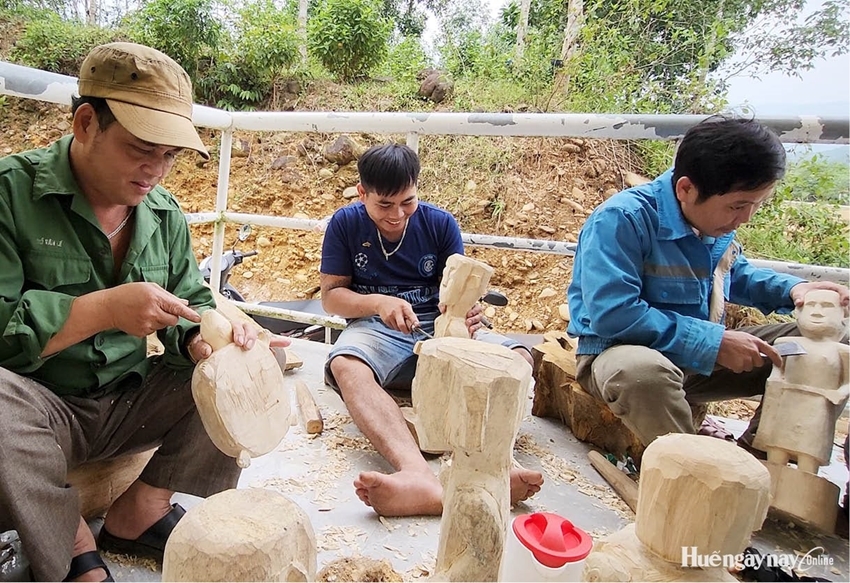
Each restoration of a Guol communal house provides a natural opportunity to pass down traditional craftsmanship. Younger craftsmen work alongside their elders, learning how to select wood, carve pillars, and create decorative patterns. Every completed project adds depth to their experience, enabling them to take on new commissions in other places.
Having participated in the construction and carving work at the Guol communal houses in A Xang and A Ka villages - both in the same commune, artisan A Ret Hinh, from A Chieu Village (Long Quang Commune), is one of the renowned and experienced craftsmen in Long Quang Commune shared: “I first learned the craft from my father-in-law, then continued learning from other skilled craftsmen in the village and commune. From building Guol communal houses to carving decorative patterns and sculpting statues, I have gained experience through many years of practice.”
As life in mountainous areas undergoes changes, the space for traditional sculptural art has gradually diminished. Many residential houses and communal buildings are now constructed using modern materials. Recognizing this trend, the cultural sector of the former Nam Dong District held a number of creative workshops and training courses in Co Tu folk sculpture in previous years.
Over the past five years, the cultural sector of the former Nam Dong District, together with the newly established Long Quang and Nam Dong communes, has organized four traditional sculpture training courses, attracting over 70 artisans, village elders, and residents. In addition to wood carving techniques, participants have been taught how to create decorative patterns and understand the cultural significance of each motif.
Mr. Le Nhu Suu, former Head of Nam Dong District Culture Office and now Vice Chairman of Khe Tre Commune People’s Committee, said: “The training courses in traditional Co Tu folk wood carving contribute to preserving valuable cultural heritage while creating opportunities for younger generations to carry it on, nurture their talents, and uphold their pride in the community.”
These training courses have helped many young artisans in Long Quang, Nam Dong, and Khe Tre communes gradually develop their skills and make a name for themselves in this craft, including Bling Ve, Ating Quy, and Ating Muoi… In the former Thuong Long area, now part of Long Quang Commune, 60 artisans and skilled craftsmen working in traditional Co Tu architecture and sculpture have taken part in passing down or learning these crafts through such programs. These efforts have also led to the restoration of many Guol communal houses, helping preserve the cultural identity of the Co Tu people.