 |
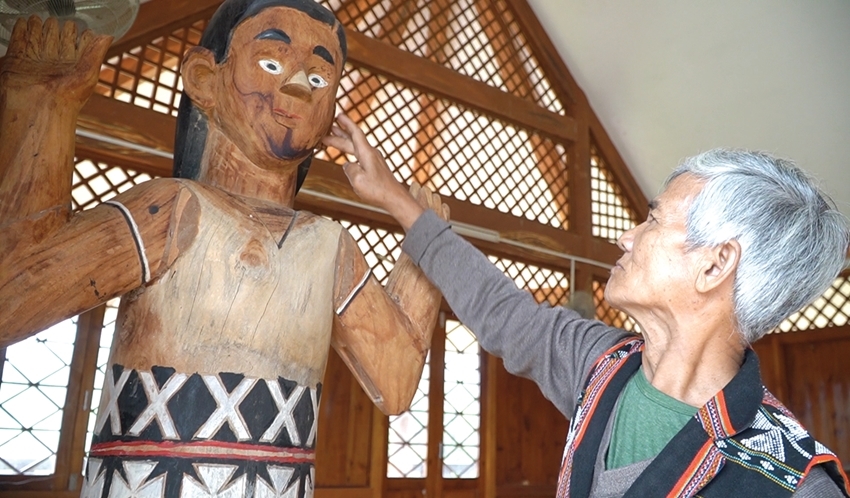
| Village elder Ra Pat Trinh with his carvings at the Roong house of Ka Vin village, A Luoi 4 Commune, Hue City. |
A lifelong passion for Ta Oi art
Born and raised during the war years, Ra Pat Trinh inherited the traditional cultural values that earlier generations had painstakingly nurtured. He proudly recalls: “Since I was a child, I watched my ‘a vo’ (grandfather) and my ‘a am’ (father) build stilt houses and Roong houses, and watched the other elders of Ka Vin village carve every line and pattern. Every house, once finished, carried marks that belonged to us, the Ta Oi people. That is why I have never forgotten.”
When peace returned to the mountains and forests of A Luoi, Ka Vin villagers built a new Roong house. Ra Pat Trinh worked day and night, contributing his labor and skill to bring patterns and lines rich in Ta Oi identity into every wooden pillar and wall panel. Since then, Ra Pat Trinh has guided and trained many young people in the village and commune, who have gradually learned how to build a Roong house and the art of shaping each wooden detail.
As a young man, Ra Pat Quynh Rai, now the village elder of Chi Lanh village, A Luoi 4 Commune, helped build and carve the Roong house at Ka Vin village. He recalls: “Back then, working on the Roong house, we learned from Uncle Trinh how to choose timber, how to carve, how to raise the pillars and assemble the parts of the house. We regarded Uncle Trinh as our teacher.”
Village elder Ra Pat Trinh also preserves many traditional rituals and cultural festivals of his people. Recently, the people of Pa-Rit – Ka Vin hamlet held a ceremony to re-enter the repaired Roong house. Elder Ra Pat Trinh was entrusted with leading related rituals, including cleansing, driving away evil and welcoming good fortune; praying to the spirits (giang) to protect the Roong house and the villagers; and the rituals of welcoming guests and lighting the fire in the new hearth.
A Viet Chung of Ka Vin village, A Luoi 4 Commune, who helped organize the revived Roong house ceremony, says enthusiastically: “Whenever there is an important matter, the villagers always want to hear the advice and guidance of elder Ra Pat Trinh, because he knows so much. Thanks to him, young people like us gain the understanding we need to preserve the traditional culture of our people.”
Beyond preserving traditional culture, elder Ra Pat Trinh also actively encourages people to follow the guidelines of the Party and the policies and laws of the State, and to build a new cultural life. Drawing on his prestige, he has persistently urged the people of Pa-Rit, Ka Vin, A Dot, Chi Lanh, A Roh and other villages to stay united and to abandon customs that are no longer appropriate.
In his view, if the elder wants the people to follow, he must first set an example. So at weddings, funerals and clan activities, he and his family always follow the new way of life. His family and the Ra Pat clan have since become a shining example for people in the area to learn from.
Le Thi Quynh Tuong, Standing Deputy Secretary of the A Luoi 4 Commune Party Committee, remarks: “Uncle Trinh has always enjoyed the trust of the people. In preserving the traditional culture of the Ta Oi people, he takes the lead; in eliminating outdated customs and building a new cultural life, he is also a role model. The cultural preservation programs, activities and projects the commune has carried out in recent years have all had Uncle Trinh’s contribution, helping them achieve practical results.”
Passing on the flame
In past years, the former A Luoi District regularly organized training courses in folk songs, folk music and folk dance for ethnic minority people in its communes. Village elder Ra Pat Trinh was one of the artisans and elders who took part. Undeterred by long distances, sun or rain, he travelled to many Ta Oi villages to teach young people and teenagers folk songs, dances and how to play traditional instruments, with all passion and sense of responsibility. Under his guidance, they mastered almost all of the traditional dances, folk songs and melodies of the Ta Oi people. On that foundation, the former A Dot Commune, later Lam Dot Commune and now A Luoi 4 Commune, has built a large, enthusiastic troupe of young amateur performers.
Blup Thi Huong, a member of the A Luoi 4 Commune amateur performing troupe, shares: “I joined the troupe when I was still a student at Truong Son Secondary and High School. Now I have graduated and work in another field, but I still make time for the cultural and artistic activities of the troupe and the commune. It is not only something I love, but also a sense of pride and of responsibility to keep preserving these beautiful cultural and artistic traditions for those who come after us.”
Folk culture researcher and Meritorious Artisan Ta Dul Tu (Ho Thi Tu), former Deputy Head of the Culture and Information Office of the former A Luoi District, shares: “Whenever the office organized activities to preserve tangible and intangible culture in Ta Oi villages, having village elder Ra Pat Trinh involved gave us great peace of mind. He was an important pillar for the success of these activities.”
Now in his eighties, village elder Ra Pat Trinh remains deeply devoted to preserving his people’s culture. From the flame he passed on, generations of Ta Oi people in A Luoi are continuing to preserve and enrich the cultural identity of their community.