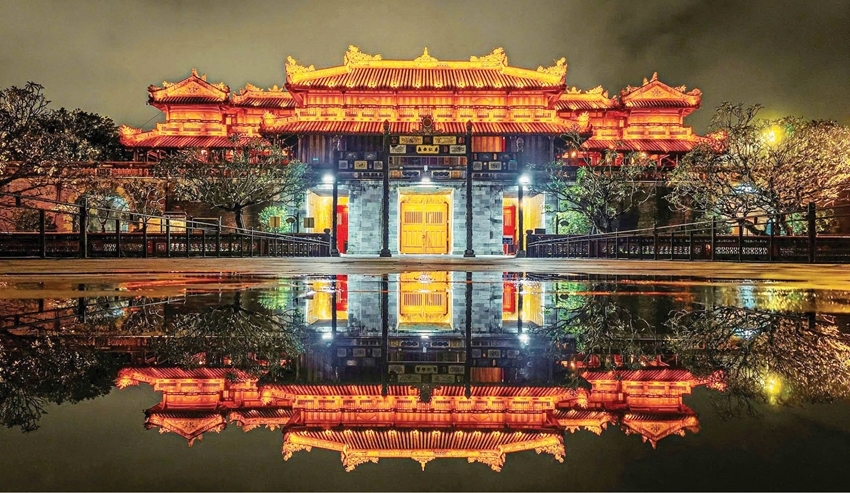
 |
| The program “Enchanting Imperial Palace” is expected to attract visitors. Photo: Hue Monuments Conservation Centre |
Night-time economy within heritage
From April 25 to 28, at 8:00 PM each evening, the Citadel will open free of charge to welcome residents and tourists to the program. This is considered a highlight of the Summer Festival “Shining Citadel”, helping to refresh a familiar heritage space through a more experiential approach.
Starting from the Ngo Mon Gate, the program opens with a guard-changing ceremony combined with cannon-firing effects. From there, visitors embark on a carefully staged visual journey. At Trung Dao Bridge, there will be a 3D mapping performance. At Thai Hoa Palace courtyard, a royal court ceremony is reenacted on stage, recreating the solemn atmosphere of the Nguyen Dynasty. To the east of Thai Hoa Palace, visitors can watch a ceremonial military banner ritual followed by martial drills enhanced with fire effects. To the west lies the “Imperial Market” space, where visitors can experience handicrafts, cuisine, and interactive activities.
The program also expands into other experiential areas such as royal games (xăm hường dice games, pitch-pot, calligraphy requests), Hue ao dai performances combined with Hanbok, a virtual reality experience titled “Searching for the lost Imperial Palace,” and the “Imperial Archaeology” space. Together, these create a multi-sensory journey where each step reveals a cultural snapshot.
According to Mr. Le Cong Son, Deputy Director of Hue Monuments Conservation Centre, the program is not just an artistic event but also a concrete step toward developing the city’s night-time economy. It is part of a series of activities running from April 24 to May 2, with synchronized services and experiences inside the Citadel, including free night access (with limited areas) to allow more people to engage with the heritage.
Meanwhile, the Phu Noi Vu area is designated as a highlight for cuisine and services. From 5:30 PM daily, it offers imperial-style dishes in various formats: buffet on peak days (April 26, 28, 30 and May 2), and set menus or à la carte on other days. Dozens of stalls from businesses, craft villages, and artisans are also set up near western Thai Hoa Palace, offering souvenirs, handicrafts, gemstones, pearls, and more, enriching the visitor experience. “We hope these activities will connect into an ecosystem that both serves visitors and creates livelihoods for residents, businesses, and artisans,” Mr. Son shared.
In fact, developing a night-time economy in heritage areas is not new. Previously, the “Imperial Night” program was implemented, but did not achieve the expected results due to limited interaction and experience.
“Learning from those lessons, this return is designed with an integrated approach: art – experience – services – commerce. Activities are no longer scattered but arranged along a logical visitor route,” Mr. Son explained.
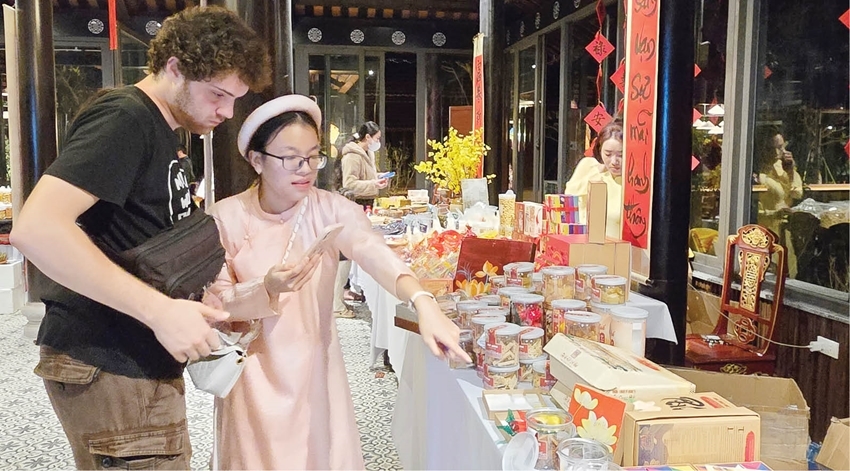 |
| Introducing traditional Hue products to international visitors at the Phu Noi Vu exhibition space |
Expectations
“Enchanting Imperial Palace” is also seen as a test for a long-term strategy of leveraging heritage for local economic development. According to Hue Monuments Conservation Centre, the immediate goal is to promote the destination, attract visitors, and build the habit of exploring heritage at night. Economic returns are not the top priority during this pilot phase. However, in the long run, heritage-based products must meet three criteria: strong Hue cultural identity, high quality, and sustainable economic impact.
To prepare for the program, the Centre has renovated landscapes, restored traditional wooden structures, and improved the environment in the Phu Noi Vu area. Plans for security, fire prevention, and traffic management have also been carefully developed in coordination with multiple forces.
“The biggest challenge is ensuring the safety of the heritage while welcoming large numbers of visitors at night. The Citadel is vast, with many valuable artifacts, so without careful planning there would be risks,” Mr. Son noted.
In addition, cooperation with businesses, tourism associations, and communication efforts is considered key to spreading the program’s impact.
Mr. Hoang Viet Trung, Director of the Center, said the broader goal is to create a ripple effect for the entire local tourism sector. With more night-time experiences, visitors are likely to stay longer, boosting services outside the heritage area.
In the future, the Center plans to further refine the program and learn from models in countries such as China to improve quality, aiming to build a distinctive night tourism ecosystem for Hue.
With systematic investment and a new approach, “Enchanted Imperial Palace” is expected to become a highly attractive art program and an important step in revitalizing heritage value, bringing the Hue Imperial Citadel to life in a more vivid and captivating way at night.