 |
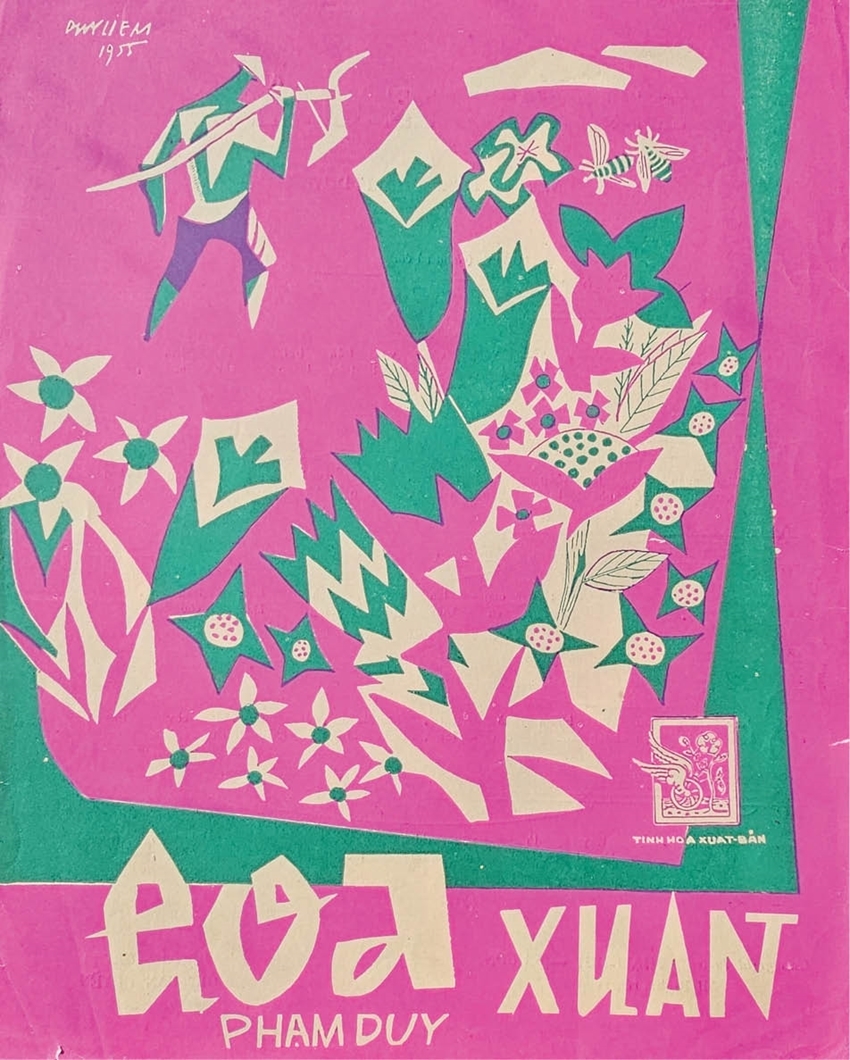
| Tinh Hoa sheet-music covers were exquisite artworks by painter Duy Liem |
Tinh Hoa Publishing House: Works of poetry and music
When music publishing in Hue is mentioned, the first and most illustrious name is Tan Hoa/Tinh Hoa (Quintessence) Publishing House. In the early 1940s, Tang Duyet, a photographer with a keen passion for books and the arts, founded Tan Hoa, initially issuing books before gradually shifting toward professional music publishing. The first musical score released by Tan Hoa was Giai phong quan (Liberation Army) by Phan Huynh Dieu in 1945, followed by Ben Han giang (Han River Wharf) by Ngoc Trai and Hung tien (Advance in Strength) by Nguyen Huu Ba. By 1946, the publisher had produced around 30 musical works by composers such as Nguyen Van Thuong, Quoc Dong, Ton That Canh, Van Dong, Pham Duy, Duc Tung, Duong Minh Ninh, and Nguyen Van Tuyen...
After a two-year hiatus, Tang Duyet returned in 1949 under the banner of Tinh Hoa Publishing House. Its first publication brought together two poem-based songs by Pham Duy—Tieng thu (Autumn’s Sound, poem by Luu Trong Lu) and Co hai mo (The Girl Picking Apricots, poem by Nguyen Binh). By 1956, Tinh Hoa had released more than 500 musical scores, some reaching their fourth or fifth printings. Going beyond simple publication, Tinh Hoa functioned as a stringent “artistic review council,” with Tang Duyet routinely consulting authoritative composers to select works of high artistic value. This careful curation helped establish Tinh Hoa as a “midwife” for numerous musical talents of the era.
Tinh Hoa’s most distinctive and unrivaled quality lay in its aesthetic refinement in presentation. Tang Duyet transformed each sheet of music into a genuine work of visual art by inviting master painters such as Phi Hung, Duy Liem, and Ta Ty to design the covers. While Phi Hung conveyed an air of elegance and sophistication through images of ao dai-clad young women set in a nostalgic milieu, Duy Liem introduced a bold, modern graphic style marked by sharp forms and cubist influences. Tinh Hoa publications were collected not only for their songs but also for their distinctive visual appeal. Its sheet music circulated widely across the country and abroad. Tinh Hoa established branches in Sai Gon and Ha Noi, followed by Hai Phong and Phnom Penh (Cambodia).
Tang Duyet was renowned for his generosity and his fairness in copyright matters. His purchase of the copyright to Mua thi (Examination Season) by Do Kim Bang for 1,500 dong astonished both the music and publishing communities, as the sum was exceptionally high—roughly equivalent to a civil servant’s monthly salary at the time. Even when Tinh Hoa was dissolved in 1956, he chose to preserve the publisher’s reputation and the honor of composers by having truckloads of unsold publications transported from Sai Gon back to Hue and stored at the former premises at 121 Tran Hung Dao, resolutely refusing to liquidate the stock. This embodied the magnanimity and forthright spirit of a cultural figure in Hue in a bygone era.
Ty Ba Publishing House: A burning aspiration to revive traditional music
Alongside Tinh Hoa, Hue was also home to a “musical oasis” imbued with a strong national spirit: Ty Ba Publishing House, founded by composer Nguyen Huu Ba. Located on Cot Co (Flagpole) Street, now Ong Ich Khiem, the publisher was established with a mission devoted entirely to art and the nation. In its early years, Ty Ba aspired to publish music in 14 categories, including Chim non (Young Birds, children’s music), Tram huong (Agarwood, religious music), Vang son (Golden Splendor, court music), Gam hoa (Silken Blossoms, aristocratic music), Lua vang (Golden Rice, folk music), Kiem cung (Sword and Bow, heroic music), Nhac binh (military music), Anh thu (Gallant Youth, youth music), Nghe thuong (Court Dance, dance music), Buom hoa (Butterflies and Flowers, romantic music), Nhac kich (musical theatre), Hai huoc (humorous music), Nhac thuan tuy (instrumental music), and Ly tao (poetry set to music). However, after only a small number of works by Nguyen Huu Ba, Le Cao Phan, Van Giang, and others had been published, the publisher entered into cooperation with Tinh Hoa and brought its modern music activities to a complete halt, shifting its orientation.
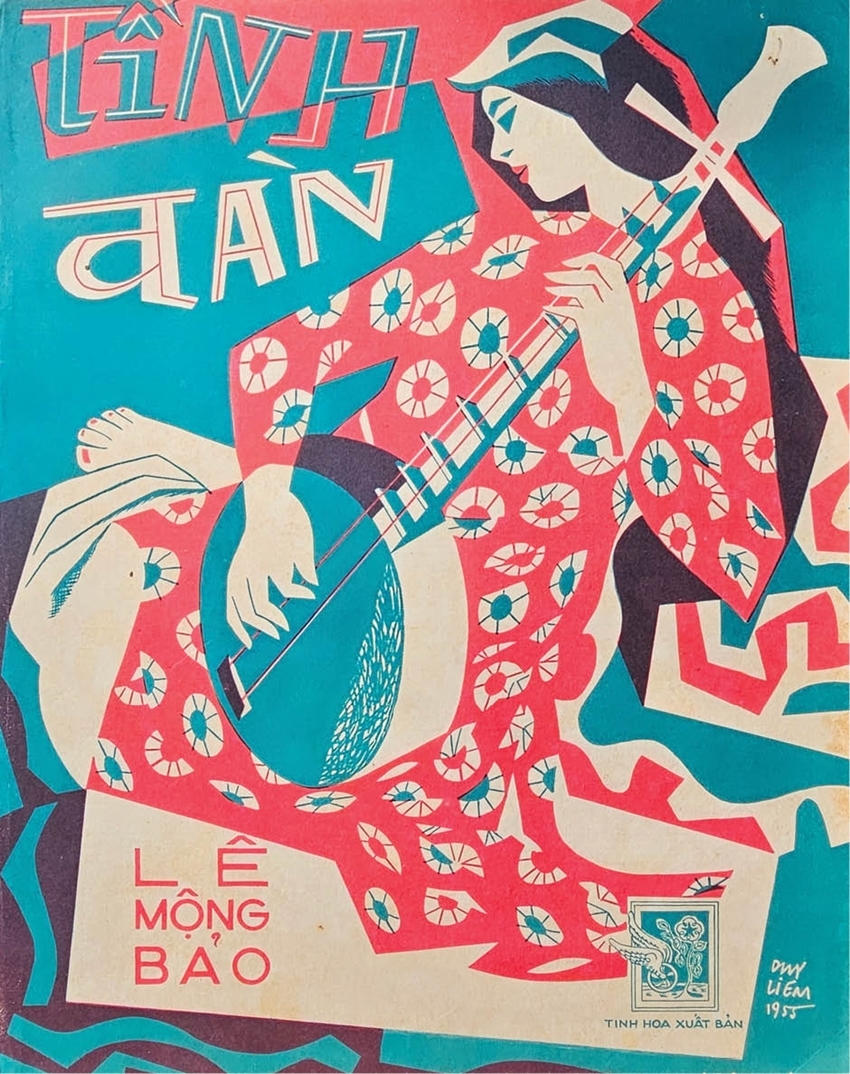 |
| Tinh Hoa sheet-music covers were exquisite artworks by painter Duy Liem |
Composer Nguyen Huu Ba was a distinctive cultural figure in Hue, serving as an important bridge between traditional and modern music. In the realm of traditional music, he was regarded as a master of the highest rank. Drawing on this strength, he redirected Ty Ba Publishing House toward the publication of educational materials devoted to traditional music. Working with his associates, he compiled and released numerous instructional books for instruments such as the dan tranh (zither), dan nguyet (moon lute), dan ty ba (pear-shaped lute), and dan nhi (two-string fiddle), as well as collections of Hue songs and folk music. Ty Ba also organized training courses in traditional music, contributing to the systematic preservation and transmission of traditional musical heritage. At the time, Nguyen Huu Ba’s role in Hue was akin to that of a captain, single-handedly steering the vessel of traditional music through the rising tide of modern music, ensuring that the nation’s musical heritage—especially Hue’s traditional music—remained unbroken.
Once, a hundred flowers in bloom
In the years surrounding 1950, Hue was truly a vibrant music publishing market, characterized by a “hundred flowers in bloom.” Beyond the two leading publishers, Tinh Hoa and Ty Ba, the former imperial capital was also home to numerous other publishing houses, each pursuing distinct business strategies and stylistic orientations, together creating a lively yet healthy competitive environment.
First among them was Than Kinh (Imperial Capital) Publishing House, founded in 1946 by composer Le Mong Bao. Operating very much as a “family-run artistic venture,” it focused primarily on publishing works by Le Mong Bao himself, including songs such as Khong lam no le (Refusing to Be a Slave) and Du huong (Lingering Fragrance). This was followed by Ho Dac Nghi Publishing House, located on what is now Phan Dang Luu Street. Although its main strength lay in literary publications, the house also ventured into music sheet publishing, releasing songs such as Xa que (Far from Home) by Le Quang Nhac and Vong huong deo xa (Gazing Toward the Distant Pass) by Van Giang, and others.
Also in the 1950s, Hue saw the emergence of two different publishing houses bearing the name Huong Giang, an intriguing feature of the local music publishing scene. The first, located on what is now Phan Dang Luu Street, specialized in sheet music and adopted a novel marketing strategy for the time: printing photographs of renowned singers and composers on the covers as gifts for readers. It planned an ambitious publishing program featuring works by leading composers such as Duong Thieu Tuoc, Tham Oanh, and Hoang Trong. The second Huong Giang Publishing House, based on Le Huan Street, followed a similar approach by placing singers’ photographs on the front covers, while adding composers’ portraits on the back covers, as seen in works such as Hop tau mua xuan (Spring Ensemble) by Viet Tuan.
In those years, music publishing across Vietnam—from Ha Noi, Hai Phong, Hai Duong, Quang Tri, Ban Me Thuot, Da Lat, Sai Gon, Can Tho to My Tho—was in many places marked by disorder and increasing commercialization, with covers sometimes adopting garish, overly ornamental styles. By contrast, publishing houses in Hue generally preserved their characteristic elegance, meticulous standards, and refinement. This pioneering drive toward professionalization, together with rigorous artistic appraisal and aesthetic sophistication in presentation, turned music publishing in Hue during this period into a radiant legacy, one that helped shape the identity of Vietnamese music in an earlier era.
|
|
| “An institution for the publication of musical works and books on music, wholly dedicated to the nation and to art. In order to contribute to the building of an independent Vietnamese culture, Ty Ba will select classical or reformed works that possess artistic value and national character…” (Mission and objectives of Ty Ba Publishing House, Hue). |