 |
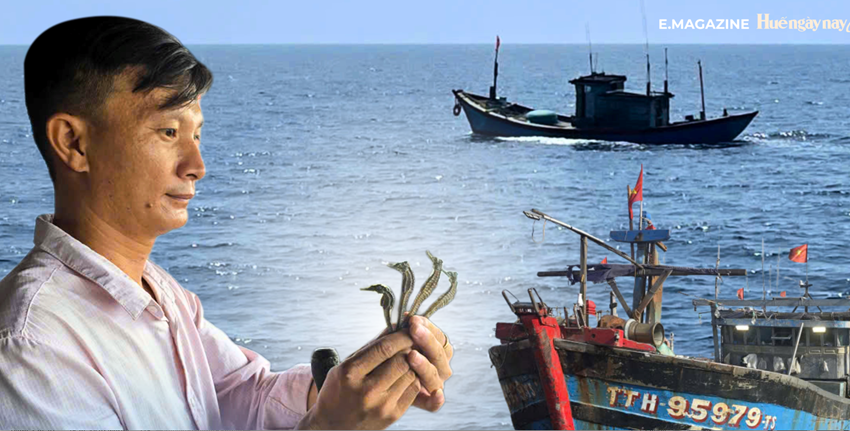
| One of the rare seahorse species found in the waters of Thuan An, Hue City |
Every time I meet young fisherman Tran Van Cuong, who is also the Chairman of the Fisheries Union of Thuan An Ward, he passionately talks about seahorses. Now in his early thirties, Cuong has spent more than 15 years at sea. Looking toward the boats anchored near the shore, he cheerfully recalls the “lucky” times he encountered seahorses. Cuong says that seahorses appear naturally, as if the sea occasionally offers fishermen a small gift. No one goes searching for them, yet they are encountered. No one hunts them, yet sometimes they drift into the nets on their own. Those moments bring both excitement and a touch of sadness to coastal residents, because the creatures are so small and vulnerable.
Cuong, in particular, has a habit that not everyone can maintain. As he says: “Any that are still alive, I release them all back into the water. Only the dead ones are brought home. If fishermen harm the sea, what would we have left to live on?” His simple words seem to embrace his deep passion for the deep ocean.
Many species listed in the Red Book
Seahorses - also known as “hai ma” - have long appeared in oral tales across many coastal regions of Vietnam. With their small, soft bodies, upright posture, sparkling black eyes, and long tails curled like hooks, seahorses have come to be regarded as a “treasure of the ocean.”
Their economic value is also one of the reasons seahorses are heavily exploited. A small seahorse, no bigger than a finger, can cost several hundred thousand dong. For coastal residents - especially those who depend entirely on the tides for their livelihood - catching just a few dozen can bring in a considerable additional income.
However, few people know that some seahorse species in Vietnam are listed in the Red Book, with varying levels of endangerment. They serve as living indicators of the health of seagrass beds and coral reefs. When the marine environment deteriorates, seahorses are among the first species to disappear. More concerning is the fact that fishermen often cannot distinguish which species are valuable or rare and therefore in need of protection.
Assoc. Prof. Dr. Mac Nhu Binh of the University of Agriculture and Forestry, Hue University - one of the few scientists and fisheries experts in the field - said that Hue has not yet conducted any large-scale survey to fully assess its seahorse populations. All current information is merely estimated based on data from neighboring regions.
According to recorded observations, the central coastal waters may host between five and seven seahorse species. Among them, the most common are the black seahorse, striped seahorse, thorny seahorse, and three-spot seahorse, along with several rarer species such as Hippocampus kelloggi, H. spinosissimus, and H. mohnikei. Within this list, many species are classified as “Vulnerable”, while others are considered Data Deficient. However, what all seahorse species share in common is the need for protection. However, in reality, significant data gaps remain—such as which species are present, where they live, and how large their populations are. Without this information, it is difficult for any conservation measures to truly begin.
Action from today
Seahorses do not live in deep waters, nor do they favor rough seas. They quietly inhabit seagrass beds and coral reefs - natural “buildings” that allow them to anchor themselves securely - as well as estuaries, tidal flats where the water flows slowly and calmly, and shallow seabeds rich in seaweed and algae. All of these are highly sensitive ecosystems. Just a single bottom-trawling vessel passing through, a round of channel dredging, or a discharge of coastal waste can cause them serious harm. Fishermen in Thuan An understand this well. They are the first to witness seagrass beds shrinking year by year, coral reefs fading in color, and patches of seaweed clearly diminishing after each storm season.
In the past, one study estimated that Vietnam harvested between 10 and 17 million seahorses each year. This staggering number largely came from bottom trawling fisheries, collection for traditional medicine, dried specimens sold as souvenirs, and the export market. Hue is not considered a hotspot for seahorse exploitation, but the risks are still present: bottom trawling continues to operate near the shore, seagrass beds and coral reefs keep declining, and the purchasing market quietly persists in the background.
In addition, in folk tradition, seahorses are regarded as a valuable medicinal ingredient. Although science has not yet fully proven their medicinal effects, market demand for this species remains high. Dried seahorses are sold in many seafood markets, and some provinces and cities have previously exported them in large quantities. These ongoing threats could lead to a serious decline in seahorse populations. Therefore, conservation efforts need to begin today.
Assoc. Prof. Dr. Mac Nhu Binh and other experts have proposed a range of solutions, including fixed-point diving surveys, rapid assessments of benthic organisms, and the documentation of species, population density, and distribution areas. To protect and restore seagrass beds, they emphasize restoring coral reefs, establishing small-scale marine protected areas, reducing bottom-trawling activities, and increasing monitoring of fishing zones.
Another effective conservation solution is that several provinces and cities in central Vietnam have successfully bred seahorses, helping reduce the pressure of catching and harvesting them from the wild. In addition, to ensure sustainable conservation of this species, local authorities need to strengthen enforcement of CITES - the Convention on International Trade in Endangered Species of Wild Fauna and Flora - by requiring relevant agencies to closely monitor and control seahorse trade. At the same time, greater emphasis should be placed on public awareness and education to reduce the use of seahorses for medicinal purposes or alcohol infusions, encouraging the release of live seahorses back into the sea, as young fisherman Tran Van Cuong has been doing.
Only when conservation solutions are implemented in a coordinated and comprehensive way, and awareness about protecting this marine species is raised, can seahorses truly reproduce and thrive.