 |
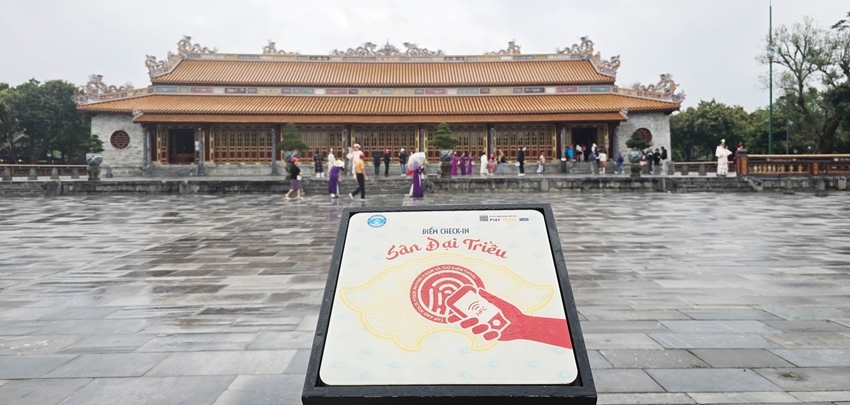
| An interactive and check-in point in front of Thai Hoa Palace |
“Tapping” to explore “living cultural treasures”
Visitors to Hue Imperial Citadel no longer face long ticket lines or feel lost within the vast complex. With e-tickets and the “Hue Monuments” app, the experience is streamlined: smart maps for navigation, automatic multilingual narration, and 3D models with supplemental content displayed instantly on smartphones, making the journey clearer and more immersive.
Since late 2024, the Tap Quest interactive station system launched by Hue Monuments of Conservation Center has introduced an entirely new way of engaging with heritage. By simply tapping a smartphone on an NFC-enabled panel, visitors are instantly drawn into the site’s story through images, videos, 3D models, or an AI-powered digital tour guide. Each station also recommends the next stop and allows visitors to “engrave” their names on a digital wall - a modern check-in that leaves a personal mark without impacting the physical landscape of the monument.
 |
| Visitors scanning a QR code to experience the smart interactive station at Hai Van Frontier Post |
According to Mr. Hoang Viet Trung, Director of Hue Monuments of Conservation Center: “Technology is regarded as an optimal tool for preserving and promoting heritage while bringing it closer to the community, adding that every new application must genuinely deliver both convenience and emotional experiences for visitors”.
To date, 96 Tap Quest stations have been installed across the Hue Complex of Monuments, forming an interconnected digital cultural map - an initiative expected to set a new benchmark for cultural tourism in Vietnam.
A standout advancement is the digital identification of antiquities and the metaverse exhibition project. Using RFID/NFC technology combined with blockchain (Nomion), each artifact is assigned a unique “digital identity” containing comprehensive 3D data, historical records, images, and related narratives. From a pilot of 10 artifacts in 2024, the project has expanded to 108 digitized items showcased in 10 virtual exhibition rooms. With just a single tap on the chip beside an artifact, visitors can view high-resolution 3D models, rotate them, zoom in, and explore intricate details with precision…
 |
| Tourists visiting Phung Tien Palace through a virtual restoration system |
Mr. Vo Quang Huy, Deputy Chef of Hue Monuments Conservation Center, informed that Nomion technology creates a one-to-one digital record, preventing forgery and ensuring transparency. National treasures such as the gilded Nine-Dragon Sphere, Minh Mang-era marble reliefs, Emperor Bao Dai’s royal palanquin, and other “golden branch, jade leaf” artifacts… have all been assigned unique identifiers, enabling visitors to explore fine details that are sometimes difficult to discern even during on-site visits.
Beyond serving local visitors, the museehue.vn platform enables global audiences to purchase tickets for digital exhibitions on the metaverse. Looking ahead, the “digital ownership” model, allowing collectors to acquire NFT versions of artifacts paired with NFC chips, is expected to open up new economic pathways for Hue’s cultural sector.
 |
| Tourists exploring and experiencing local products with VR technology |
“Digital identification not only supports preservation but also unlocks new value, creating digital economic value from heritage,” Director Hoang Viet Trung affirmed.
Up to now, Hue City People’s Committee has approved a plan that in the period of 2025-2027, the city will digitally identify nearly 1,000 artifacts, aiming to establish a comprehensive digital heritage ecosystem, a major milestone in the ancient capital’s digital transformation journey.
Heading to a digital heritage ecosystem
In addition to providing experiences for visitors, Hue is investing heavily in scientific platforms for the work of restoration. From 2023 to 2025, the Center collaborated with UALS (South Korea) to conduct 3D scanning and build an HBIM model of Thai Hoa Palace, digitizing over 5,200 individual elements; in which, HBIM enables monitoring of deterioration, structural assessment, standard-compliant restoration, and systematic maintenance. Following Thai Hoa, this technology will be applied to Can Chanh Palace and other key heritage structures.
Recently, Hue has received a valuable archival collection from France, including 8,400 historical photos from ANOM, 957 images from EFEO, 39 original documents on Can Chanh Palace, and 32 3D models of exceptional artifacts, such as the Nine Dynastic Urns, the Nine Divine Cannons, and royal thrones… “From scattered and hard-to-access data, we are now standardizing and storing it scientifically to support both preservation and long-term research,” said Mr. Hoang Viet Trung.
Currently, Hue Monuments of Conservation Center is also developing open-data modules to support cultural creative enterprises. Royal motifs will be vectorized, and 3D models and restoration drawings can become digital assets for economic use. While this model is common worldwide, it remains relatively new in Vietnam. According to Mr. Hoang Viet Trung, Hue has 24 types of heritage, from architecture, feng shui, medicine, festivals, to customs. He said: “If these intangible treasures can be transformed into economic resources, Hue will truly enter the era of cultural industry”.
In the coming time, Hue aims to establish a Digital Knowledge Repository on its heritage, encompassing: architectural and infrastructure databases; restoration and conservation data; open-data systems for research, education, and creative use; and a platform integrating VR/AR, AI, IoT, and big data.
“Today, heritage experiences go far beyond merely seeing, listening, or taking photos. Every step within a historical site is a journey of emotions, knowledge, and the stories behind each artifact. “Technology is the key to bringing this experience to life, ensuring heritage endures, feels closer, and touches the heart of every visitor,” shared Mr. Hoang Viet Trung.
|
|
| These digitization efforts have helped Hue Monuments of Conservation Center to receive consecutive honors at the Vietnam Digital Transformation Award 2024; Top Innovative Science & Technology Organization/Enterprise at the Industry 4.0 Awards 2024; and Outstanding Digital Transformation Unit 2025… These honors not only recognize the Center’s achievements but also testify to Hue’s chosen path: preservation must go hand in hand with innovation, and heritage must align with the digital economy. |