 |
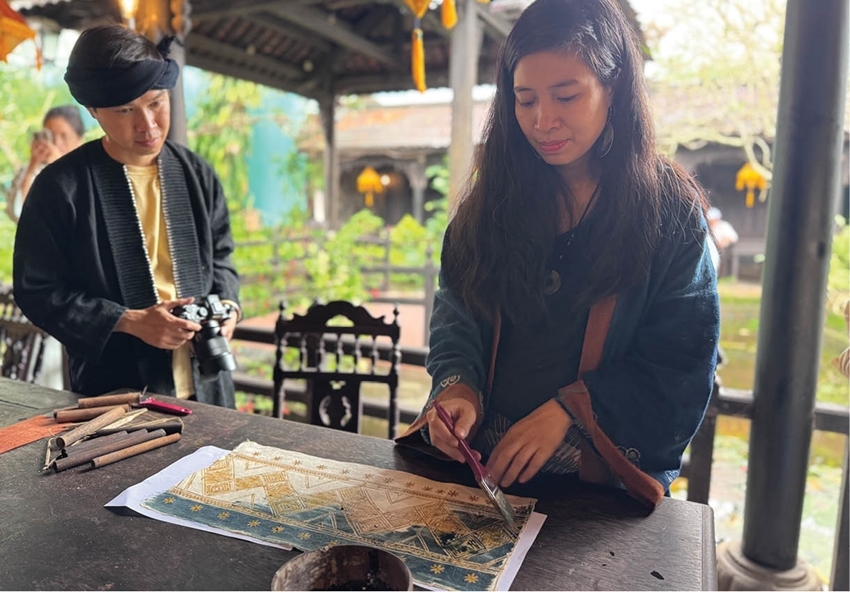
| Ms. Tran Hong Nhung instructed participants on beeswax painting and indigo dyeing on dó paper during an experience session at Ngu Ha Vien, Hue City |
The journey of dó paper
In Sung Village, Cao Son Commune, now part of Phu Tho Province, dó trees have been cultivated on upland fields for years. However, Dao Tien people there mainly harvested the bark to sell to other paper-making regions. As a result, the craft of making paper once associated with dó trees is no longer present in community life.
During a business trip to the highlands, Ms. Tran Hong Nhung (born in 1982, from Hanoi) visited Sung Village while working in community development sector. Seeing dó trees growing in the very place that once produced traditional dó paper left a deep impression on her. Through conversations with Dao Tien people, Nhung realized that the paper-making craft once existed in Sung Village, gradually faded from community life as social needs changed.
After the trip, Ms. Tran Hong Nhung began researching traditional dó paper-making techniques. She returned to Sung Village to work alongside Ly Sao Mai, an artisan, and local households to revive the paper-making process. From there, a cooperative producing dó paper was gradually formed, combined with experiential activities for visitors. “Dó paper can only return to the village when the locals practice the craft themselves, understand the product's value, and earn an income from it,” shared Nhung.
In addition to reviving the craft in Sung Village, Ms. Hong Nhung proactively built a linkage chain to ensure stable output for dó paper. From the raw-material area, the paper is brought to Hanoi to be featured in exhibitions, workshops, and sold through Zó Project. This helps the paper-makers not only look beyond just production but clearly recognize the value of their creations as well.
According to Ms. Nhung, reviving the dó paper-making craft must go hand-in-hand with expanding how the material is used in life. As a result, dó paper is being tested in various applications, from notebooks and cards to decorative items and design products. These experiments aim to create demand, thereby sustaining production in the raw material area.
When dó paper combined with beeswax
In the lives of Dao Tien people, beeswax is inextricably linked to the traditional attire. Artisan Ly Sao Mai explained: “In the past, women in the village melted beeswax and painted directly onto fabric by hand, creating vignettes based on their memory and life experience. These beeswax vignettes symbolize the elements of everyday life such as mountains, clouds, the sun, and plants.”
When the fabric is dyed in indigo multiple times, the parts covered in wax retain the original fabric color, creating the signature vignettes on garments. This technique has been passed down through generations. However, as ready-made clothing became popular, beeswax painting began to fade. The idea of applying beeswax on dó paper stemmed from a desire to create more space for traditional techniques. Ms. Nhung noted that the fibrous structure of dó paper holds wax very well. When light passes through, the waxed parts create a translucent effect, giving the vignettes a sense of depth and transforming the paper into more than just a flat surface.
Based on these characteristics, beeswax-painted dó paper has been tested in decorative products. Table lamps, bedside lamps, and small interior decor items are considered suitable applications. These experiments follow the principle of preserving the spirit of traditional techniques while leveraging the material’s characteristics to suit contemporary living spaces.
At the workshop “Awakening the beauty of dó paper and beeswax”, held in late December, 2025 at Ngu Ha Vien, Hue City, young participants had the opportunity to paint beeswax directly on dó paper. Through this, they gained insight into the value of Dao Tien people’s handicraft techniques. Pham Thuy Duong, a participant from Ho Chi Minh City, shared: “To me, beeswax is both a painting medium and a natural material. Through this, I understand more about the vignettes of the Dao people and how they create painting tools directly from the nature.”
According to artisan Ly Sao Mai, bringing beeswax to dó paper is a way for traditional painting techniques to continue being practiced in a contemporary context. During the workshops, she personally instructs participants on how to melt the wax, maintain the temperature, create strokes, and explains the meaning of each vignette used on Dao Tien clothing.
“After these experimental sessions, if the results are promising, this technique will be further refined for wider application in decoration, interior design, and handmade gifts. This creates a new pathway for dó paper while providing more stable market outlets for artisans,” said Ms. Tran Hong Nhung.