 |
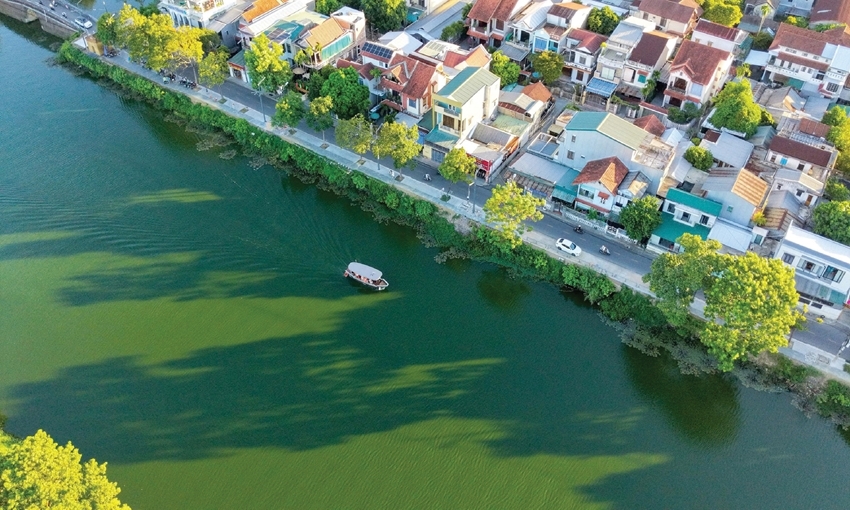
| The Ngu Ha River, part of the waterway system of Hue Imperial City. Photo: Duc Quang |
Protecting natural flood drainage corridors
Climate change has made flooding in the downstream areas of Hue City increasingly complex in recent years. Observations across many areas show that floodwaters are not only reaching greater depths, but are also draining less effectively. Patterns of flooding have also become more diverse than in the past. In addition to flooding caused by rising river levels along both banks of the river, heavy rainfall can also cause localized inundation, making floodwater rise rapidly and difficult to drain.
It is not only low-lying areas, but also new urban areas that have experienced prolonged flooding following heavy rain. This shows that, in addition to extreme rainfall, urbanization and the way urban spaces are organized must also be taken into account when developing long-term solutions to urban flood drainage.
According to Dr. Ho Dac Thai Hoang, Chairman of Hue City Union of Science and Technology Associations, extreme rainfall such as that recorded on October 27, 2025, serves as a test of urban resilience. The 24-hour rainfall recorded at Bach Ma Peak reached 1,739 mm, setting a record in Vietnam’s meteorological history. Therefore, heavy rainfall should no longer be regarded as an anomaly, but as an essential data for calculating and designing urban flood drainage solutions.
Apart from climate change, urban planners have also pointed to shortcomings in spatial planning and urban infrastructure development. Phan The Dat, architect, Chairman of Hue City Association of Architects, said that ring roads with elevated road surfaces to prevent flooding are necessary; however, the culvert and viaduct systems do not have openings wide enough to drain stormwater during heavy rainfall.
Nguyen Vu Minh, architect, Deputy Head of the Faculty of Architecture, University of Sciences, Hue University, identified the narrowing and obstruction of waterways and natural flood drainage corridors during urbanization as reasons why floodwater rises quickly but recedes slowly. Meanwhile, urbanization has replaced low-lying areas and green areas with concrete surfaces, severely affecting the city’s capacity to absorb stormwater.
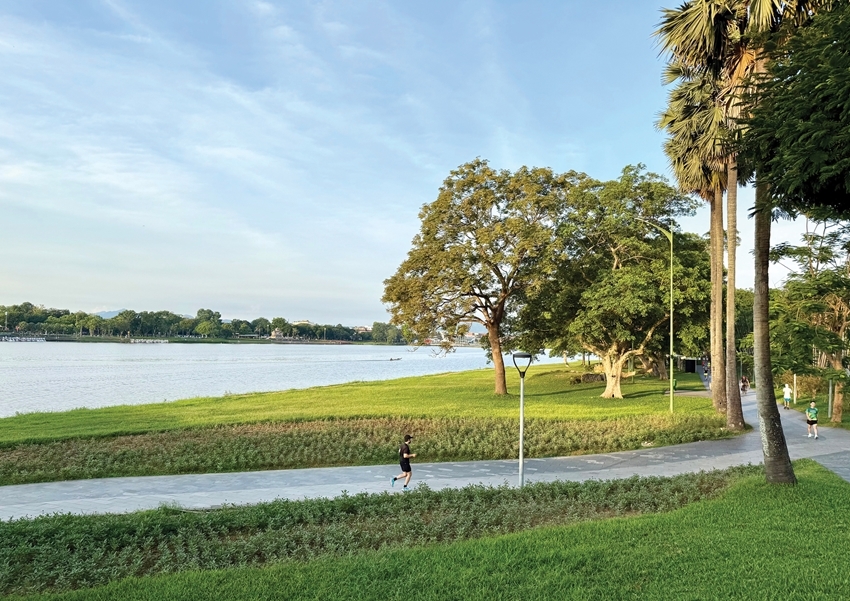 |
| The Huong River, a natural flood drainage corridor of Hue. Photo: Minh Anh |
In light of these causes, many experts believe that protecting the city’s natural flood drainage corridors is an immediate solution for helping urban areas in Hue drain floodwater more quickly. These corridors include rivers, canals, ditches, creeks, and, in particular, the network of rivers and creeks that connect to the lagoon. Over time, these drainage corridors have become silted up and encroached upon, limiting their drainage capacity.
Under Official Dispatch No. 11486 dated July 30, 2026, signed by Standing Committee Member of the City Party Committee and Permanent Vice Chairman of the City People’s Committee Hoang Hai Minh, the city requested a review of plans and projects involving riverbeds, riverbanks, and flood drainage corridors. Along these corridors, prioritizing the preservation of open spaces and clearing pathways for flood drainage will be decisive in determining the extent and duration of flooding in the central urban area.
From this requirement, the city needs to clearly identify which spaces must be preserved, which river sections must be protected, which low-lying areas can store stormwater, and where flows are being constricted. Once mapped and put under specific management, these spaces can continue to regulate water for the urban area. Protecting flood drainage corridors also means protecting natural flows, enhancing drainage capacity during prolonged periods of heavy rainfall.
The ‘sponge city’ model
The architect Nguyen Vu Minh believed that, alongside flood drainage corridors, urban spaces should be planned with high water absorption capacity under the ‘sponge city’ model. This planning philosophy views the entire city as a giant ‘sponge’ capable of naturally absorbing, retaining, and regulating stormwater, rather than rapidly channeling it away through concrete drainage systems. To achieve this, ‘gray infrastructure’ must be limited, while smart underground infrastructure systems should be developed. Most importantly, land must be reserved for green spaces, including parks, retention lakes, and unobstructed drainage channels.
Hue Imperial City is a typical example of a ‘sponge city’. With the Ngu Ha River as its main waterway, and more than 40 lakes of various sizes distributed evenly throughout the area, it has an interconnected network of waterways that effectively absorbs and drains water. In practice, even when flood levels are similar, floodwater levels within the Imperial City tend to rise more slowly and recede more quickly. This is thanks to conservation and restoration efforts that have preserved these river and lake systems fairly well. In addition, the protection of the planned zones has also helped maintain existing flood drainage corridors, enabling better flood drainage and absorption than in new urban areas.
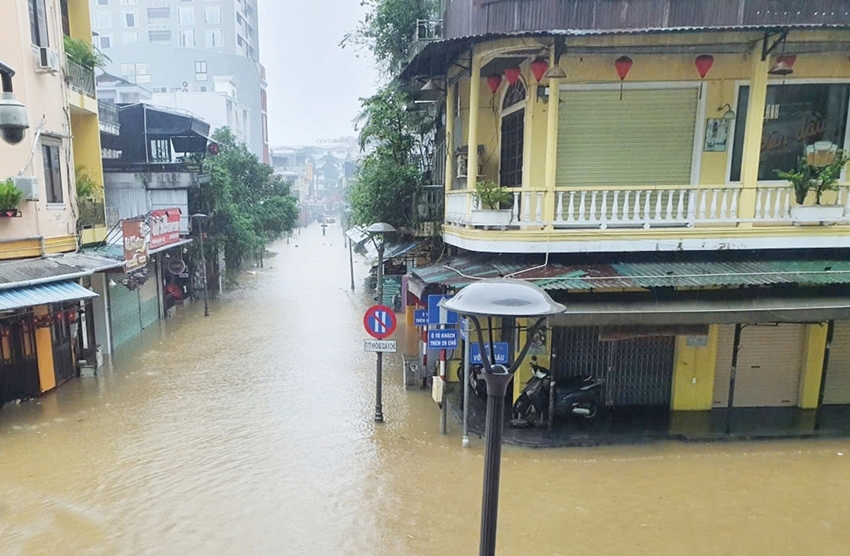 |
| Pham Ngu Lao and Vo Thi Sau streets were flooded in late October 2025. Illustrative photo: Quoc Vinh |
Dr. Ho Dac Thai Hoang proposed installing ‘rain gardens’ at high density in new urban areas. A ‘rain garden’ is a sustainable landscaping solution designed to collect and treat stormwater runoff from rooftops, sidewalks, or parking lots. Instead of allowing stormwater to flow directly into drains, potentially causing flooding and carrying pollutants with it, rain gardens allow stormwater to gradually seep through the soil, be naturally filtered, and replenish groundwater.
As climate change and extreme rainfall become increasingly frequent, rain gardens offer multiple benefits as they reduce flooding and water pollution while creating healthier living spaces that bring people closer to nature. This is a smart approach for modern cities and well-suited to Hue.
Given the unpredictable changes in climate, finding sustainable flood drainage solutions for Hue City requires more than a few isolated measures. It requires coordinated efforts in planning and planning oversight, as well as close cooperation among relevant departments, agencies and localities across affected areas; in which, safeguarding flood drainage corridors must be a priority, alongside developing the city in line with green, ecological, and smart criteria. These are essential conditions for enhancing absorption and drainage capacity under the ‘sponge city’ model.