 |
| Chinese visitors visiting Hue. Photo: Huu Phuc |
This is excellent news for tourism in Hue and many provinces in the Central region, as China Southern Airlines' flight CZ8155 from Shenzhen (China) landed at Da Nang International Airport on the evening of October 2, carrying more than 170 passengers. This marks the resumption of the route after 5 years of interruption due to COVID-19.
If Da Nang directly benefits as an international air gateway, neighboring localities such as Hue also have the opportunity to welcome a wave of visitors from Chinese market - which was once a key source of visitors. The question is: What does Hue need to do to turn this opportunity into a real advantage?...
Before the COVID-19 pandemic, the number of Chinese visitors to Da Nang reached nearly 1 million arrivals per year, thanks to 5 regular air routes and nearly 30 charter flights directly connecting with many Chinese cities. During that period, an average of about 230 Chinese visitors arrived in Hue each day after landing at Da Nang airport. However, after the COVID-19 pandemic, Chinese visitors were almost absent in Hue and the Central region for various reasons.
Now that the Shenzhen - Da Nang air route is back in operation, this flow of visitors will certainly tend to return, as Shenzhen is an economic, financial, and technology hub of China, home to a concentration of middle- and upper-class individuals who love experiential tourism, and are willing to spend generously when traveling.
Hue is only more than 100km from Da Nang, with a highway and the Hai Van Tunnel reducing travel time to about 1.5 hours. This is an advantage for Hue to become the second destination in the itinerary of international visitors. Visitors can combine a beach holiday in Da Nang with a visit to Hoi An ancient town, and continuing on to Hue to explore world cultural heritages, royal cuisine, and local cultural life.
If Da Nang is strong in beaches and entertainment services, and Hoi An is famous for its ancient town, Hue has its own strengths in heritages, culture, and cuisine. Hue Imperial City, the Nguyen Dynasty tombs, Royal court music, traditional festivals, and sophisticated cuisine - all are “specialties” that can make a strong impression on international visitors, especially Chinese visitors who have similar culture, but are curious about the differences in details.
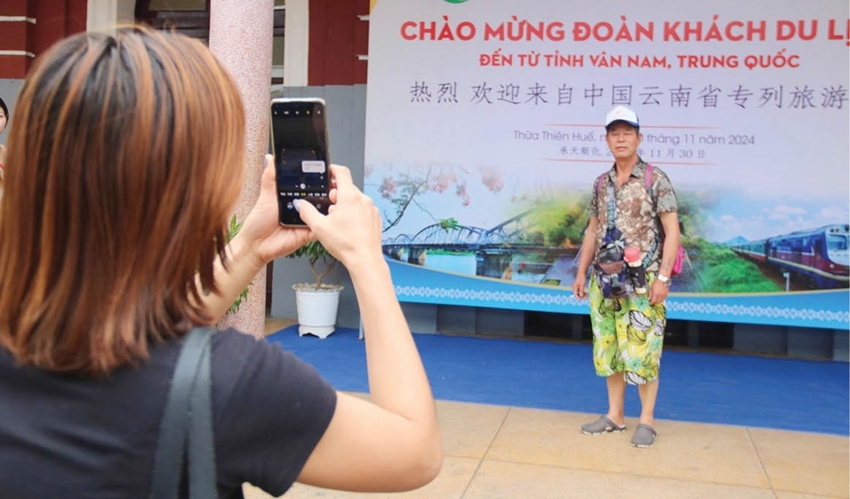 |
| Chinese visitors visiting Hue. Photo: Huu Phuc |
Moreover, Hue also has potential in medical and wellness tourism, with a system of high-quality hospitals, oriental medicine centers, and spas. This is a suitable product for the middle- and upper-class visitors from Shenzhen, who seek to combine relaxation with health care.
However, to attract these high-spending visitors to return, Hue needs to establish regional links to create appeal. In reality, Hue cannot directly compete with Da Nang in terms of air connectivity, but it can completely “ride the wave” if it knows how to collaborate. There is a need to build tour packages connecting Hue - Da Nang - Hoi An - My Son, where Hue serves as a cultural and heritage highlight. This collaboration will help extend visitors’ stays, and increase their spending, rather than having them spend only 2 - 3 days in Da Nang.
Next is innovating promotional activities. Chinese visitors, especially the younger generation in Shenzhen, access information mainly through digital platforms. Hue needs to boost promotion in Chinese on WeChat, Douyin, and Xiaohongshu with short videos and vivid images of the royal palace, the ao dai, cuisine, the Huong river, and Truong Tien bridge. This is an effective way to “reach” the market, instead of relying on traditional promotion.
Third is upgrading guest services. Hue needs to focus on training more Chinese-speaking tour guides, adding bilingual signage, and developing unique souvenir products. Furthermore, hotels and restaurants must improve service quality, and pay attention to the consumption habits of Chinese visitors, from food preferences to convenience services.
The Shenzhen - Da Nang air route serves as a “gateway” for the Central region to welcome visitors from the billion-people market. But from that gateway, whether each locality can attract this flow of visitors depends on its own initiative. For Hue, the opportunity is clear, the advantages are already, and all that remains are the determination and strategy.
If Hue knows how to link up, innovate promotional methods, and upgrade services, it will not only benefit from a single air route, but can also affirm its position as the leading cultural and tourism hub in the Central region, a destination where international visitors will always want to return to.