 |
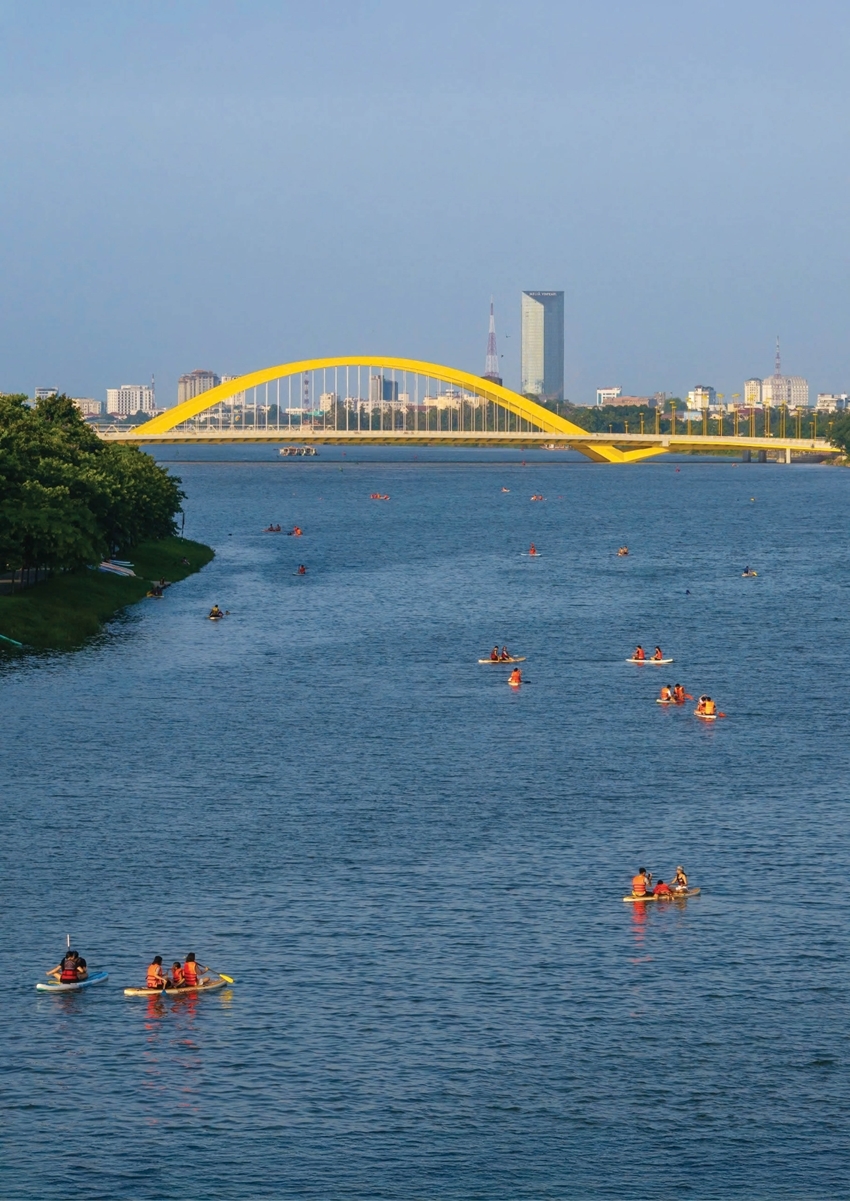
| The heritage river. Photo: Anh Le |
A strategic development orientation
This is not merely an administrative decision, but a strategic development direction. For Hue, the core issue does not lie in population size or land area, but in how a heritage city can adapt to modern development requirements while preserving its cultural depth, historical layers and distinctive landscape.
Hue possesses around 128 kilometers of coastline and holds a strategic position within the central region’s marine economic space. It is also one of the few localities whose provincial master plan has already been approved by the Prime Minister, with relatively low volatility, as it does not need to reorganize its urban planning mindset to accommodate new variables arising from post-merger adjustments, unlike many other provinces and cities. This creates favorable conditions for Hue to focus immediately on adjusting implementation plans with flexibility and to quickly adapt to its new role as a centrally-governed municipality.
Hue is currently standing before numerous opportunities and advantages, yet it also faces structural challenges. The question is not whether Hue should develop rapidly, but how it should develop without losing itself, while still generating sufficient momentum for the future.
Preserving heritage while creating “future heritage” amid urbanization
Hue is a distinctive heritage city, where heritage is not merely a collection of tourist attractions, but an integral structural component of a living urban fabric. Therefore, heritage preservation cannot be separated from socio-economic development.
Pressures from natural disasters, climate change and urbanization require a proactive approach to heritage protection, rather than passive conservation. Heritage tourism and cultural services have yet to be fully leveraged in proportion to their potential, while the risk of uncontrolled commercialization could erode long-term values.
The Hue Festival has built a recognizable brand name. However, to reach an international level, a more systematic approach is needed, linking a four-season festival chain with cultural-spiritual events and traditional craft village festivals, forming an event ecosystem rather than isolated occasions.
Hue also has sufficient conditions to participate more deeply in the UNESCO Creative Cities Network, particularly in gastronomy, provided there is an appropriate investment and governance strategy.
Alongside preserving the historic urban core, the city must create new development spaces in areas such as Chan May - Lang Co and Tam Giang lagoon. These new urban zones need to be shaped with 21st-century architectural language and infrastructure, not competing with heritage, but complementing and enriching Hue’s overall identity. In the future, they may become “future heritage” passed on to the next generations.
Smart and sustainable urban planning and governance
Hue’s inner city has clear spatial limits and is not suited to dense development models. Therefore, its strategy should aim to reduce pressure on the heritage core by establishing conservation belts and developing new urban areas in coastal zones, river corridors and higher-elevation areas.
Encouraging urban development along coastal corridors and the East - West axis, combined with a green urban - heritage orientation, aligns well with Hue’s natural and cultural conditions.
In an increasingly complex urban context, digital technology and smart governance are not merely trends but essential tools for effectively managing traffic, the environment, heritage assets and administrative systems.
Transport infrastructure - the foundation for development
Transport infrastructure plays a decisive role in enhancing Hue’s competitiveness. Investment should prioritize multimodal connectivity, closely integrating road networks, highways, railways, air transport via Phu Bai Airport, and maritime routes through Chan May Port with the city center, new urban areas, and regional linkages with Da Nang and neighboring provinces and cities.
Completing the North - South and East - West corridors will not only serve Hue’s urban development but also enable the city to participate more deeply in regional logistics and economic networks, rather than remaining on the margins of major development flows.
Adapting to flooding and climate change
Flooding is part of Hue’s natural condition. The issue is not to eliminate it entirely, but to live with it intelligently. Urban planning must allocate space for water, integrated with green spaces to form green and soft infrastructure that enhances the city’s resilience to climate shocks.
If managed effectively, Hue can ensure public safety while maintaining socio-economic activities and tourism even during the rainy and flood seasons.
Diversifying the economy and developing human
A heritage city cannot rely solely on tourism. Hue needs to diversify its economic base and selectively attract key industries, creative sectors, information technology, healthcare and education.
Hue University need be further invested in to become a regional center for training and research, closely linked with a creative urban model and the knowledge economy. More importantly, Hue must create an attractive living and working environment capable of attracting and retaining high-quality human resources.
In conclusion, in the long term, Hue’s greatest challenge is not a lack of potential, but the pressure to develop rapidly amid increasingly intense competition among cities. If it pursues short-term growth models, Hue risks diluting the very values that define its distinct position.
Conversely, by leveraging its strengths in heritage, culture and education - along with its status as a centrally-governed municipality - to improve planning quality, urban governance, infrastructure and human capital, Hue can chart its own path: development that may be slower, but more sustainable; less noisy, yet deeper; not expansion at any cost, but growth grounded in careful selection and long-term vision.
A heritage city like Hue does not need to become another version of larger metropolitan centers. It needs to evolve as a distinct development model, where preservation and innovation are not opposing forces, but complementary ones. If achieved, Hue will not only safeguard its identity but also emerge as a model green heritage city for Vietnam in a new phase of development.
Key factors
Hue is a special heritage city, where heritage is not merely preserved, but forms a living component of the urban structure.
Becoming a centrally governed municipality does not mean dense urbanization, but socio-economic development accompanied by higher standards of governance, infrastructure, living space and stable livelihoods for residents.
The heritage core needs to be “decompressed” by developing new urban areas in Chan May - Lang Co, Tam Giang…, rather than adding further density to the historic center.
Hue’s urban planning should prioritize green infrastructure and water-sensitive spaces, viewing flooding as a natural condition to adapt to, not merely a risk to eliminate.
Hue and Da Nang are complementary poles, not competing cities, jointly playing central roles in the urban structure of central Vietnam.
Hue’s long-term competitive advantage lies in the quality of development, not in speed or scale.