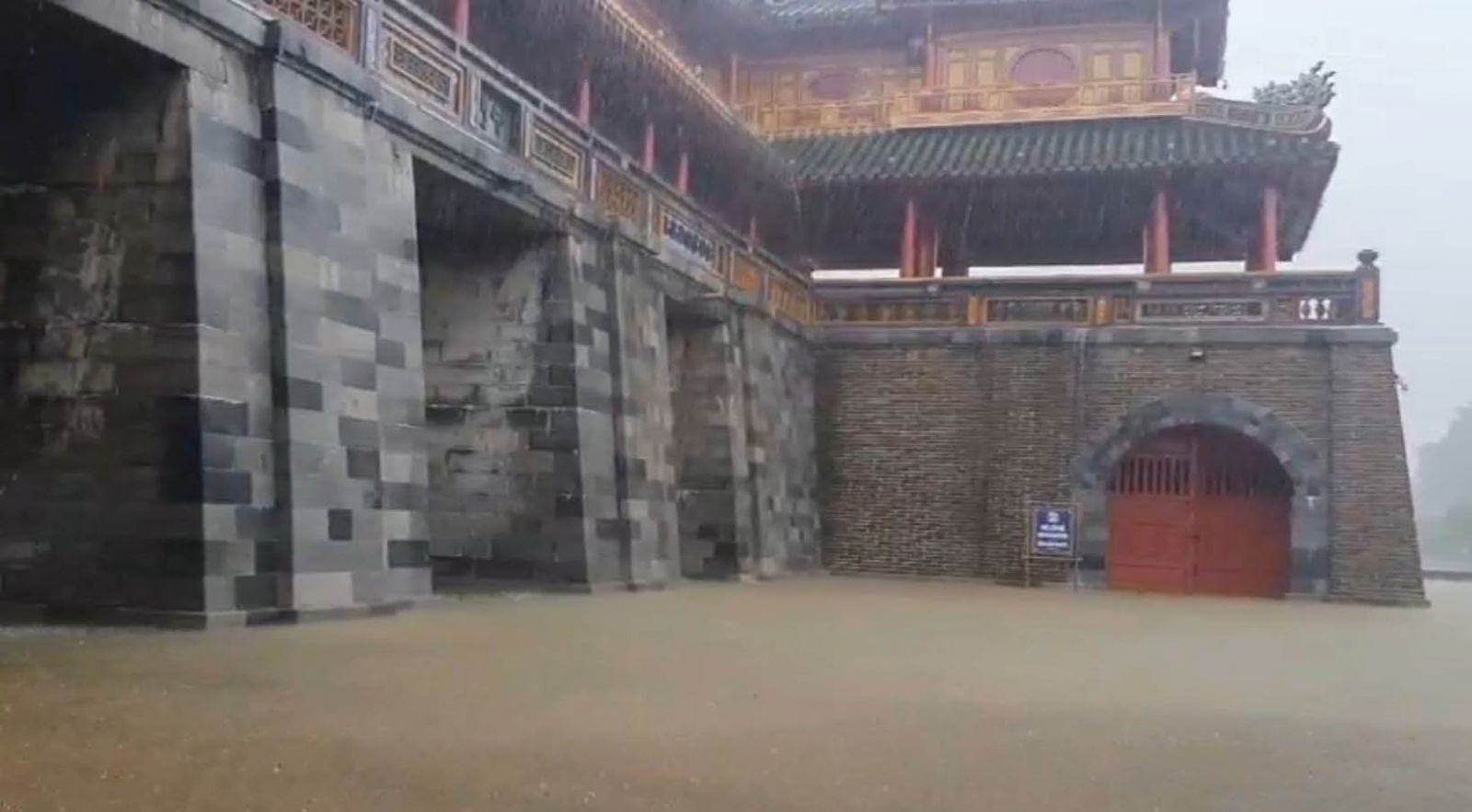
The Imperial Citadel was flooded during the recent big floods. Photo: HMCC
Facing risks from natural disasters
Mr. Vo Le Nhat, Director of Hue Monuments Conservation Center, said that thanks to the proactive response, relics belonging to Hue Monuments Complex were not significantly affected by the last heavy storms and floods. However, the Complex of Hue Monuments with massive architectural works, scattered over a large area with many different terrains, still faces many risks in the rainy season.
Mr. Le Cong Son, Chief of Office of Hue Monuments Conservation Center, said that during the storms and floods in early October and November, heavy rains lasted for many days, flooding occurred on a large scale. Many relic sites located in low-lying areas and riverside areas were deeply flooded, such as: Nghinh Luong Dinh, An Dinh Palace, Tang Tho Pavilion...
The entrance to the Royal Palace was flooded with a meter of water. Many relics along the Huong River were also heavily flooded, such as Gia Long tomb, Thieu Tri tomb ... Despite careful protection efforts, with the devastation of natural calamities, many relic sites of the ancient capital complex of Hue could not avoid being affected.
These monuments are mainly located along the Huong River, so they are strongly influenced by the river water level in the flood seasons. In terms of science, the long immersion in water more or less affects the life of the building. This year, heavy and prolonged rainfall increases the roof load, leading to leaks in many monuments, creating a favorable environment for fungi to grow. It is also a factor causing termites, damaging wooden pillars, hindering heritage conservation, preserving artifacts, and affecting archaeological relics in the heritage area.
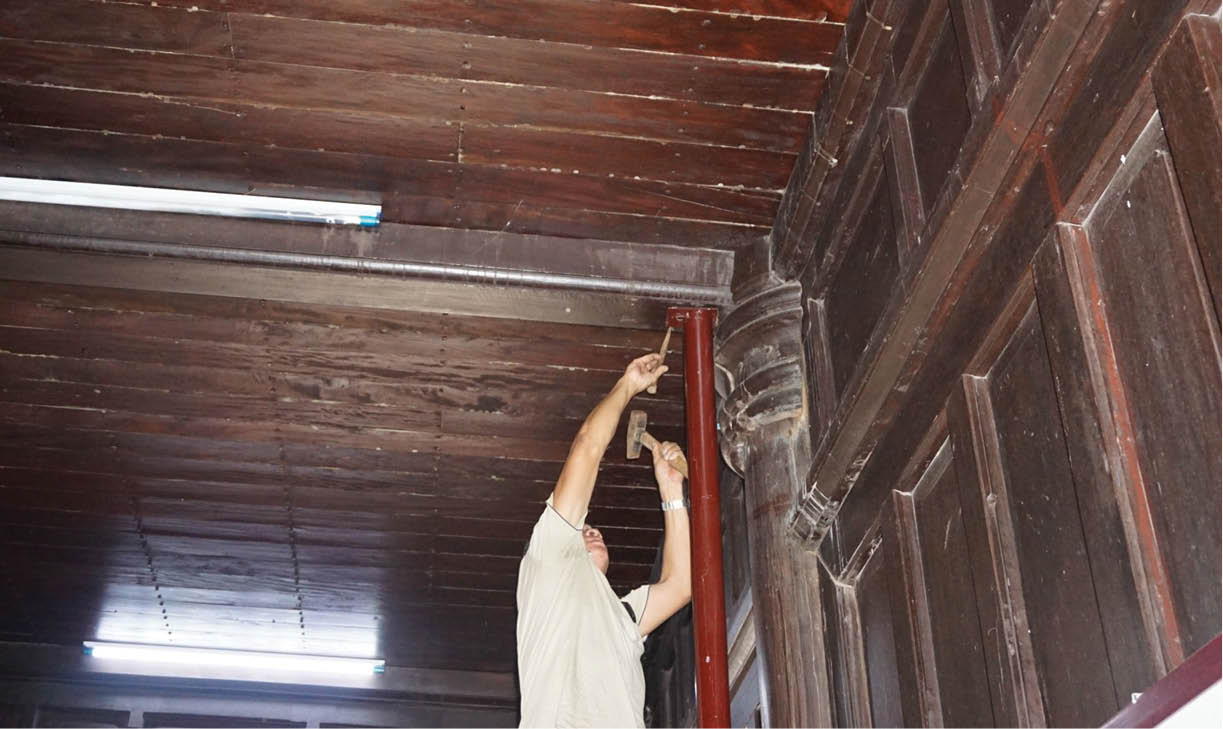
Reinforcing wooden structures against storms. Photo: HMCC
According to Mr. Vo Le Nhat, Hue Monuments Complex with most of the works built with wood roofing tiles is the most vulnerable. In the rainy season, the roof load on monuments in Hue can increase by 15-20%. The wooden structures in traditional Hue imperial architecture are also affected by high humidity, causing cracks, dropped tiles, displaced and loosed tenons, and increased chance of mold, termite, ...
In addition, the characteristic of wood is that it is susceptible to degradation under the effects of weather. Unfavorable climate conditions can result in erosion from the outside into the center of the structure or the wood is rotted from the inside, accumulating moisture and spreading from the inside out, or biologically corroded under the impact of termites, fungi, weevils, parasitic trees on wood ... Most of the works in Hue Monuments Complex are made of wood and date back a long time ago. Therefore, facing storms and floods is a challenge for these monuments.
Taking the initiative to protect relics
In order for the monuments to cope with storms and floods, before each rainy season, Hue Monuments Conservation Center always takes the initiative in implementing measures to protect buildings and structures. Mr. Le Cong Son said that the Center always actively reviews all architectural works, checks the situation of sites that are degraded or damaged in order to carry out necessary protection measures.
For buildings and relics with deterioration or weak structure, the Center would reinforce, shield, support and tie up. By many ways: using budget capital, calling for socialization of funds, cooperating with international partners, the Center invests in restoring deteriorated and high-risk works.
After the recent big storms, one corner of the roof of Thai Hoa palace was blown away and had to be temporarily roofed with corrugated iron. In the coming time, Hue Monuments Conservation Center needs resources to urgently repair and renovate relic sites that are seriously degraded, greatly affecting the face of the heritage as well as the urban landscape, such as: Thai Hoa, Thai Mieu, Van Mieu - Vo Mieu ...
Mr. Nhat said that this year, the Center also researched solutions to prevent moisture and mold caused by weather, harmful organisms on wooden structures, and plants invading the buildings, which can cause serious damage to the monuments, exhibits and archives. Simultaneously, they are carrying out measures to treat termites.
“This year's rainy season shows the complexity and danger to the safety of the monument compared to previous years. In the upcoming plan, Hue Monuments Conservation Center will strengthen preventive measures to make Hue monuments more resilient to the harshness of nature,” Mr. Nhat emphasized.
By Minh Hien