 |
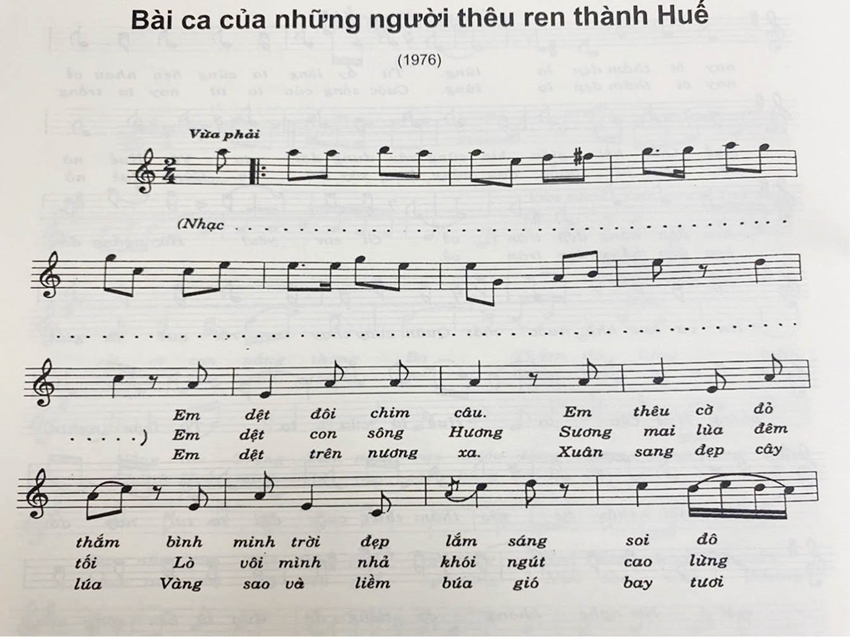
| The music sheet of “Bai ca cua nhung nguoi theu ren thanh Hue” (Song about embroiderers in Hue) |
On those days, together with musicians in Hue were many others returning from elsewhere. Tran Hoan, Nguyen Huu Van were from war zones; Nguyen Phu Yen, Le Gia Pham, then Trinh Cong Son were in Hue; from the North were Tran Huu Phap, Le Anh, Minh Phuong, Mai Xuan Hoa, Quach Mong Lan, Hoang Song Huong, then Thai Quy, Nguyen Trong Tao, Huy Chu, Hoang Nguyen, etc. Although they had never met before, they immediately worked with one another to organize many significant musical events.
Tran Huu Phap had a special connection with Hue. In 1975, he and conductor Mai Sao took the same coach crossing the Hien Luong bridge. Happy for the reunification, he got off the coach, walked 18 kilometers to Dong Ha, then took the car of the Water Factory to Hue. Touched by war traces on the road, he composed the song “Tien ve thanh Hue” (Going to Hue City). The song was immediately sung by People's Artist Trung Kien and People’s Artist Quy Duong, and broadcast on Voice of Vietnam Radio.
On April 30th, 1975, Trinh Cong Son sang “Noi vong tay lon” (Joining Hands,) which he composed in 1968, at Saigon Broadcasting Station, expressing the desire for the reunification of the North and the South. In early 1976, from Saigon Trinh Cong Son came back to his hometown. In the peaceful atmosphere in Hue, he composed “Ganh rau ra cho” (Carrying Vegetables to the Market). The song was welcomed by music lovers in Hue because of its fresh vibrant image-evoking melody, “Carry, carry, carry vegetables to the market; this morning her heart gets restless..."
Hue National University of Music and Drama was established in 1962 with majors such as Music Theory, Harmony and Orchestration, Instrumental Music including National Music (Zither, Four-Chord Lute, Two-Chord Fiddle, Moon Lute, etc.) and Western Music (Piano, Clarinette, Hautbois, Violin, Cello, Contrabass, Guitar, Mandolin, etc.)
After 1975, its name was changed into Hue Music School. Regarding training, when the musician Ha Sam came back from abroad, he was sent to Hue by the Ministry of Education and Training to take over and manage the school. Hue Music School quickly stabilized and many others majors were opened, meeting the national criteria.
The teaching board was completed with well-trained lecturers such as Lo Thanh, Truong Ngoc Thang, Hoang Cong Nghe (Hoang Nguyen), Nguyen Khac Yen, Xuan Lai, Vinh Hung, Truong Hue Man, Le Quang Hung, etc. Later Hue College of Music and Art was founded, contributing to the diversity in cultural and artistic activities in Hue.
In late 1975, the Hue Drama Troupe returned to Hue from Hanoi. Some artists came to live on Chi Lang Street, not very far from Tieng Dan Newspaper Office. After the war, life was very difficult, but music returned. They met again Hue singers such as Van Phi, a highly-valued singer who worked at Hue Radio Station during the years of separation.
After that, many Hue musicians joined to fulfill new movements and tasks. With love and enthusiasm new songs were quickly born, encouraging thousands of young men and women in Hue to leave the city for new homelands. Nguyen Phu Yen composed the song "Coming back to Tay Nguyen" in D major.
In order to encourage people to cultivate vegetables to fight the famine, some new songs were born, which combined classical music and folk music, such as “Mau xanh yeu thuong” (Lovable Blue) by Le Anh. Tran Hoan composed other sweet songs about Hue such as “Bai ca cua nhung nguoi theu ren thanh Hue” (Song of Embroiderers in Hue) (1976), “Tinh ca Mua Xuan” (Spring Love Song) with lyrics by poet Nguyen Loan.
The vibrant musical atmosphere in the first years right after the reunification was a good premise for the development of Hue Music Association later.