 |
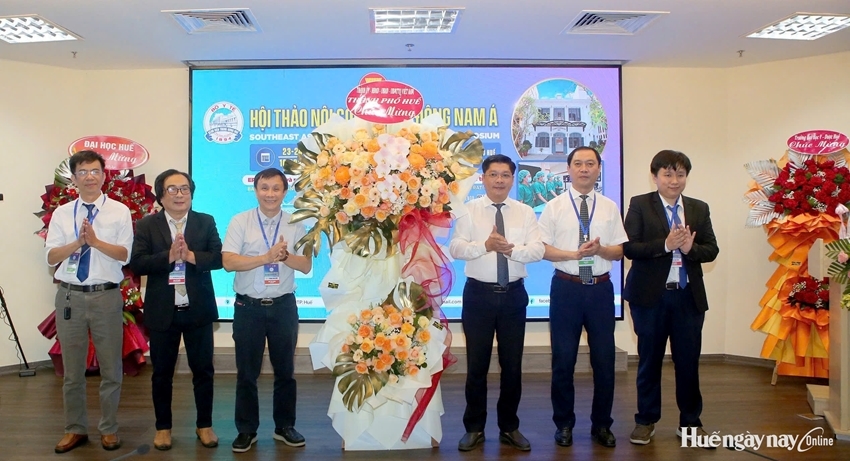
| Deputy Secretary of Hue City Party Committee and Chairman of Vietnam Fatherland Front Committee of Hue City Nguyen Chi Tai (third from right), presenting flowers to congratulate the conference organizers |
Attendees included Mr. Nguyen Chi Tai, Deputy Secretary of Hue City Party Committee and Chairman of Vietnam Fatherland Front Committee of Hue City; Associate Professor Mr. Tran Kiem Hao, member of Hue City Party Committee and Director of Hue City Department of Health; and representatives of city departments and agencies. Representing Hue Central Hospital were Professor Pham Nhu Hiep, the hospital's director, along with leaders of its centers, departments and divisions, as well as specialists and physicians in endoscopy.
Held over two days, October 23rd and 24th, the conference focused on three key areas: basic and advanced endoscopic retrograde cholangiopancreatography (ERCP), endoscopic ultrasound (EUS) for diagnosis and intervention, and live demonstrations of endoscopic procedures. These modern techniques play an important role in detecting, diagnosing and treating a wide range of gastrointestinal, hepatobiliary and pancreatic conditions.
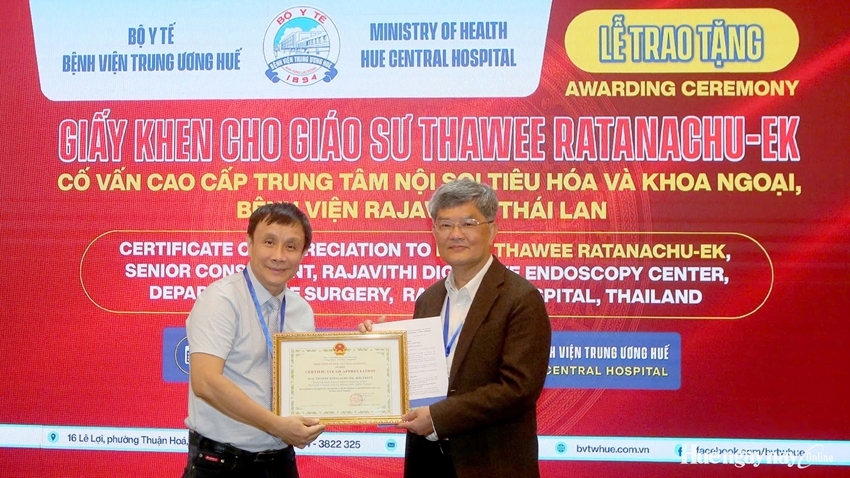 |
| Hue Central Hospital leaders presenting a certificate of commendation to Professor Thawee Ratanachu-Ek, Senior Advisor to the Center for Gastrointestinal Endoscopy and the Department of Surgery at Rajavithi Hospital, Thailand. |
ERCP was one of the advanced interventional techniques highlighted at the conference. It can be used to treat various conditions, including common bile duct stones, large stones requiring lithotripsy, malignant biliary obstruction requiring stent placement, biliary strictures, postoperative bile leaks and pancreatic duct obstruction requiring drainage. A key advantage of ERCP is that it can reduce the need for open surgery, shorten hospital stays and accelerate recovery. This is particularly beneficial for older adults and patients with multiple underlying conditions.
Meanwhile, EUS enables detailed visualization of organs and structures such as the pancreas, bile ducts, gallbladder, lymph nodes and gastrointestinal tract walls. The technique helps detect lesions at an early stage, assess the stage of gastrointestinal cancers, obtain tissue samples through needle aspiration for diagnostic purposes, and perform various interventions, including drainage of pancreatic pseudocysts and biliary drainage when ERCP cannot be performed.
Combining ERCP and EUS can improve diagnostic accuracy, enhance the effectiveness of interventions and reduce complications. However, successful implementation of these techniques requires modern equipment and a team of physicians with specialized training. Therefore, exchanging clinical experience, updating professional knowledge and strengthening cooperation among endoscopy centers across the region are essential to advancing clinical practice.
At the program, international experts shared their countries' experiences in developing ERCP and EUS. They also presented specialized reports on reducing the risk of acute pancreatitis following endoscopic interventions, combining the two techniques to diagnose and treat biliary and pancreatic duct obstruction, and assessing the risk of malignancy in pancreatic cystic lesions …
As one of six national key hospitals prioritized for investment and development with the goal of achieving regional and international standing, Hue Central Hospital has established strong capabilities in gastrointestinal endoscopy and interventional endoscopy. The hospital has mastered numerous advanced techniques, including ERCP, EUS, and endoscopic extraction and lithotripsy of bile duct stones. Several procedures that were first introduced in the Central Vietnam–Central Highlands region have since become routine practice. In addition to providing medical examinations and treatment, the hospital's Endoscopy Center also provides training, transfers technical expertise and shares clinical experience with healthcare institutions in Vietnam and abroad.
Through the conference, Hue Central Hospital reaffirmed its role in advancing specialized interventional endoscopic techniques, expanding international cooperation and strengthening the professional capabilities of healthcare personnel. These efforts will help create more opportunities for patients in Vietnam and other Southeast Asian countries to access minimally invasive, safe and effective diagnostic and treatment methods.