 |
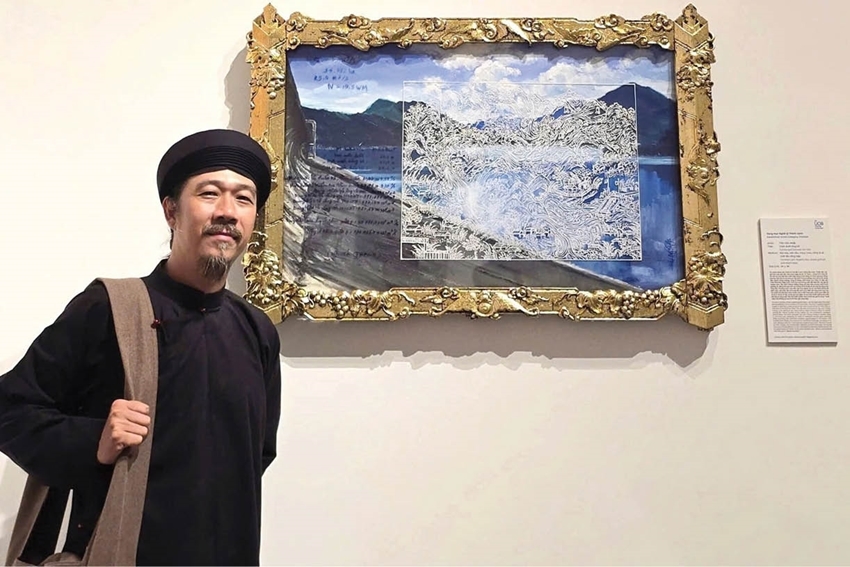
| Artist Tran Huu Nhat |
In search of memories of ancient Hue
In his studio, filled with the scent of oil paint and countless sketches, Tran Huu Nhat speaks of Hue in the deep voice of a man in search of lost memories. Since 2001, driven by his passion for painting the landscapes of his homeland, he has cherished the idea of recreating Than Kinh Nhi Thap Canh, which were once ranked and praised by Emperor Thieu Tri (1841–1847) in his poetry.
To Hue people, Than Kinh Nhi Thap Canh embodies the soul of the former imperial capital, where nature, architecture, and spiritual life combine. But due to time, wars, and urbanization, many of them have been in ruin. That is a big concern for Huu Nhat.
For over 20 years, he has traveled extensively to the sites listed in Than Kinh Nhi Thap Canh, researching, comparing the sites with antique paintings, and meeting with Hue culture researchers. Each trip for him is an “excavation of memories.”
Painting in dialogue with the heritage
What makes the series Than Kinh Nhi Thap Canh unique is its two-layered structure.
The first layer is made using the technique of reverse painting on glass, inspired by the glass paintings of the Nguyen royal court. On glass panels, Tran Huu Nhat paints the landscapes of the imperial land with a correction pen.
The second layer is the oil painting painted on location. They are like conversations between past and present. Through this interaction, viewers not only admire the beautiful scenery but also feel the contrast between what once existed and what remains today.
Some paintings took him more than three years to finish. Nhat met with cultural and historical researchers in Hue, gathering and cross-referencing numerous historical records, including praising poems by emperors engraved on stone steles. He then put together those bits and pieces, which became the foundation for his recreation. For him, each painting is not merely an artwork, but also the reconstruction of cultural memories in the language of painting.
What makes the series remarkable is not documentary accuracy, but the sense of nostalgia it evokes. It is the regret over the lost heritage. For the first time after more than two decades, such once well-known sites as Trung Mien Vien Chieu, Vinh Thieu Phuong Van, Cao Cac Sinh Luong, etc., are brought back to life by Tran Huu Nhat in a unique way. Viewers can see the transformation of the landscape in Hue: the pale sunlight reflected on water surfaces, the mist drifting over pine-covered hills, or the tranquility that characterizes the ancient capital city.
More than a personal art project, Than Kinh Nhi Thap Canh is the journey of preserving cultural memories through art as an effort to recall the lost landscapes in the minds of Hue people.
In this early June, art enthusiasts have the opportunity to admire this unique collection in an activity called O Ly Art Fair held from June 6th to June 16th, 2026 at Hue Book and Culture Space (23–25 Le Loi Street, Hue City.)
All in all, Tran Huu Nhat’s over twenty years in search of Than Kinh Nhi Thap Canh is not merely the journey of a painter and his painting, but that of a Hue-born painter who wants to rediscover the beauty of his homeland.