 |
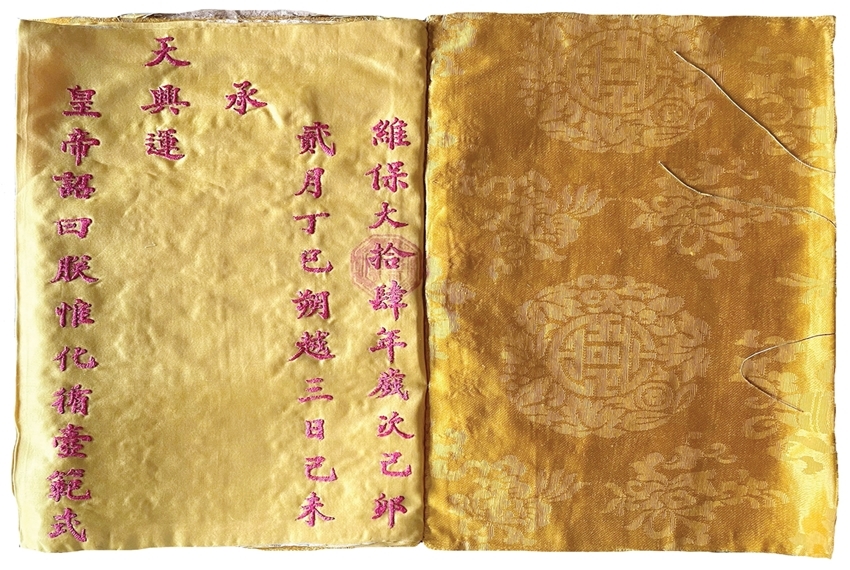
| The covers of the two silk investiture books of Diem Tan Nguyen Dinh Thi Bach Lien |
During a survey at the ancestral worship hall of the Crown Prince’s Junior Guardian Nguyen Dinh Hoe in the old Gia Hoi quarter (12 Bach Dang Street, Phu Xuan Ward, Hue City), we had the opportunity to examine two silk investiture books belonging to Diem Tan (Fifth-ranked imperial consort) Nguyen Dinh Thi Bach Lien. More than simply artifacts of exquisite imperial court craftsmanship and artistic value, these two investiture books are also valuable historical sources, helping to shed light on the system of titles and investiture as well as court rituals under the reigns of Emperor Khai Dinh and Emperor Bao Dai.
The form and artistry of the two silk investiture books
Within the Nguyen Dynasty’s system of court rituals and the conferral of titles, the granting of an investiture book was an important ceremonial act, demonstrating the authority of the emperor and formally recognizing the person being invested with a title. Depending on rank and recipient, investiture books could be made from a variety of materials, including gold, silver, bronze, paper, or silk. Among these, silk books came into widespread use from the reign of Emperor Thieu Tri (1846) onward.
Both of the investiture books belonging to Diem Tan Nguyen Dinh Thi Bach Lien were made of yellow brocade silk, lending them a solemn and refined appearance. The first, issued by Emperor Khai Dinh in 1922, is rectangular in shape (19.6 cm long and 30.4 cm wide), consisting of two cover pages and three double interior pages. The pages were carefully sewn together with thread of the same color, creating a seamless and delicate appearance.
The most striking feature of the investiture book is its elaborate embroidered decoration. On the two covers, dragons are embroidered in relief in gracefully winding poses, symbolizing imperial power. They are surrounded by clusters of multicolored clouds, while below them is the tam son thuy ba motif, representing three mountain peaks and water waves. The border of the book is decorated with a honeycomb pattern, with each compartment containing an exquisitely rendered eight-petaled flower. In addition, motifs belonging to the bat buu (Eight Auspicious Treasures) are embroidered intermittently, creating a harmonious composition rich in symbolic meaning.
The text is written in Chinese characters, embroidered in purple thread on a yellow silk ground, producing a clear contrast that is both solemn and delicate. The second book, issued by Emperor Bao Dai in 1939, has a similar form, but its text is embroidered in pink thread. The silk is additionally decorated with clusters of grapes, the characters ‘van tho’ (longevity), and bat buu motifs, creating a subtle visual distinction.
Taken as a whole, the two investiture books are not merely administrative documents but also works of art combining calligraphy with imperial court embroidery and sewing. They reflect the high level of technical skill attained by artisans of the Nguyen Dynasty, while also expressing the distinctive aesthetic principles of Hue’s imperial court culture.
Documentary value and historical - cultural significance
The contents of the two investiture books focus on the conferral and hereditary recognition of titles for Nguyen Dinh Thi Bach Lien. They begin with praise for the virtues and moral qualities of the person being invested; this is followed by moral admonitions reflecting Confucian ideals; and finally comes the emperor’s formal declaration of investiture, establishing her position within the Nguyen Dynasty’s hierarchy of court ranks.
These texts make clear the Nguyen Dynasty’s conception of the role of women within the imperial court: women were not only responsible for managing the inner palace but also served as embodiments of virtue, ritual propriety, and social order. Although the wording of the investiture books follows the formulaic conventions of official investiture documents, it nevertheless conveys the emperor’s regard for the person being invested. They are also valuable sources for understanding the distinctive genre of administrative documents under the Nguyen Dynasty, thereby contributing to a clearer understanding of the literary value and verbal artistry of this body of court writing.
From a documentary perspective, the two investiture books are valuable not only for research into the system of titles, court rituals, and life within the inner palace under the last Nguyen emperors, but also as important sources through which scholars can continue to explore the literary and artistic value of Nguyen Dynasty investiture books in particular and Nguyen court literature more broadly.
From an artistic perspective, the two books are representative evidence of the development of Hue imperial embroidery, characterized by refined techniques, structured compositions, and a high degree of aesthetic sophistication. Their value extends beyond their tangible, intangible, and documentary dimensions. The two investiture books also carry profound symbolic significance: they are marks of a bygone historical period, while at the same time serving as a bridge between the past and the present, and between personal memory and collective memory.
The discovery, study, and introduction of the two silk investiture books of Diem Tan Nguyen Dinh Thi Bach Lien not only enrich the historical and cultural sources relating to the Nguyen Dynasty, but also help the public gain a deeper understanding of the imperial court culture of Hue - a precious heritage that deserves to be respected, preserved, and promoted for generations to come.
Diem Tan Nguyen Dinh Thi Bach Lien was born on the 22nd, December of the year of the Dragon (1905). Her ancestral home was Hien Luong Village, Quang Nam Province, now within the administrative area of Da Nang City. She was the daughter of Nguyen Dinh Dung and Nguyen Thi Hoanh, and the granddaughter of Junior Guardian of the Crown Prince, Nguyen Dinh Hoe - a high-ranking mandarin who held an eminent position and title under the reigns of Emperor Khai Dinh and Emperor Bao Dai.
From an early age, she was known as intelligent, graceful, and filial. Not only did she possess an attractive appearance, she was also distinguished by her scholarly aptitude and exemplary conduct. It was precisely these qualities that brought her into the imperial palace at the age of just 17, in the seventh year of Khai Dinh’s reign (1922). There, Emperor Khai Dinh invested her with the rank of Fifth-Rank Diem Tan, making her one of the emperor’s consorts.