Regardless of its distinctive mechanism, Thua Thien Hue province must reference the Resolution No. 1210/2016 / UBTVQH13, dated May 25, 2016 by the Standing Committee of National Assembly, in the orientation of developing a special heritage city on the basis of preserving and promoting Hue’s ancient cultural heritage values.
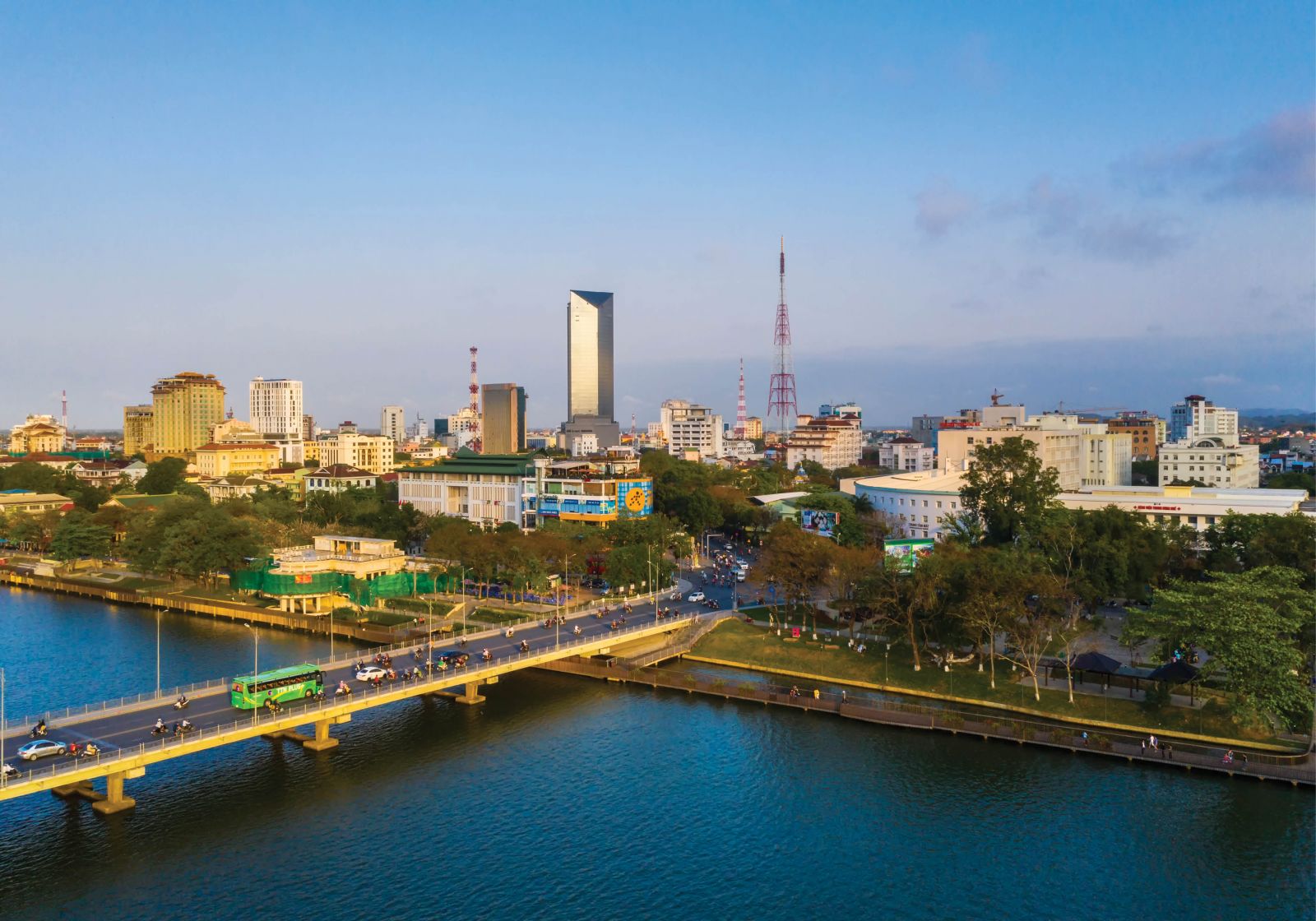
The city of Hue is greener and finer. Photo: Hoang Hai
In the proposal for “Establishing the criteria for heritage-specific urban area” presented at the meeting of Thua Thien Hue People’s Committee on May 3, 2020, the problems are related to certain criteria. The criterion 2 about the population was proposed to decline by 50%. Criterion 5 related to the development degrees of infrastructure, architecture and landscaping was proposed to drop 70% compared to the standard. It was suggested that the criterion 1 ‘The role and function, the organization and level of socio-economic development’ and criterion 3 ‘population density’ should not be applied. There was no justification for criterion 4 related to the percentage of non-agriculture labor force.
Obviously, it is necessary to highlight the distinctive features and the internal power of the heritage identity to support the development of the culture specificity of Hue city or Thua Thien Hue.
The approach of urban heritage conservation and the approach of historical heritage revival and conservation are essential. However, in the development of the core heritage city of Hue, it is crucial for Thua Thien Hue to include the approach of classical landscaping art (or, Feng Shui art) and the approach of traditional restoration, in the light of spiritualizing, noblizing and writing historical-cultural stories to connect heritage with tourism.
Located in the coastal area leaning the mountain, between Hoanh Son and Hai Van Son, Binh Tri Thien and Hue area has been classified as a climatic and cultural zone in the history. It is the harsh climate and changeable weather that make the local people choose to live in harmony with the nature, tackling the relationship between people, and between people and nature.
Accordingly, the classical Feng Shui art has resulted in a unique model of garden houses – pillared houses, garden temple, garden villa, garden tombs and even garden city. In the charming paintings, ranging from the sea, lagoons, inland sandy areas, plains, midland and mountainous areas, the modest traditional architectural works nestle harmoniously with nature, especially along the rivers.
In Feng Shui principles, attention is paid to the construction and preservation of the green, clean, fine and ventilated space with a construction ratio in harmony with the area, height, building material and color.
The principle has brought certain national achievements and impressions ever since the border expansion, in the time of Dang Trong (‘Inner Realm’), during the Nguyen Lords and Dynasty, the cross-cultural style between Vietnamese and French construction in early twentieth century. These make the distinctive Hue that there is no other resemblance.
The principle also serves as a basis for explanation in terms of width and height for construction works in Hue, which have typical characteristics. These characteristics can be used as reference to establish the special construction rules and standards that are appropriate and Hue-specific. They also fit in the trends in the restoration of the human ecology.
It is essential to supplement fundamental approaches to revive “Hue qualities” and restore the traditions and cultural history through legends of typical values. This is a worthy cause because Hue, despite its small geographical space and modest nature-harmony works, used to function as an outpost in the time of border expansion in Dang Trong, the capital under Tay Son Dynasty and Nguyen Dynasty. Hue also manifests the elite values of the cross-cultural construction between France and Vietnam.
With its important roles and missions, Hue used to be an emergence of distinctive products and elite artisans. The uniqueness to make Hue a political center and religious center, plus the Western civilized characteristics during the French colony in early twentieth century are the basis to develop Hue with specificities.
Changing the status from a capital to an ancient capital, Hue has had numerous difficulties being no longer a center. The city had to manage to develop on its own advantages, especially to become a center of culture, tourism, education and specialized healthcare.
In terms of cultural history, Hue is indeed like a living museum where stories related to Nguyen Lords, Tay Son Dynasty and Nguyen Dynasty are vividly presented through historical relics, antiques and figures. The research, restoration and promotion of cultural values have been systemized into a technical procedure, so Hue is an exemplar of this new special education in the country and in the region.
Moreover, as an emergence of the traditional handicraft of the country under the Nguyen Dynasty, Hue deserves to be a big workshop where the heritage of the traditional handicraft is revived, passed on and promoted, contributing the unique products to be introduced in education and in the tourism market.
In addition, it is essential to focus on the role of education and training of Hue University and the healthcare system of Hue Central Hospital and the Hospital of Hue University of Medicine and Pharmacy. Therefore, with this unique peaceful natural landscape, it is unnecessary to take into account the criterion of population. Instead, there should be an appropriate concentration on attracting the trainee sources and the visitors, making Hue significantly sustainable.
In this way, there is a good reference to untie two of the knots in the proposal of specific heritage city of Hue, which will accomplish its mission and improve its unique values.
By Tran Dinh Hang