 |
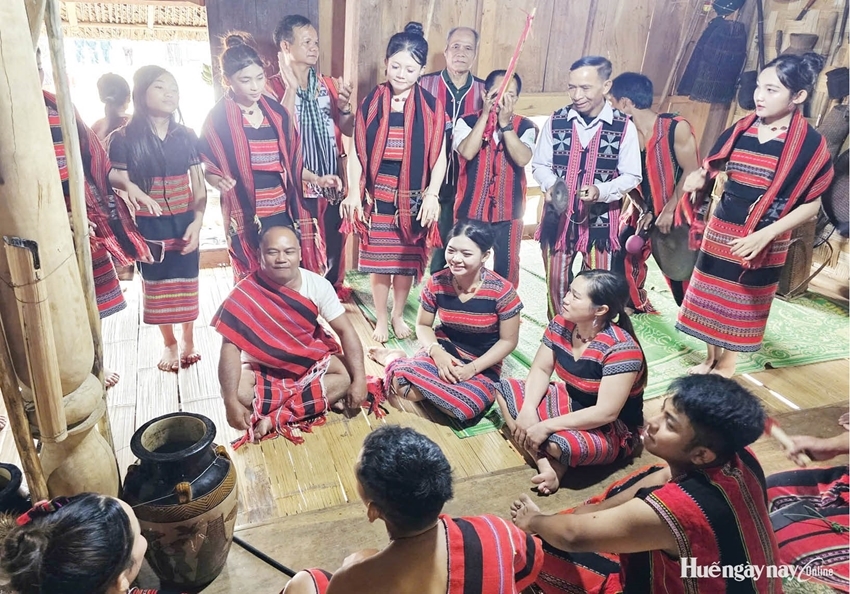
| The Moong house of the Pa Co people (A Nam Village, A Luoi 1 Commune) has been restored, recognized as a relic site, and become an important cultural space |
The ‘joy’ of heritage sites
Located downstream of the Huong River, Chau Huong Vien relic site (Nguyen Sinh Cung Street, My Thuong Ward) is closely associated with the life and legacy of Ung Binh Thuc Gia Thi, a poet. Once left in ruins, it has now become a cultural destination.
Chau Huong Vien is a complex of several structures, including a main house with three main bays and two side wings, built by Mr. Ung Binh in 1933 after he left public office. It was the complex that once served as a gathering place for writers and scholars of the once renowned ‘Huong Binh thi xa’(Huong Binh Poetry Society).
Over time, however, the garden was encroached upon, while the house’s structural components deteriorated severely. Following calls for action from cultural enthusiasts and artists, the site underwent restoration in 2023 across many key components.
Not only was Chau Huong Vien preserved in time, but it was also later handed over to Hue City Museum of History for management. The site has since been put to good use as a cultural space, hosting commemorative events, poetry gatherings, Hue-Singing performances, and activities incorporated into tourism tours and itineraries.
Mr. Nguyen Duc Loc, Director of Hue City Museum of History, said: “Through these events, we hope to bring the cultural space back to life in a way that reflects the site’s original spirit”.
Located in the western area of Hue City, the Moong house of the Pa Co people in A Nam Village, A Luoi 1 Commune, on the Truong Son mountain range, also failed to survive intact due to war and changes in daily life. It was not until 2013 that local authorities and residents rebuilt the structure using traditional materials such as wood, bamboo, rattan, and leaves.
According to Mr. Ho Manh Giang, Head of the Culture and Social Affairs Division of A Luoi 1 Commune, the Moong house serves as a gathering place for village elders, hamlet heads, and residents. It is the venue for traditional rituals, festivals, weddings, cultural and artistic activities, as well as other important events. It is also in this space that older generations pass on to younger generations their production experience, customs, traditions, stories of their origins, and principles of conduct within families, clans, and the community.
Therefore, the value of the Moong house lies not only in its traditional architecture, but also in the living cultural space that has been created and enriched over generations.
The reconstruction of the Moong house is highly significant. It has not only brought a traditional architectural structure back to life, but also restored a communal cultural space, enabling customs, rituals, cultural and artistic activities, and folk knowledge to continue to be practiced and passed down in the life of the Pa Co people.
More than a decade after its reconstruction, the site was also recognized as a city-level relic site. In addition to managing and protecting it, the local authority places considerable importance on the knowledge and experience of village elders, artisans, and others familiar with traditional Moong house construction techniques to ensure that the structure’s distinctive values are preserved.
According to Mr. Giang, alongside architectural preservation, what matters most in the long term is safeguarding the cultural space associated with the Moong house.
“We have also identified the need to gradually link cultural preservation with sustainable community-based tourism development. The Moong house could become a distinctive cultural destination where visitors can do more than simply visit an architectural structure. They can also learn about local history, experience community life, enjoy folk songs and dances, cuisine, and other characteristic features of the Pa Co people,” said Mr. Giang.
Some sites are still in disrepair
While some relic sites are being well preserved and their values are effectively promoted, some others are still in disrepair. One example is the former editorial office of the Tieng Dan Newspaper at 193 Huynh Thuc Khang Street (Phu Xuan Ward), a city-level relic site. Over the years, the building has suffered severe deterioration in several components.
A representative of Hue City Museum of History, which manages the site, said that since 2021, the museum has prepared documentation, and advised and proposed that to the relevant authorities to approve an investment project to preserve, restore, and promote the site’s values. However, funding has yet to be allocated for the project. The Museum will therefore continue to urge the relevant authorities to give further consideration and allocate resources so that the project can be implemented soon.
Similarly, the thatched house with earthen walls at the Phan Boi Chau Memorial Site in Hue (119 Phan Boi Chau Street, Thuan Hoa Ward), has fallen into a state of severe disrepair. According to observations at the site, the building has been fenced off for safety reasons. Hue City Museum of History said relevant authorities have approved funding for repairs, and the Museum is urgently completing the necessary procedures to begin implementation.